Angles | O Level Mathematics 4024 & IGCSE Mathematics 0580 | Detailed Free Notes To Score An A Star (A*)
- Angles at a point
- The total angle in the complete circular form is 360 degree.
- All angles that we add at any point will be 360 degree
- The total angle on a straight line is 180 degree.
- The total angle where we have a perpendicular line is 90 degree.
- 90 degree means that one line is perpendicular to another
- Remember
- Bisector is a line that divides another line into two equal halves
- Perpendicular bisector is a line that divides another line into two equal halves and creates angles of 90 degree as well.
- Angles formed when two parallel lines intersect each other
- Parallel lines have the same gradient.
- They will never touch each other no matter how much we extend each line.
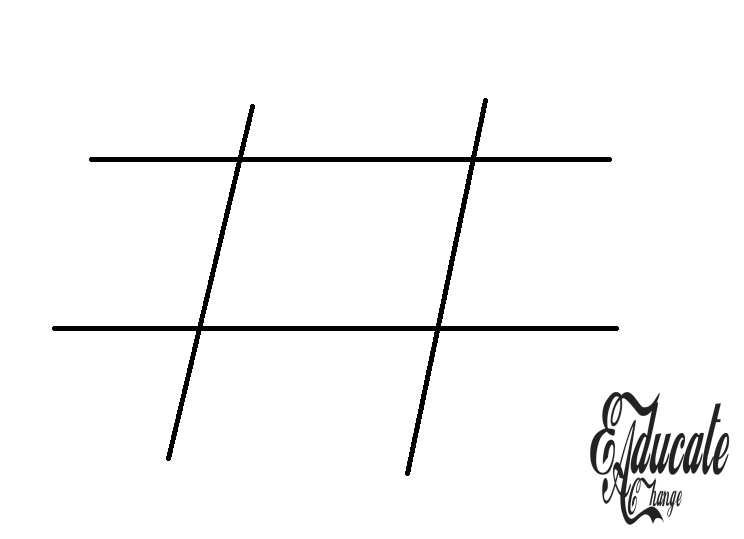
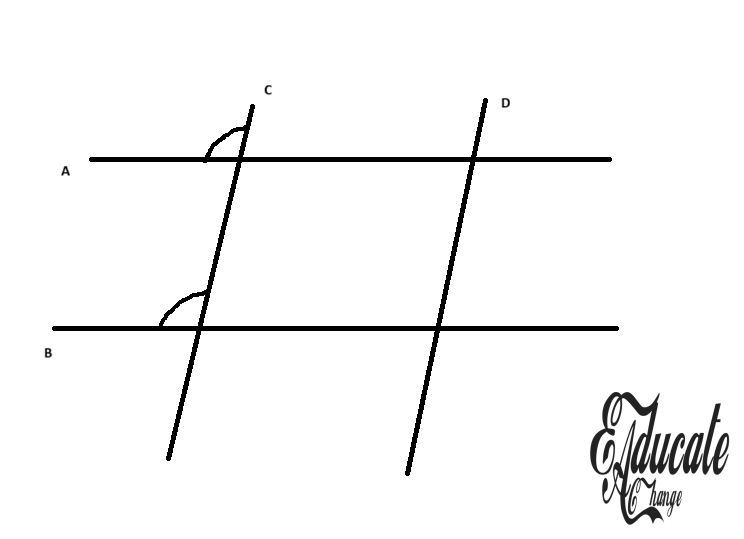
- Here, there are two sets of parallel lines, let’s call them A B C D
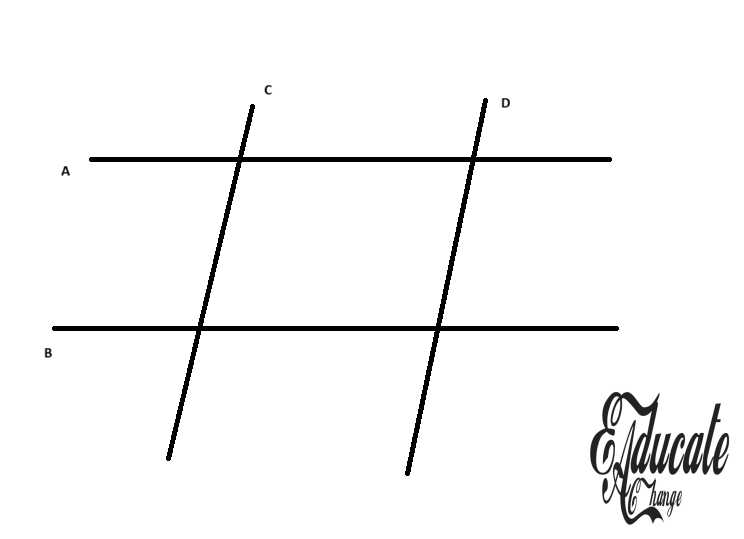
- Here, A and B are parallel
- C and D are parallel
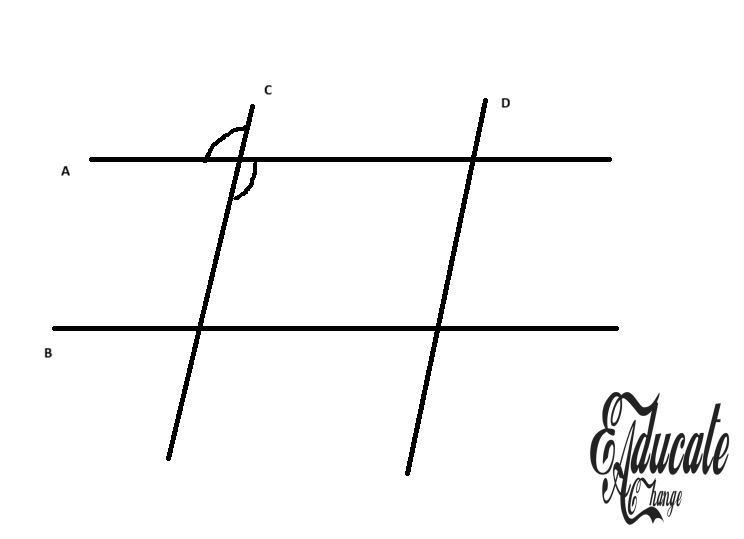
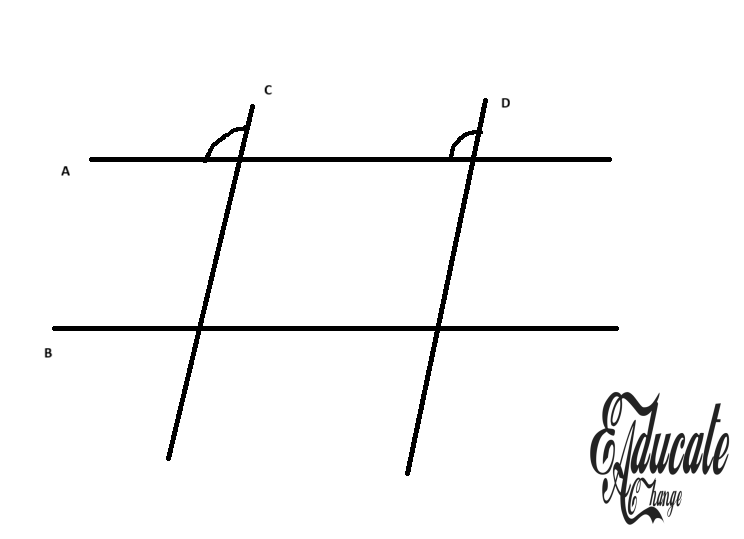
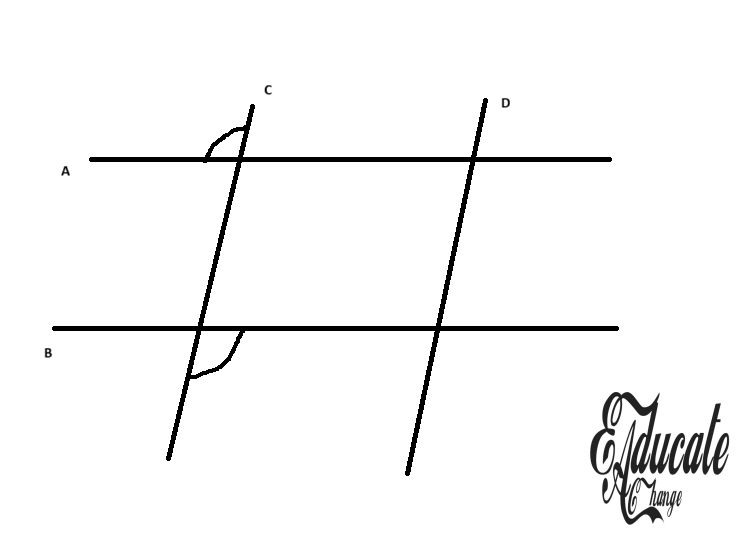
- Here, some angles are equal to each other.

- There two angles are equal
- There two angles are equal as well
- These two angles are equal as well
- These two angles are equal as well.
- Parallel lines have the same gradient.
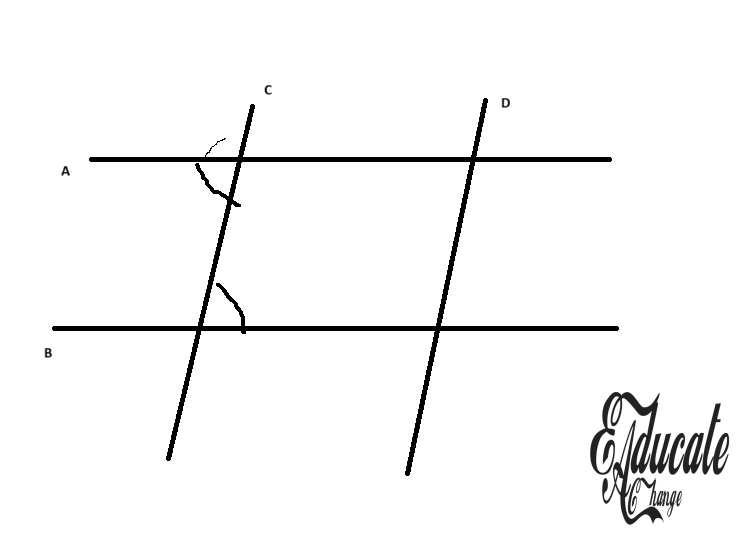
- Also, wherever we form a Z, we also have same angles
- These two angles are equal as well.
- Angle properties of triangles
- The total angles of triangle is 180 degree
- In a right angled triangle, one angle is of 90 degree
- The other two angles are less than 90 degree each.
- In an acute angled triangle
- All three angles are less than 90 degrees.
- In an obtuse angled triangle
- One angle is greater than 90 degree
- Other two angles are all than 90 degree each.
- Square
- All 4 angles are of 90 degrees
- Rectangle
- All 4 angles are of 90 degrees
- Polygon
- A shape with multiple sides.
- Regular Polygons
- A polygon where all the interior angles are equal.
- Interior angles
- Angles inside the polygon
- Here, we use the following formula
- A single interior angle of a regular polygon = total sum of interior angles / number of sides
- The sum of exterior angles (angles that are outside the polygon) is 360 degree.
- The length of each side are equal
- Irregular polygons
- The interior angles of a polygon are not equal
- Their lengths are also not equal
- Angle of Semi Circle
- A semi circle is one that has been divided from the middle
- Therefore, the straight line at the bottom of the semi circle is the diameter
- The circumference is half.
- Angle between a tangent and radius of a circle
- Tangent is a line that just touches the circumference of a circle at one single point
- The angle between radius and the tangent is 90 degree or right angle
Circle Properties
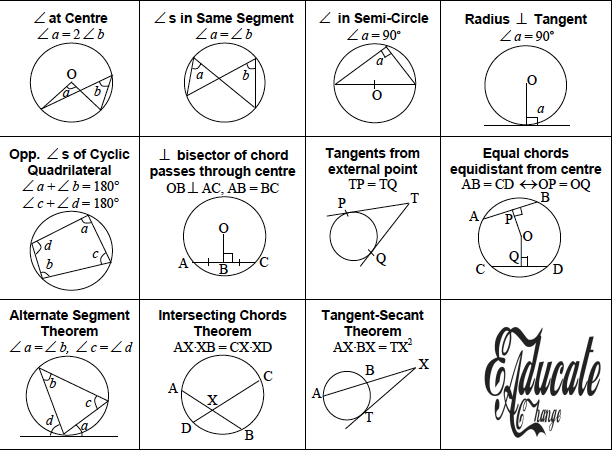
Courtesy Math Tutor
- Cord
- A line that touches the circle’s circumference at two points, but does not pass through the center.
- If it pass through the center, then it is called diameter
- Top left
- The angle at center is two times the angle at the circumference if made from the same cord
- First row, second one
- The angle made from the same cord on the same side of the circumference at two different points is the same
- First row, third one
- Angle made by diameter at the circumference is a 90 degree or right angle
- First row, Fourth One
- Angle made by radius on the tangent is on 90 degree or right angle
- Second row, first one
- A cyclic quadrilateral is one that has four angles made at the circumference.
- The alternative angles in a cyclic quadrilateral have a sum of 180 degree
- Alternative angle means one angle, then leave the next angle in clockwise/ anticlockwise movement, and then the next angle.
- Second row, second one
- Radius touching a cord is a perpendicular bisector
- Divides in two equal parts and makes an angle of 90 degree or right angle.
- Second row, Third one
- Two tangents originating form the same point make the same angle on the circle
- They also make the same angles
- Second row, Fourth one
- To cord that are on the same distant from the center have the same length to each other
- The rest three are not that important