Coordinate Geometry | O Level Mathematics 4024 & IGCSE Mathematics 0580 | Detailed Free Notes To Score An A Star (A*)
Basic Formulae
- For the equation of a line, we use y= mx+c
- y here represents the variable that is dependent. It depends on the value of x.
- A dependent variable is always plotted on the vertical axis
- REMEMBER
- It is not a MUST that the vertical axis variable will always be named y.
- It can be named anything.
- The name of the axis, however, remains the same.
- x here represents the independent variable. It is the variable the user manipulates
- An independent variable is always plotted on the X axis
- REMEMBER
- It is not MUST that the horizontal axis variable will always be named x.
- It can be named anything.
- The name of the axis, however, remains the same.
- m is the gradient
- The slope of the line
- How straight or slant the line is.
- It is found by simply

- In other words, you can also say rise over run
- The formula will be
- If two coordinates you select are as follows (x1, y1) and (x2, y2)
- Then

- Remember, you can select any point of the two points as y2, just make sure you select its corresponding x as x2.
- Gradient of a straight line is the same at all points
- Why?
- Because straight line rises without breaking
- C represents the constant
- It can also be called the Y-intercept of the equation
- Y-Intercept
- The point at which a line will cut the y-axis
- It will be zero if the y-axis is cut at a perfect zero.
- Otherwise, once you have the values of m, you will insert one of the points you selected, either (x1,y1) or (x2,y2) in the places of y=mx+c in the equation.
- Then solve it to get the value of c.
- C can be negative, it can be positive.
- y here represents the variable that is dependent. It depends on the value of x.
Some Crucial Information To Note
- If two lines are parallel
- They will have the same gradient, i.e the value of m if the equation is in the form of y=mx+c (do check for anything with y or x).
- The gradient will have the same sign as well.
- If two lines are perpendicular
- When you multiply their gradients, you will get minus 1
- So
- If m1 is the gradient of line 1
- and m2 is the gradient of line 2
- And they are perpendicular
- Then
- m1 x m2 = -1
- If two lines are perpendicular bisector
- The place where they intersect will cut the line into two EQUAL halves
- The angle would be 90 degrees
- If a line bisects another line
- It passes through the midpoint of the other line
- If line a bisects line b
- Line a passes through the midpoint of line b
- If a line is perpendicular to another line
- You can use it to find the gradient of the other line using the above mentioned formula
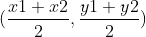
- Mid-point
- The exact half of a line
- Method
- Take the two farthest points on a line segment
- Like dono konay walay points
- Then

- Take the two farthest points on a line segment
- If you have to find the midpoint between two points
- Use those two points in the same equation
- Distance between two points
- Simple formula
- Use those two points
- And insert in this formula