Electromagnetism and Electromagnetic Induction | O Level Physics 5054 & IGCSE Physics 0625 | Detailed Free Notes To Score An A Star (A*)
Topics:
- Electromagnetism
- Fleming Left Hand Rule
- Effect of Magnet on a Current Carrying Conductor.
- Electromagnetic Induction
- Faraday’s Ring Experiment
- Magnetic Flux
- Faraday’s Solenoid Experiment
- Faraday’s Law
- Lenz’s Law
- Simple AC Generator
- Graph
- Factors affecting EMF
- Transformer
- Types of Transformers
- Working of transformer
- Power in Transformer
- Voltage and Turns in coil
- Formula
- Transmission of Electric Power
Fleming Left Hand Rule:
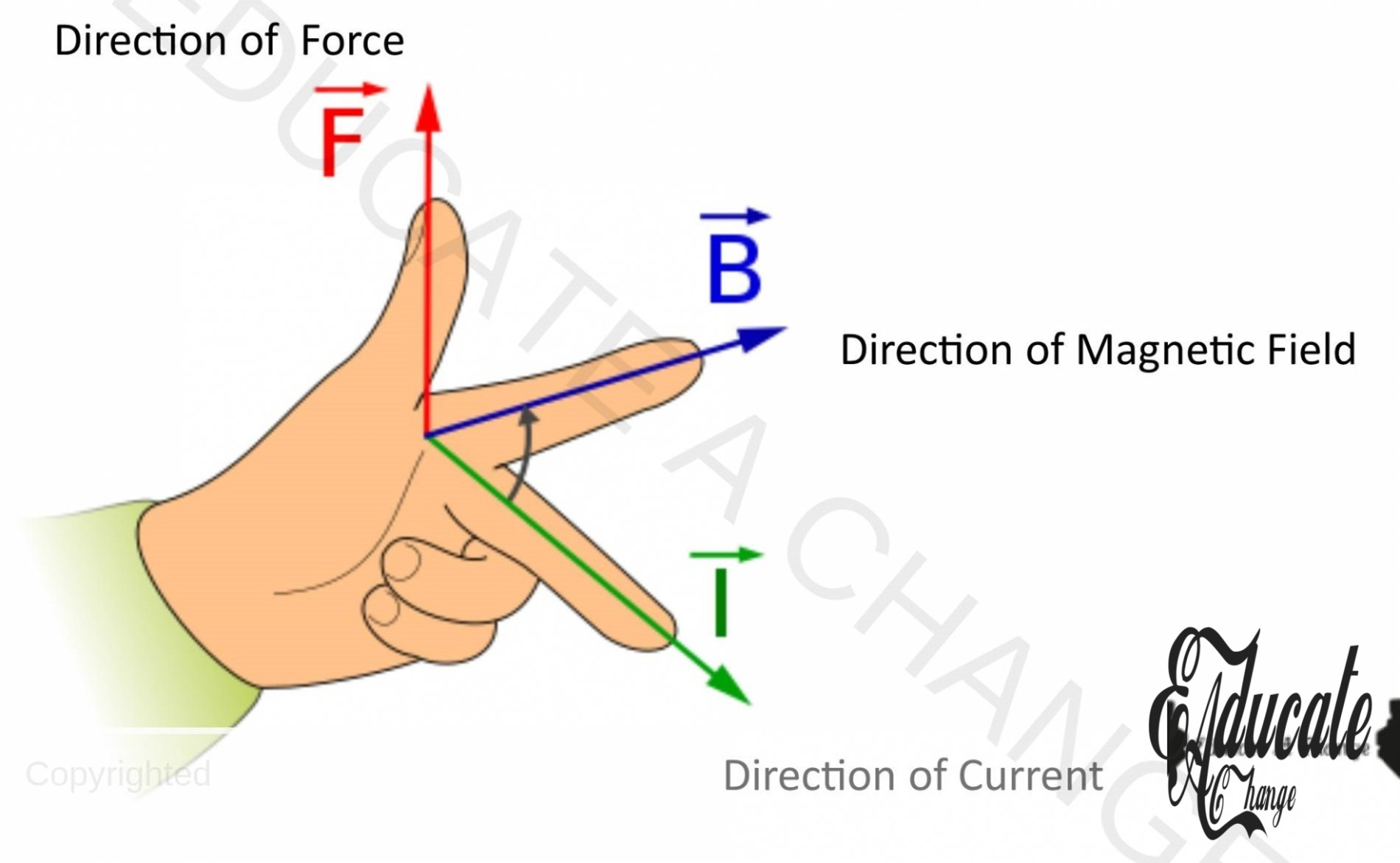
- In order to determine the force on a current carrying wire based on the direction of the current and the magnetic field, we use the Fleming Left Hand Rule.
- As the name suggests, always use your LEFT hand for this rule.
- The direction of your fingers after you arrange them in the manner shown in the diagram shows you the quantities listed.
Effect of Magnet on a Current Carrying Conductor:
Look at the diagram. A current carrying wire is placed in the middle of an electric field in the way shown.
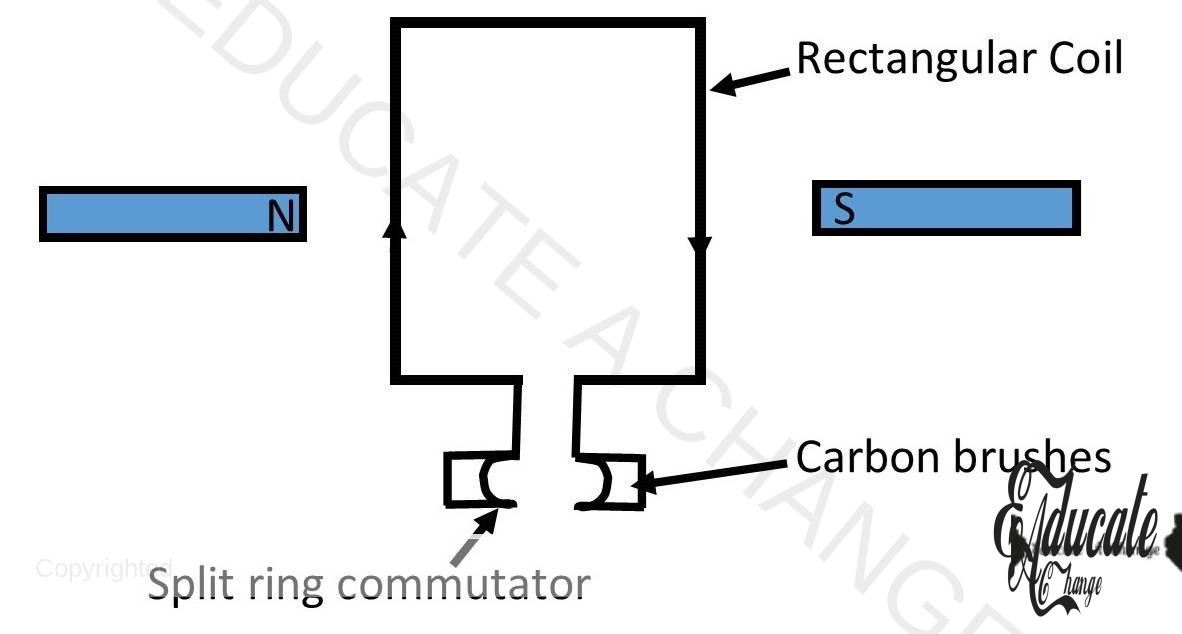
- The force will be on the coil, making the coil turn.
- Use the Fleming left hand rule to find the direction of the force. On one side, the force is upward and on the other side the force is downward. This causes the turning effect on the coil
- However, when the coil will be perpendicular, no force will be present. The original force will push the coil down.
- If we do not change the direction of the current, the next time, forces will be reversed (use the rule to check) and the coil will not keep on rotating.
- For this reason, we use AC current instead of DC which changes direction.
- We place carbon brushes and a split ring commutator which helps the change of current direction.
- The coil will keep on rotating as long as current is present.
- This is how a motor works.
- If we increase the number of turns in the coil, there will be more rotation. Similarly, increasing the current will also increase the rotation.
Electromagnetic Induction:
Electromagnetic induction is the process of inducing electromagnetic force in a conductor.
Faraday’s Ring Experiment:
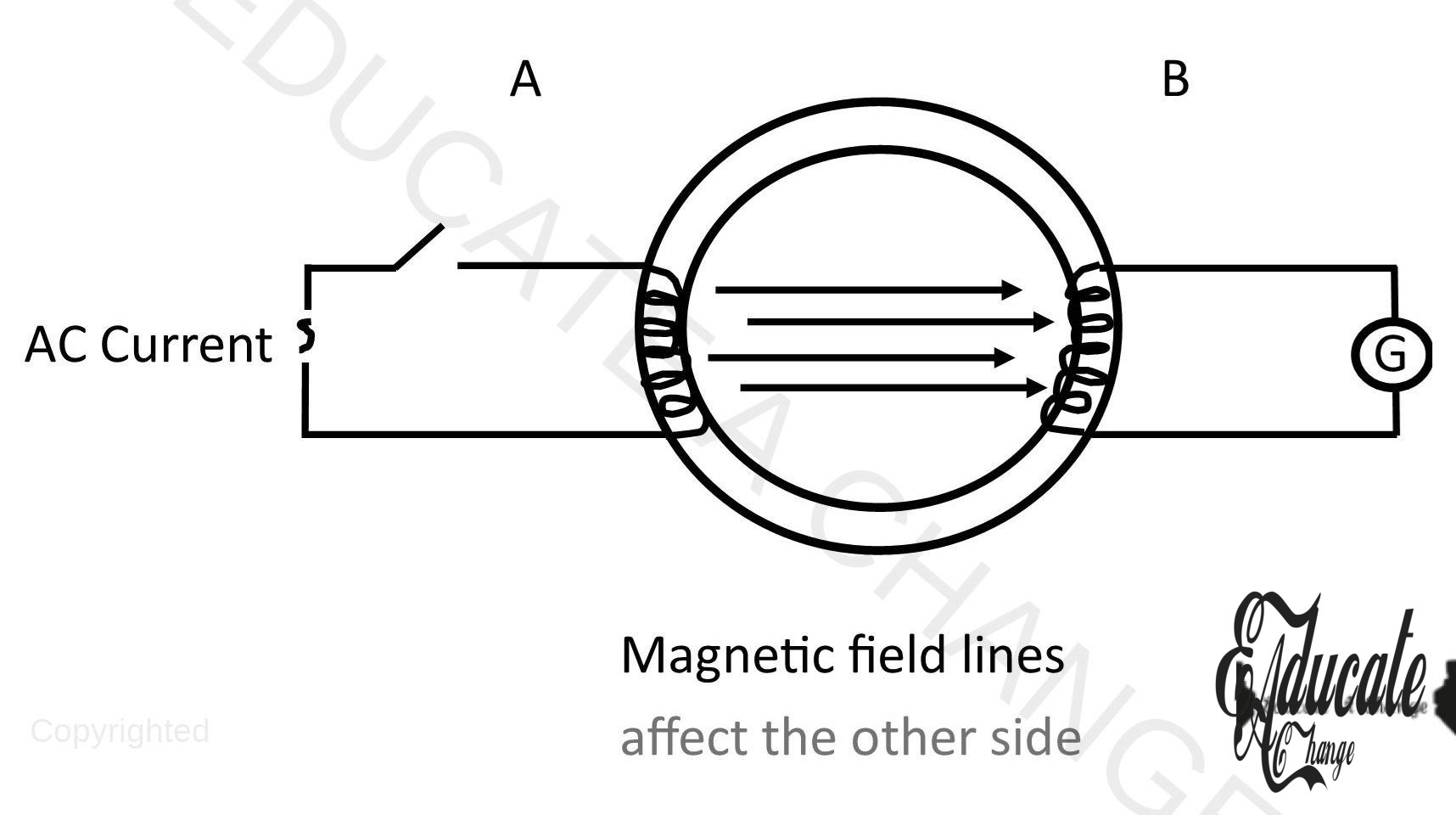
- Faraday made a ring of soft iron and winded it with wire on two sides.
- He attached one with a galvanometer (small ammeter)
- Ring did not have any contact with the wire. Either it is insulated, or the wire is coated insulated. So that the circuit does not complete.
- He then attached the other to a switch and passed AC current.
- As the current passed, the current produced magnetic field and the field lines affected the other side B and produce current in B which was detected by the galvanometer.
- If the number of turns in B were reduced, the current would also decrease as the facing area would decrease so the effect of the magnetic field on B reduced.
- This showed the effects of electromagnetic induction.
Magnetic Flux:
Number of field lines passing through unit area.
Faraday’s Solenoid Experiment:
- A solenoid is attached to a galvanometer.
- A north pole of a bar magnet is pushed into the solenoid.
- Due to the change in magnetic field, current is produced.
- The current will make the solenoid work as a magnet.
- Near the magnet, north pole is made
- Both north poles repel each other and to overcome repulsion, work is done producing current
- Galvanometer will detect and show change
- When the bar magnet is pulled outside, the direction of the current will change, and according to the right-hand rule, south pole will be made at the end
- The two south poles will repel, and it will resist the magnet from escaping the solenoid.
- In order to overcome the repulsion, work is done, and current is produced again, in the opposite direction.
- The galvanometer will show movement but in the opposite direction.
- The faster the movement of the magnet, the more the current and EMF.
- As the number of turns increase in the coil, the EMF increases
- Increasing the strength of the magnet will increase the EMF.
Faraday’s Law:
EMF generated in a conductor is directly proportional to the change in magnetic flux.
Lenz’s Law:
The direction of the EMF and hence, the induced current is always opposite to the change that causes the production of the current.
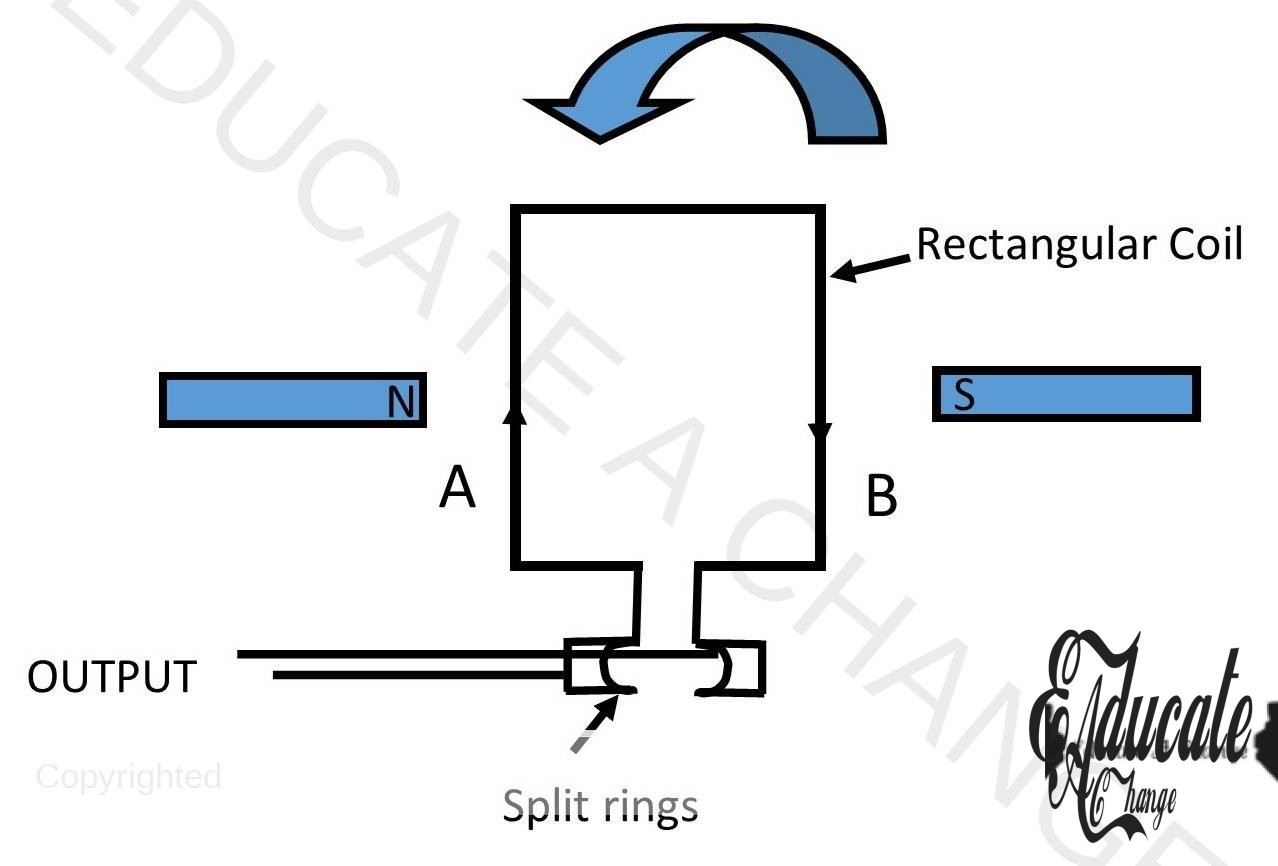
Simple AC generator:
AC generator is a device that converts mechanical energy to electrical energy by using electromagnetic induction.
Graph:
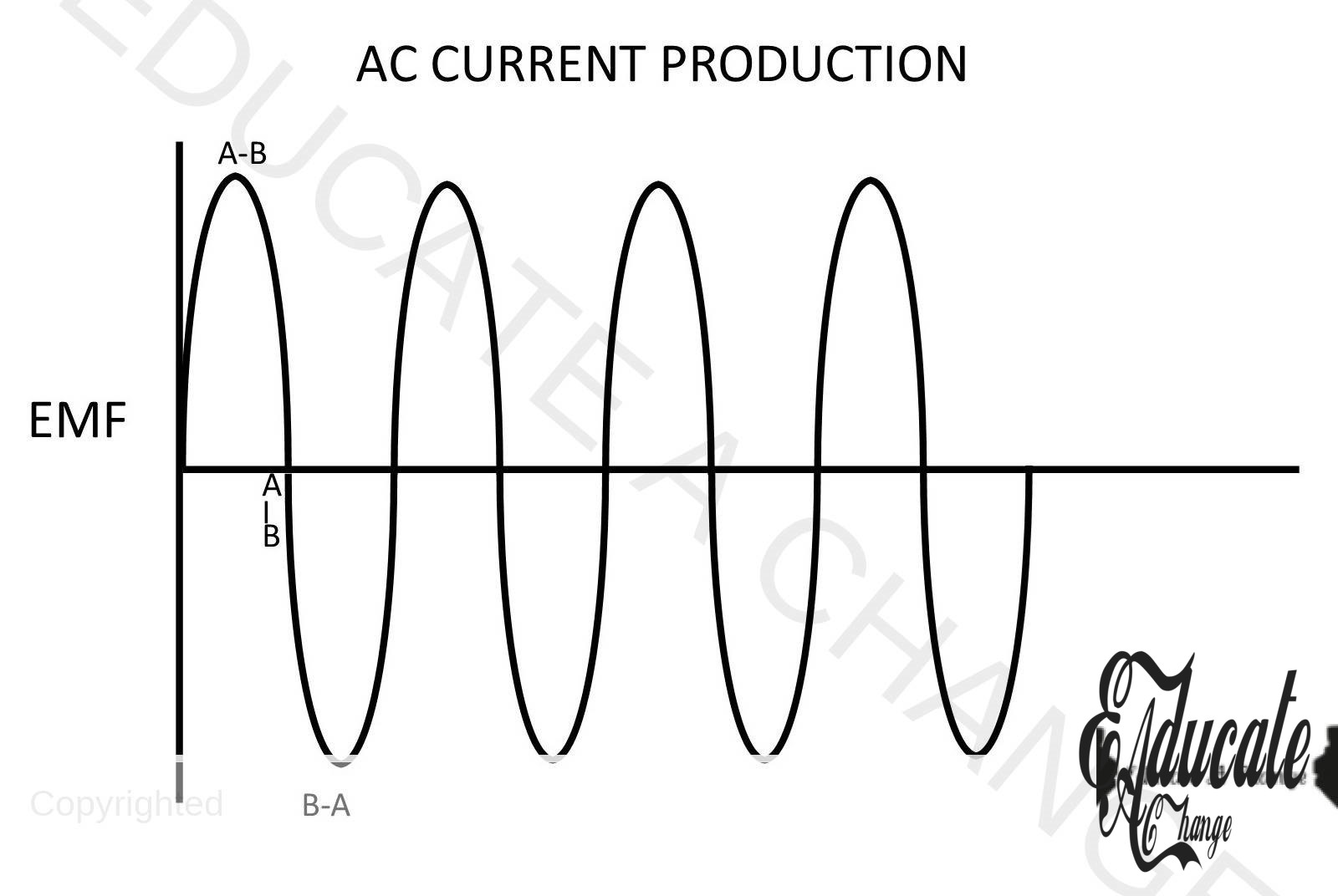
The graph of EMF produced over time is shown below:
Factors effecting EMF:
- No of turns in coil: increasing turns increase EMF
- Magnetic Flux: higher change in magnetic flux mean more EMF
- Speed of rotation: More the speed of rotation, more EMF produced
Transformer:
Transformer is a device that converts high voltage at low current to low voltage at high current and vice versa.
Types of Transformers:
Step Up transformer:
It converts low voltage to high voltage. It has a greater number of coils in the secondary coil so more magnetic field lines will affect and the magnetic flux will increase, causing the production of more voltage.
Step Down Transformer:
It converts high voltage to low voltage. It has a greater number of coils in the primary coil. This means that less field lines will affect and so less voltage is produced.
Working of Transformer:
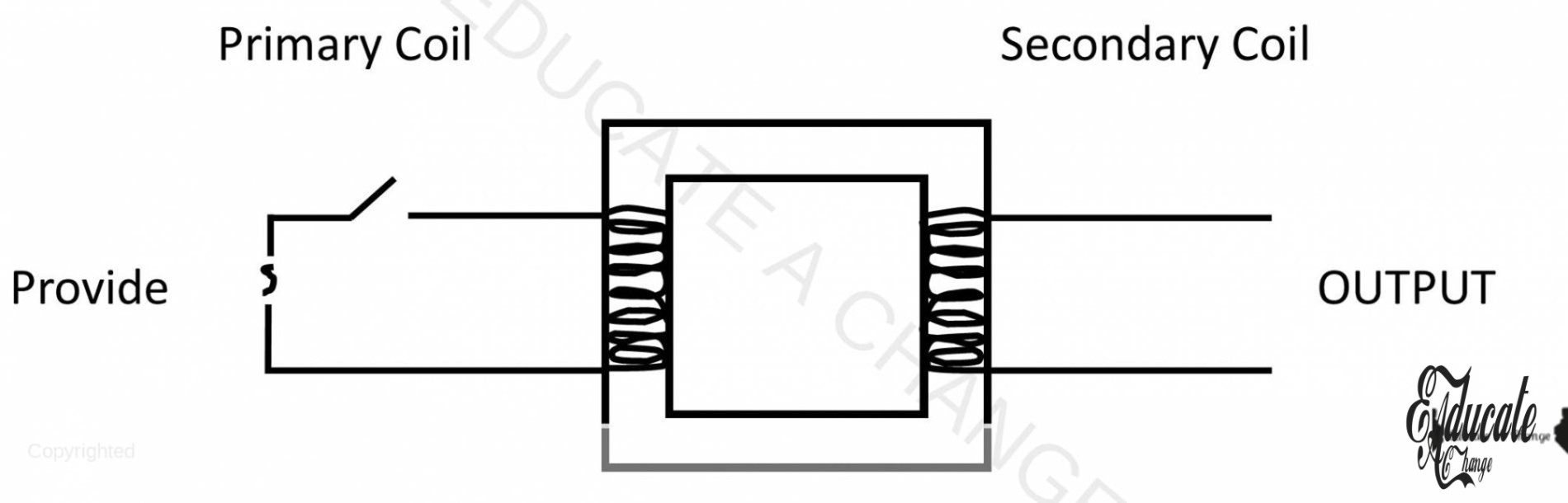
- A soft iron is winded with wire and provided AC Current.
- Magnetic field is set up in the primary coil
- Field lines affect the secondary coil
- The change in magnetic flux will produce induced current in the secondary coil.
Power in Transformer:
Power in secondary coil is equal to power in primary coil
- Pp = Ps
- Ip Vp = Is Vs
- Ip/Is = Vs/ Vp
Voltage and turns in coil:
The number of turns is directly proportional to voltage.
- Ns ∝ Vs
- Np ∝ Vp
- Vs/ Vp = Ns/Np
Formula:
Ip/Is = Vs/ Vp = Ns/Np
Transmission of Electric Power:
Pout = IV I = Pout/V Ploss = IV, I2R Ploss = (Pout/V)2 x R
- Hence, the more the voltage in wires, the less power loss will be there.
- After electricity is produced, step up transformers are used to maximize voltage at low current to prevent power loss.
- When electricity reaches grid station, step down transformers are used to reduce voltage.
- Furthermore, at separate housing societies, according to the voltage requirements, transformers are used.