Static Electricity | O Level Physics 5054 & IGCSE Physics 0625 | Detailed Free Notes To Score An A Star (A*)
Topics:
- Static Electricity
- Electrostatic Phenomenon
- Laws of Electrostatics
- Charge
- Electric Field
- Force Lines
- Charging and discharging through Induction
- Electroscope
- Electrical Conductors and Insulators
- Charging Uses and Hazard
- Current Electricity
- Current
- Electromotive force (EMF)
- Potential difference (PD)
- Graphs
- Designing Battery
- Resistance
- Ohm’s Law
- Resistivity
- Resistance in series and parallel
- LDR
Static Electricity:
Electrostatic Phenomenon:
Some objects get charge by rubbing with each other. This process is called Electrostatic phenomenon.
Laws of Electrostatics:
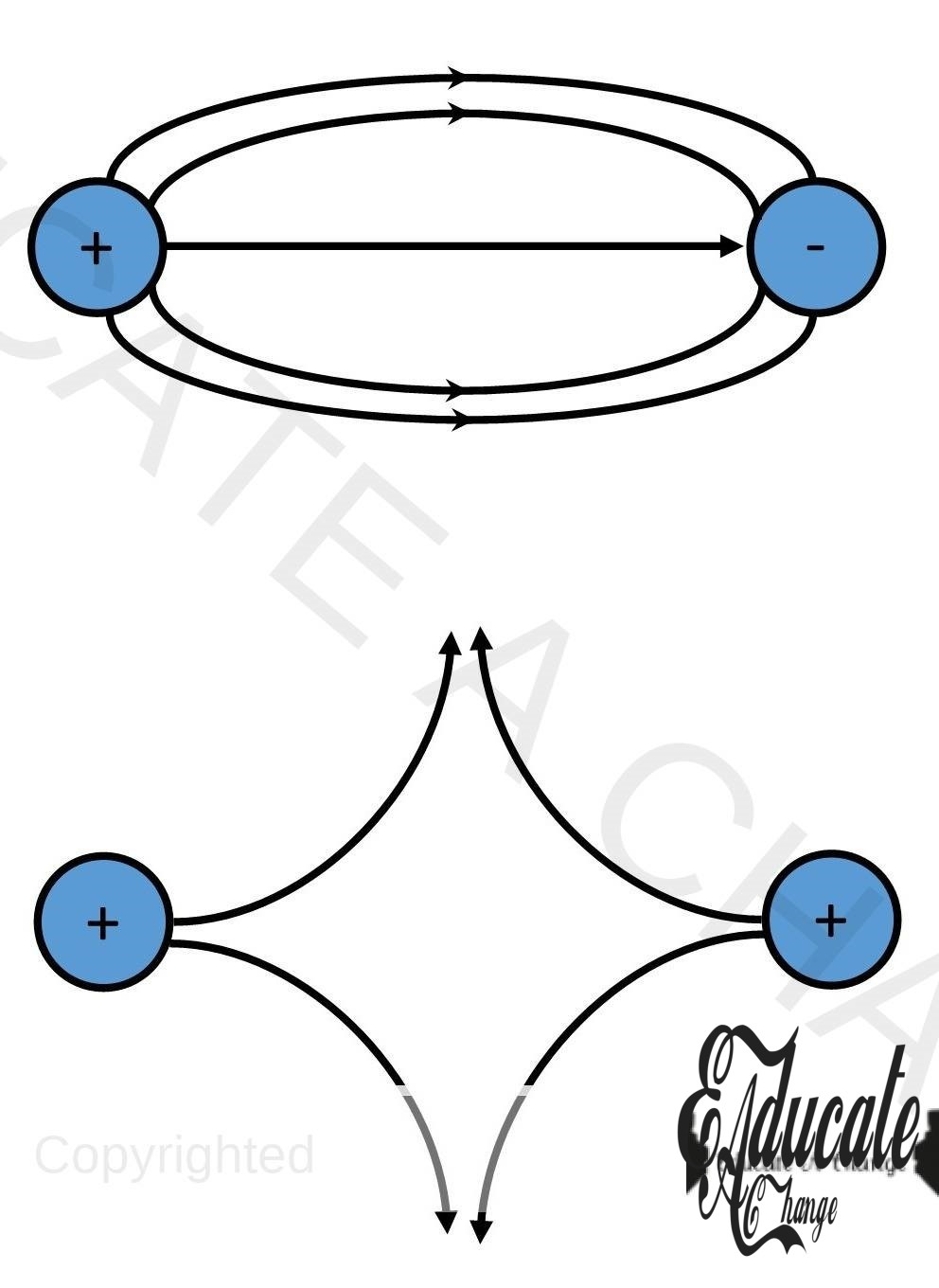
- Same charges repel each other.
- Opposite charges attract each other.
Charge (Q):
- The current flowing in a specific point of circuit in unit time is called charge.
- SI UNIT: Coulomb (C)
- 1 Coulomb = 1 ampere current flowing in circuit in 1 second
- Q = IT where Q is charge, I is the current and T is time in seconds.
Electric Field:
The region in which a positive charge is influenced by a force is called an electric field.
Force Lines:
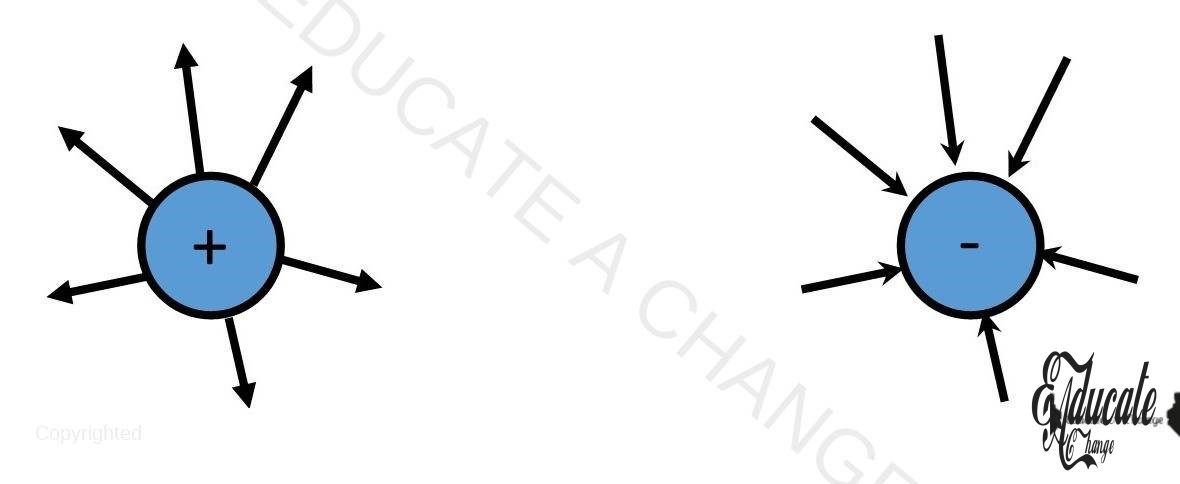
The force/ field lines go out of a positive charge and into a negative charge.
Important Point:
- Current flows from high potential to low potential.
- Earth Provides 0 potential. Earthing means to connect to earth to neutralize charge.
Charging through Induction:
Charging happens due to friction on some materials:
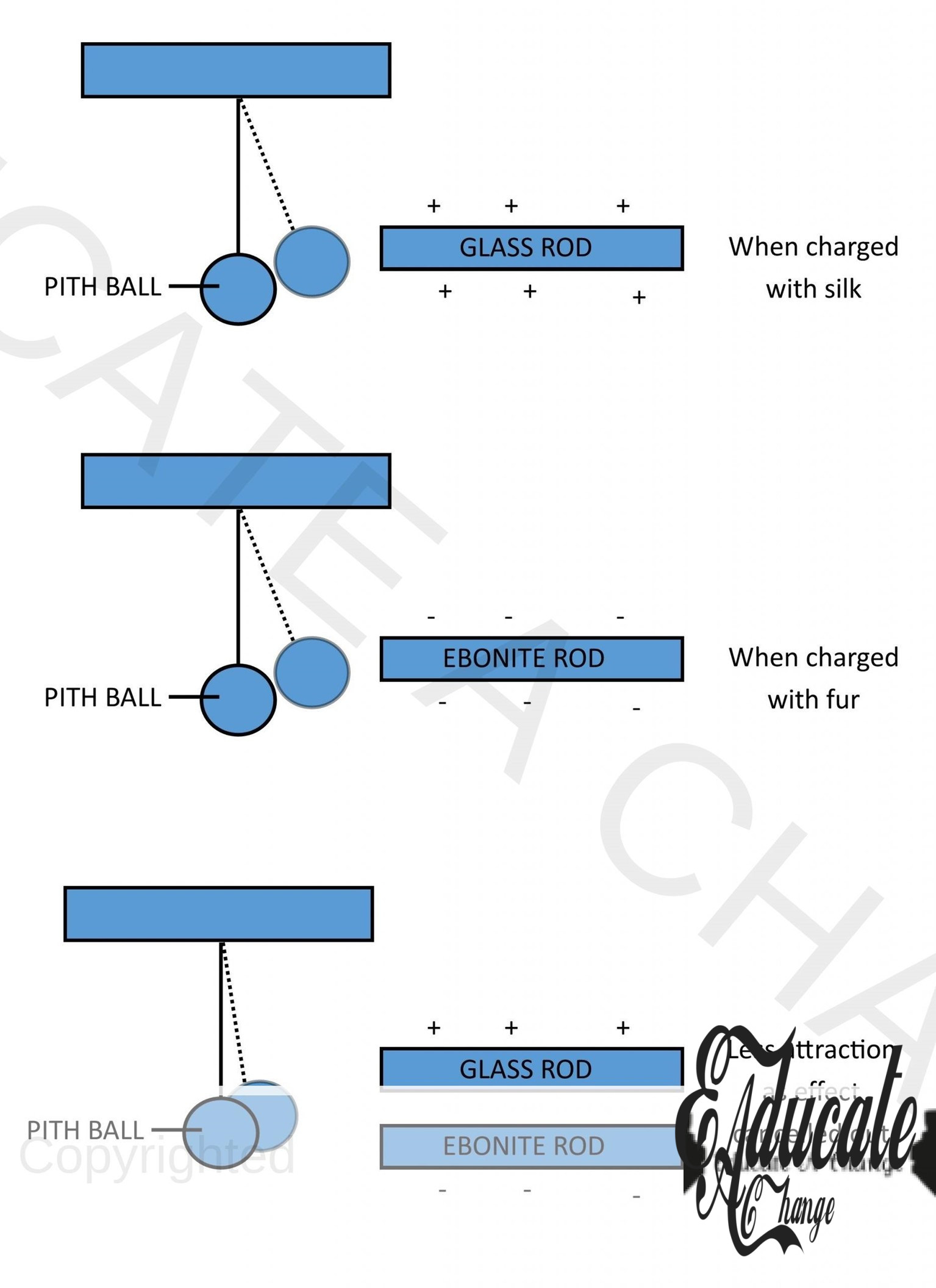
- Glass rod is charged with silk. It has positive charge.
- It will attract an uncharged pith ball
- Ebonite rod is charged with fur and has negative charge.
- It will attract an uncharged pith ball
- If both ebonite rod and glass rod are used to attract, they will cancel each other’s forces and the ball will attract less.
Methods of Charging through Electrostatic Induction:
Induction charging happens when electrons move. They carry negative charge. If electrons are reduced, we get positive charge.
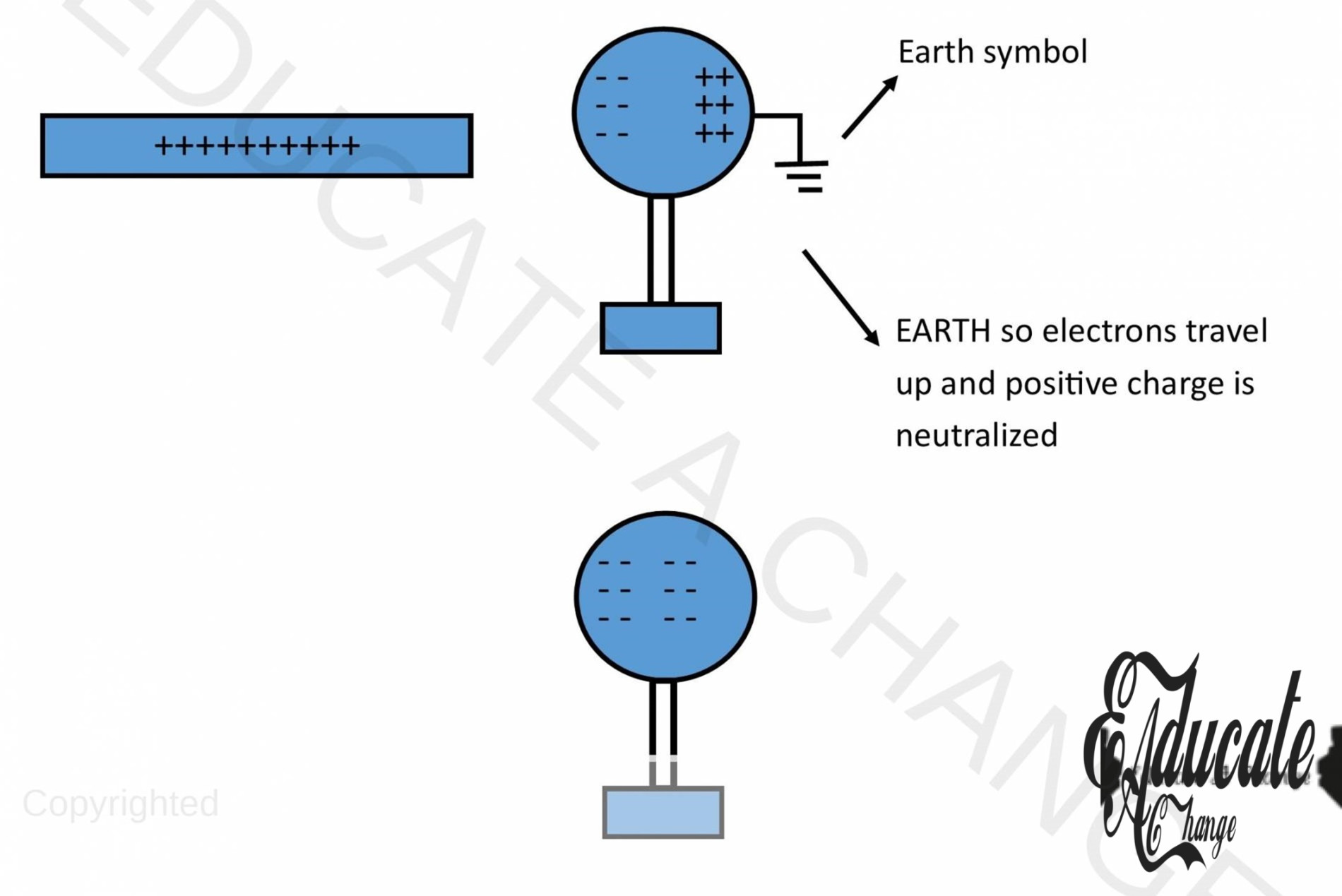
Two Metal spheres:
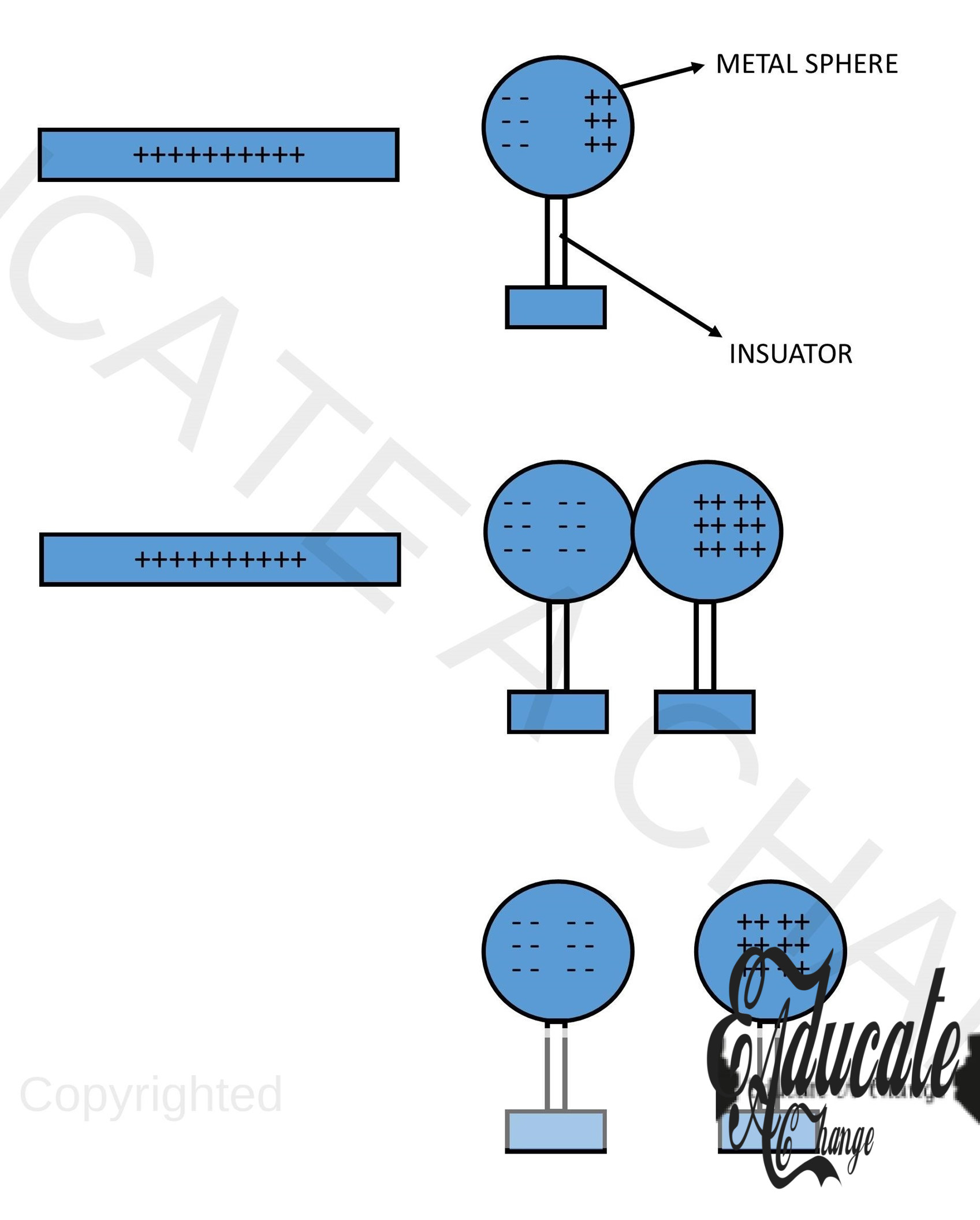
- Place the metal spheres on insulator so that the charge won’t leak.
- Bring charged rod near one sphere. Let us say the rod has positive charge
- The negative charges will attract and the positive (Same) charges will repel.
- Bring the other sphere closer with the rod still present.
- The positive charges will be pushed to the other sphere and the negative will be attracted to the first sphere. (see diagram for placement).
- Remove the spheres first and then the rod.
- Removing rod first will make the spheres neutral again.
Single Sphere:
- Place the sphere on insulator.
- Bring charged rod near to the sphere.
- Like charges repel and unlike will attract.
- Earth the other side and neutralize those charges.
- Remove earth connection
- Remove rod.
- Only one charge is left, and sphere is charged.
Discharging Spheres:
Touch or Earth to discharge. Make sure they are not on insulators when discharging.
Electroscope:
An electroscope is a device that is commonly used in the labs. It has three uses:
- To check if something is charged or not
- To check if something has positive charge or not
- To check if something has negative charge or not
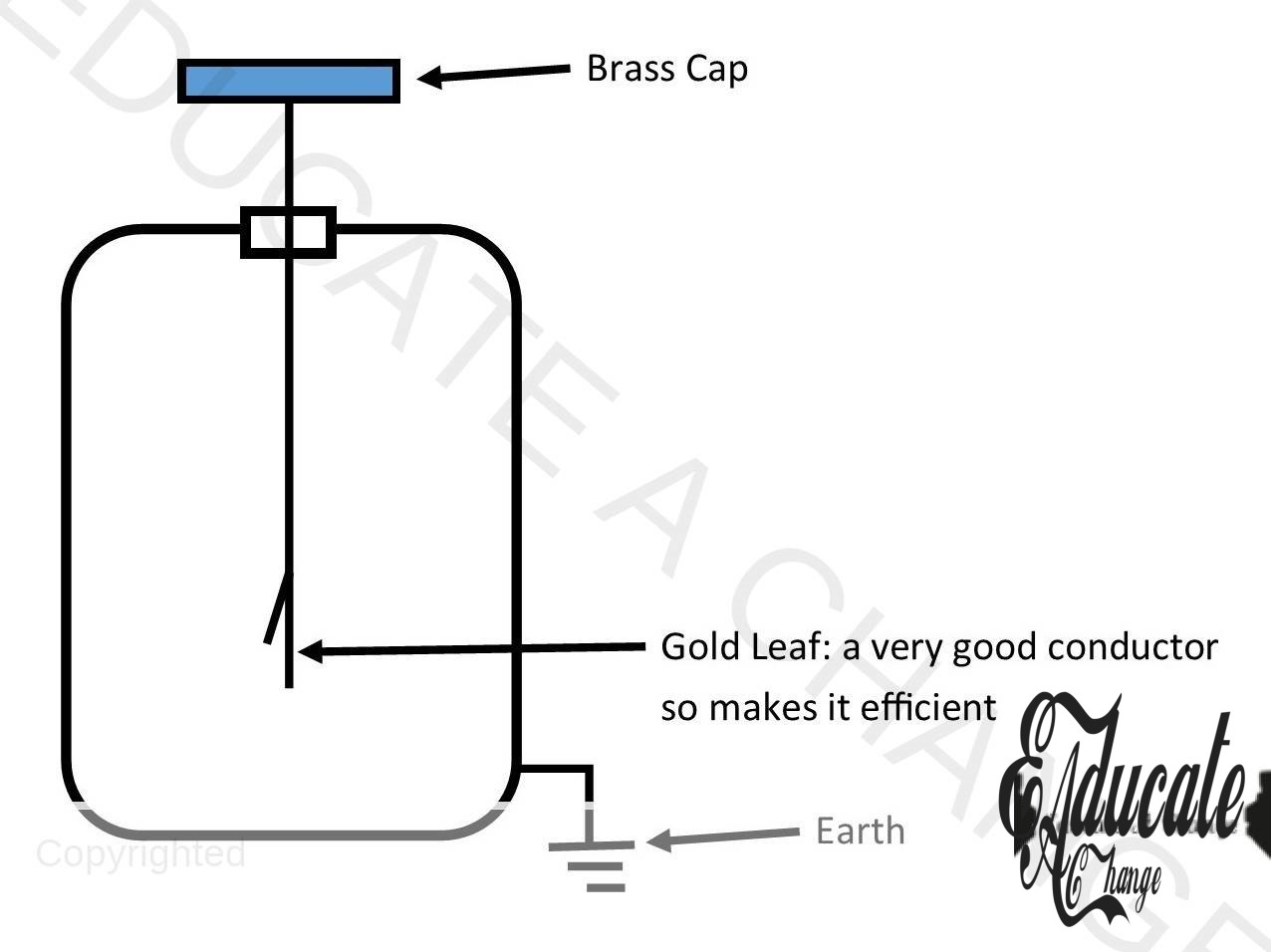
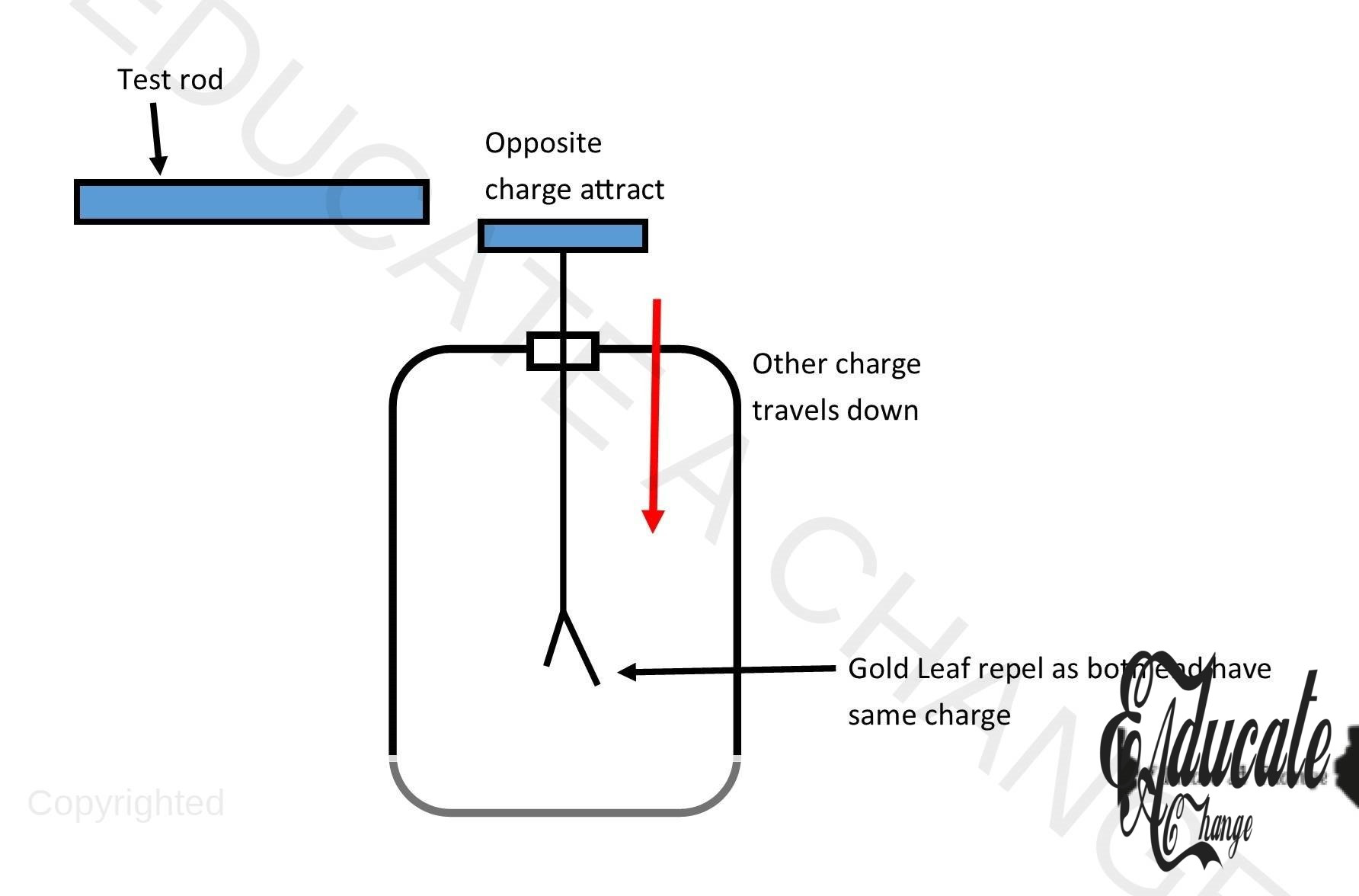
To check if something is charged or not:
- Bring the rod near the brass cap.
- Opposite charges are attracted, and same charges will travel down to the gold leaf.
- The gold leaf ends will have the same charges and hence, they will repel.
- This shows that the rod is charged.
To check if something is positively charged or not:
- Charge the electroscope with a negative rod.
- Earth will remove the negative charge and leave the positive charge.
- Positive charge would spread to balance on surface in brass cap and gold leaf.
- Bring your test rod near.
- If the repulsion increases, it means more positive charge has travelled down.
- The rod has to be positively charged in order to repel positive charge down to the gold leaf.
To check if something is negatively charged or not:
- Similar to positive charge, charge the electroscope with negative rod to give it initial negative charge.
- If the test rod has negative charge, it will cause negative charge to travel down to gold leaf and the repulsion would increase.
Electrical Conductors and Insulators:
Conductors:
Materials that allow current to pass through are known as conductors. For example: metals
Insulators:
Materials which prevent the passage of electricity are known as insulators. For example: plastic, wood
Charging Use and Hazard:
- Electrical Charging could be hazardous for example in lighting
- It has benefits for example in photocopier, electrostatic precipitator
Current Electricity:
Current:
- Current is the rate of flow of charge.
- SI UNIT: ampere
- Measured using an ammeter (Always connected in series)
- Q = IT
- We use ammeter with bigger range when we have circuits with more current. Ammeter with smaller ranges can measure in more decimals and are hence, more accurate.
Electromotive Force (EMF):
- Electromotive force is defined as the work done or energy converted from non-electrical to electrical form when one coulomb positive charge flows through a circuit.
- EMF is measured across the battery in parallel.
- SI UNIT: Volt
Potential Difference (PD):
- Potential difference is the amount of work done or energy converted from electrical to non-electrical form when one coulomb positive charge flows between two points.
- Measured across two points in parallel.
- PD across straight wire is O.
- SI UNIT: Volt
- We use potentiometers/ voltmeters with bigger range when we have circuits with more voltage. With smaller ranges, we can measure in more decimals and are hence, more accurate.
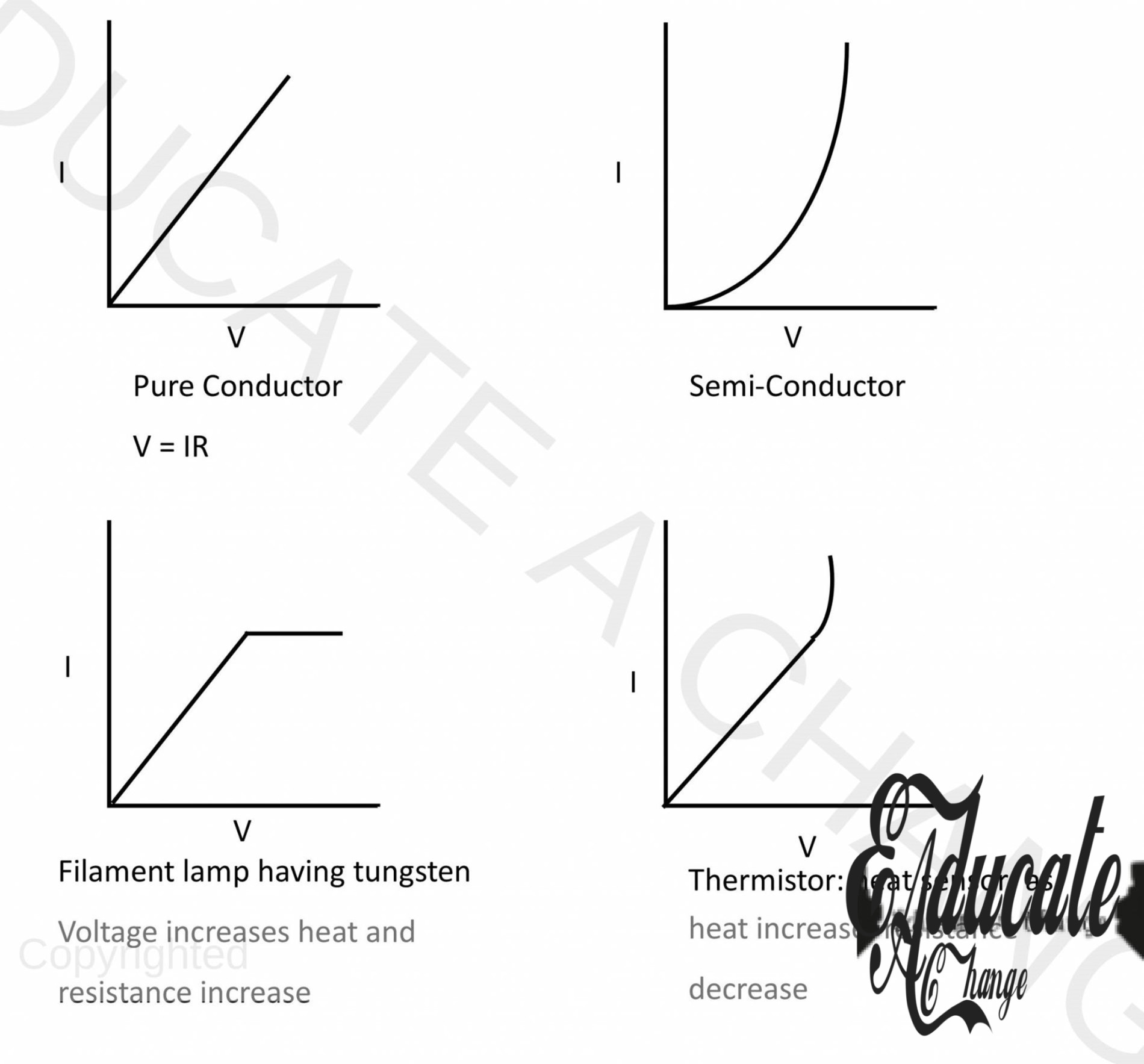
Graphs:
The graphs of voltage against current (with resistance info) for some common material are given below:
Designing Battery:
EMF is the total voltage that a battery supply. Measuring EMF while designing a battery is the best way to design. Also, battery is designed in parallel rather than series.
Resistance:
- Resistance is the property of material that restricts the flow of free electron.
- SI UNIT: Ohms (Ω)
- Symbol r
- Resistance is PD/I or voltage/ current.
Ohm’s Law:
- The current is directly proportional to potential difference under controlled conditions such as temperature.
- The materials that obey ohm’s law are called Ohmic material.
- V = IR
Resistivity:
- Resistance depends on two main factors:
- Resistance is directly proportional to Length (l)
- Resistance is inversely proportional to Surface Area (A)
- r ∝ L/A
- r = R(L/A)
- where R is the resistivity
- SI UNIT: Ohm meters (Ω m)
Resistance in Circuits:
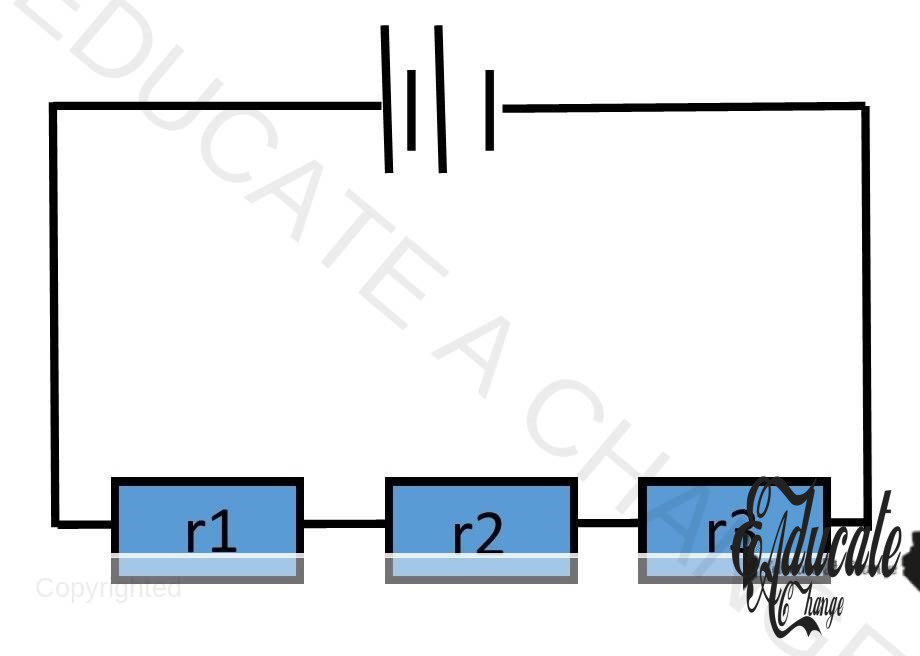
Series:
Resistance in series circuit is measured by adding all the resistances across all components. r = r1 + r2 + …. + rn
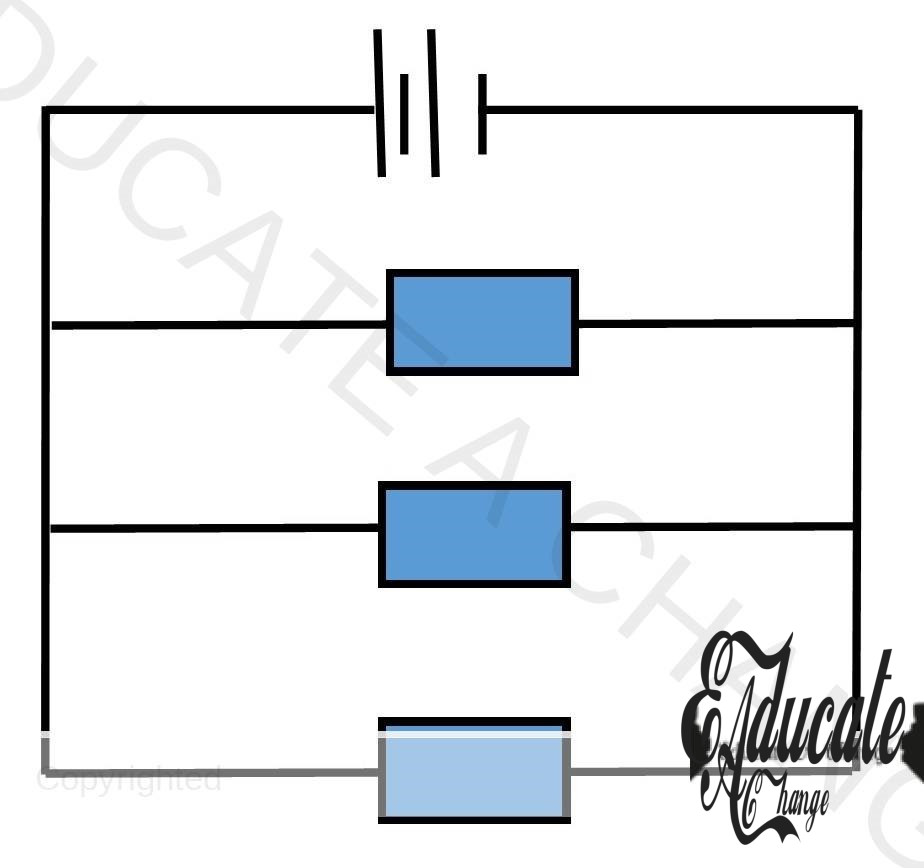
Parallel:
Resistance in parallel circuits is calculated by the following formula: 1/r = = 1/r1 + 1/r2 + … + 1/rn
LDR:
Light dependent resisters or LDRs (photoreceptor) are components that decrease in resistance as light increases.