Waves | O Level Physics 5054 & IGCSE Physics 0625 | Detailed Free Notes To Score An A Star (A*)
Topics:
- Waves
- Waves
- Sources of Waves
- Wave Motion
- Types of Waves
- Properties of Waves
- General Wave Equation
- Light
- Light
- Converging and Diverging Light
- Reflection of Light
- Refraction
- Total Internal Reflection
- Lens
- Linear Magnification
- Color Spectrum
Wave:
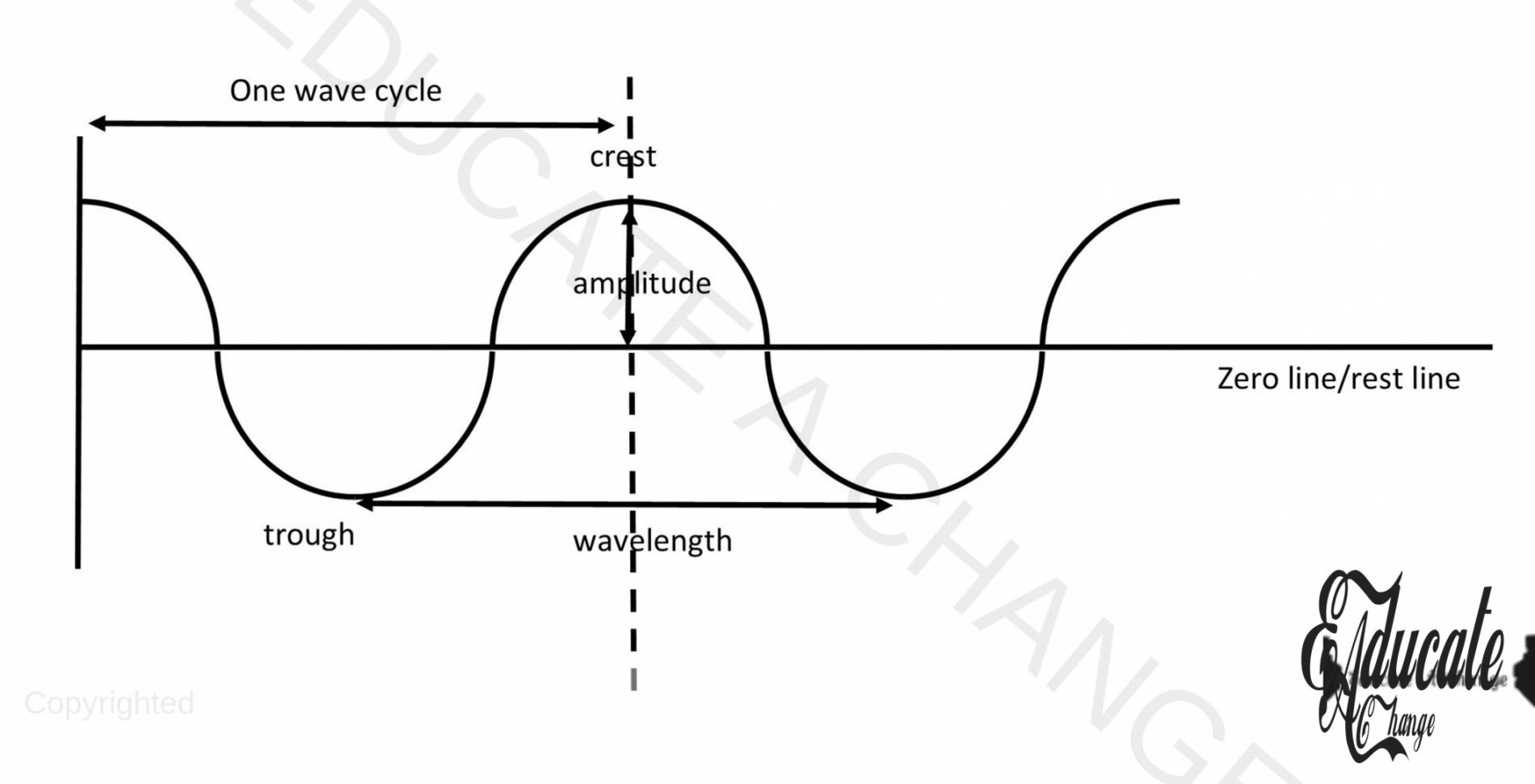
Wave is a disturbance spreading from one point to another point.
Sources of waves:
Any oscillating or vibrating object is a source of a wave. Waves can be demonstrated as ripples in water or even using springs.
Wave Motion:
Wave motion is a mechanism in which wave transfer energy from one point to another without actual movement of physical parts.
Types of Waves:
Transverse Waves:
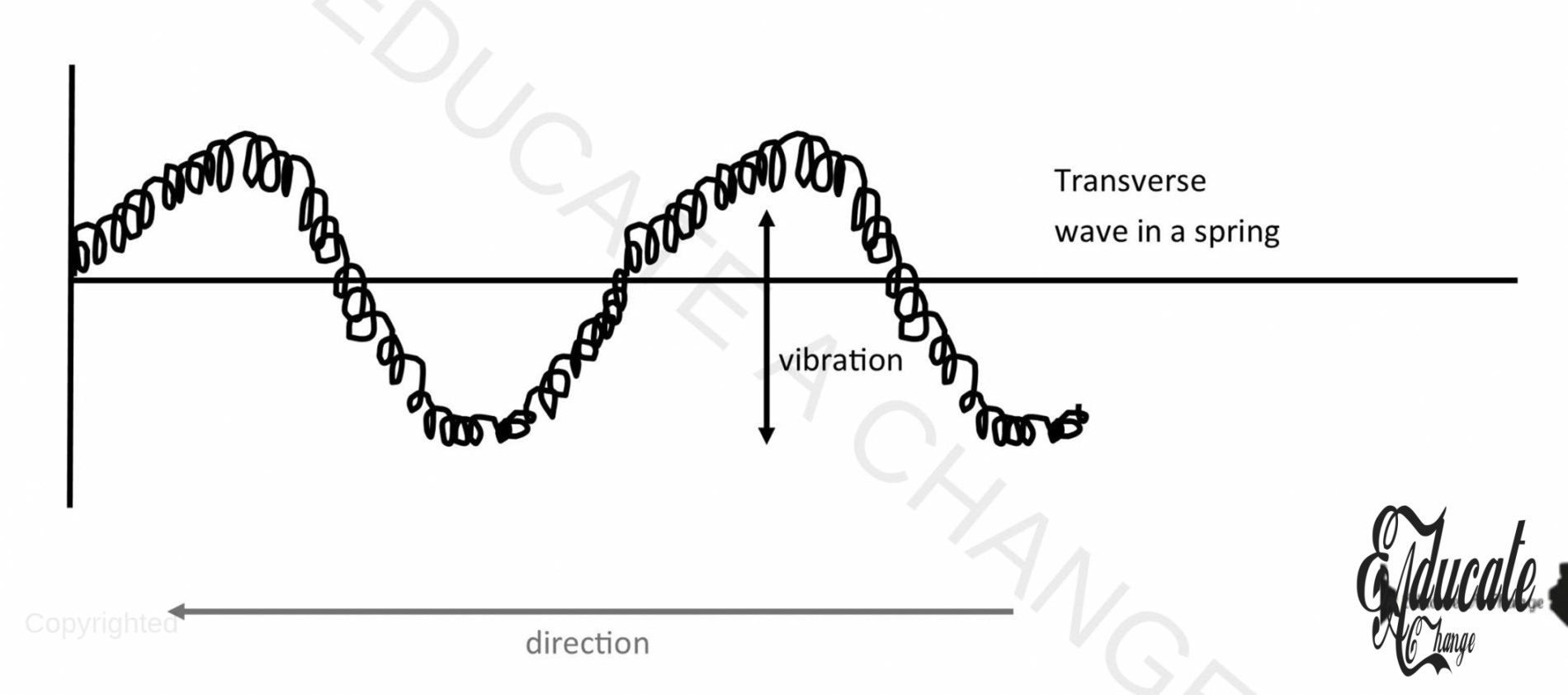
The waves in which vibrational direction is perpendicular to travelling direction (propagation). E.g. electromagnetic waves.
Longitudinal waves:
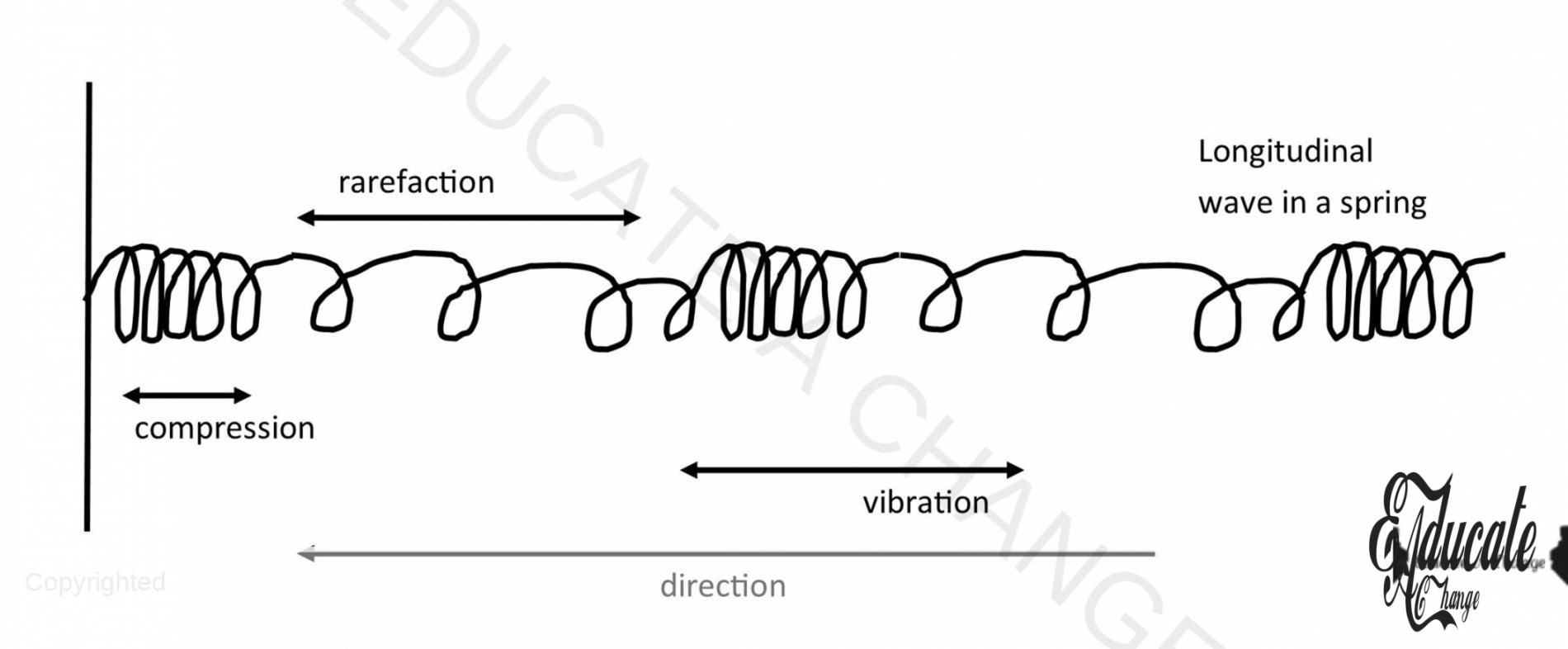
The waves in which the vibrational direction is parallel to the propagation. E.g. sound waves.
Properties of waves:
Wavelength:
Difference between two consecutive wave crests / wave troughs/ in-phase particles.
Time Period:
The time taken for one complete wave cycle.
Frequency:
Number of wave cycles completed in one second.
Wave Fronts:
Imaginary lines that join all in-phase particles of waves.
Amplitude:
The distance between the zero line and the crest/trough of the wave.
Phase:
Change in angle of the wave.
In-phase particles:
Particles on a wave which have the same direction and distance from the rest line are called in-phase particles.
General Wave Equation:
Speed = frequency x wave length V=Fλ Where lambda is the sign for wavelength.
Light:
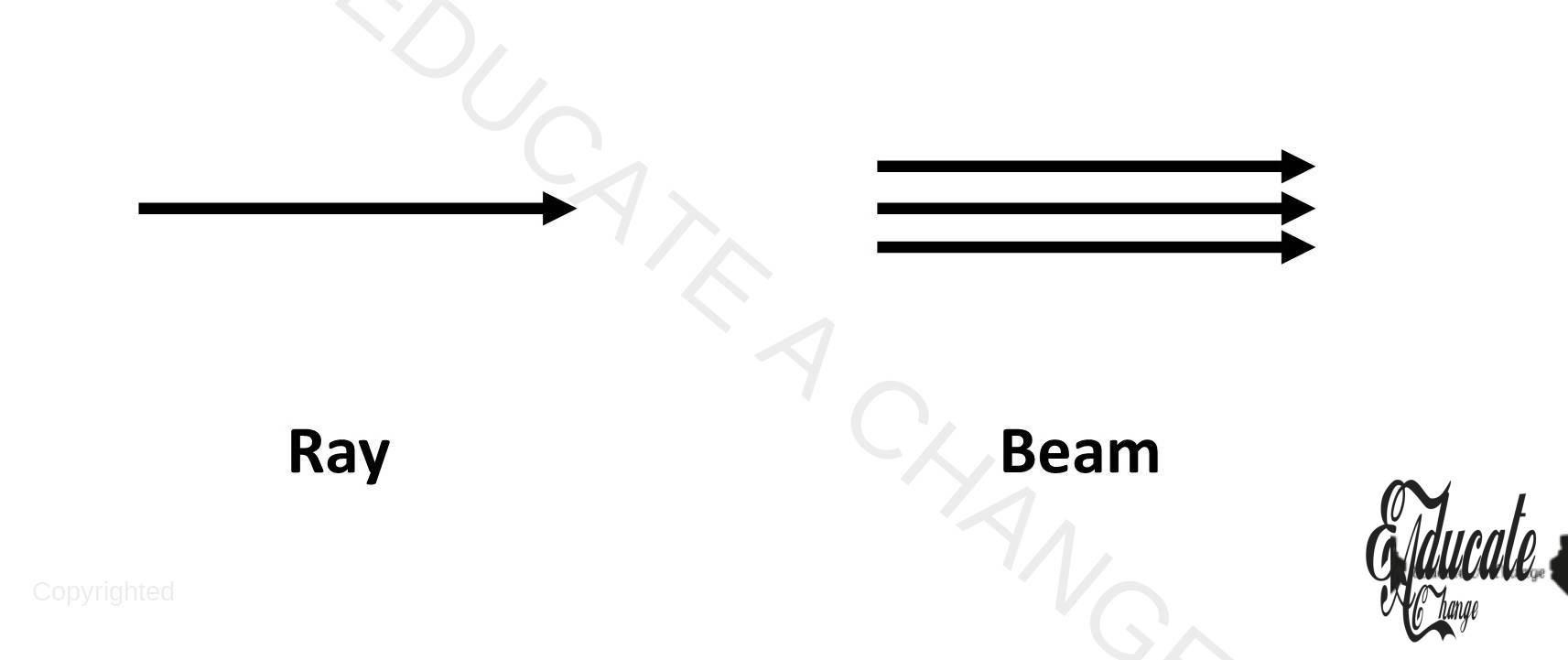
Light is the part of Electromagnetic spectrum. It always travels in straight lines.
Converging and Diverging Light:
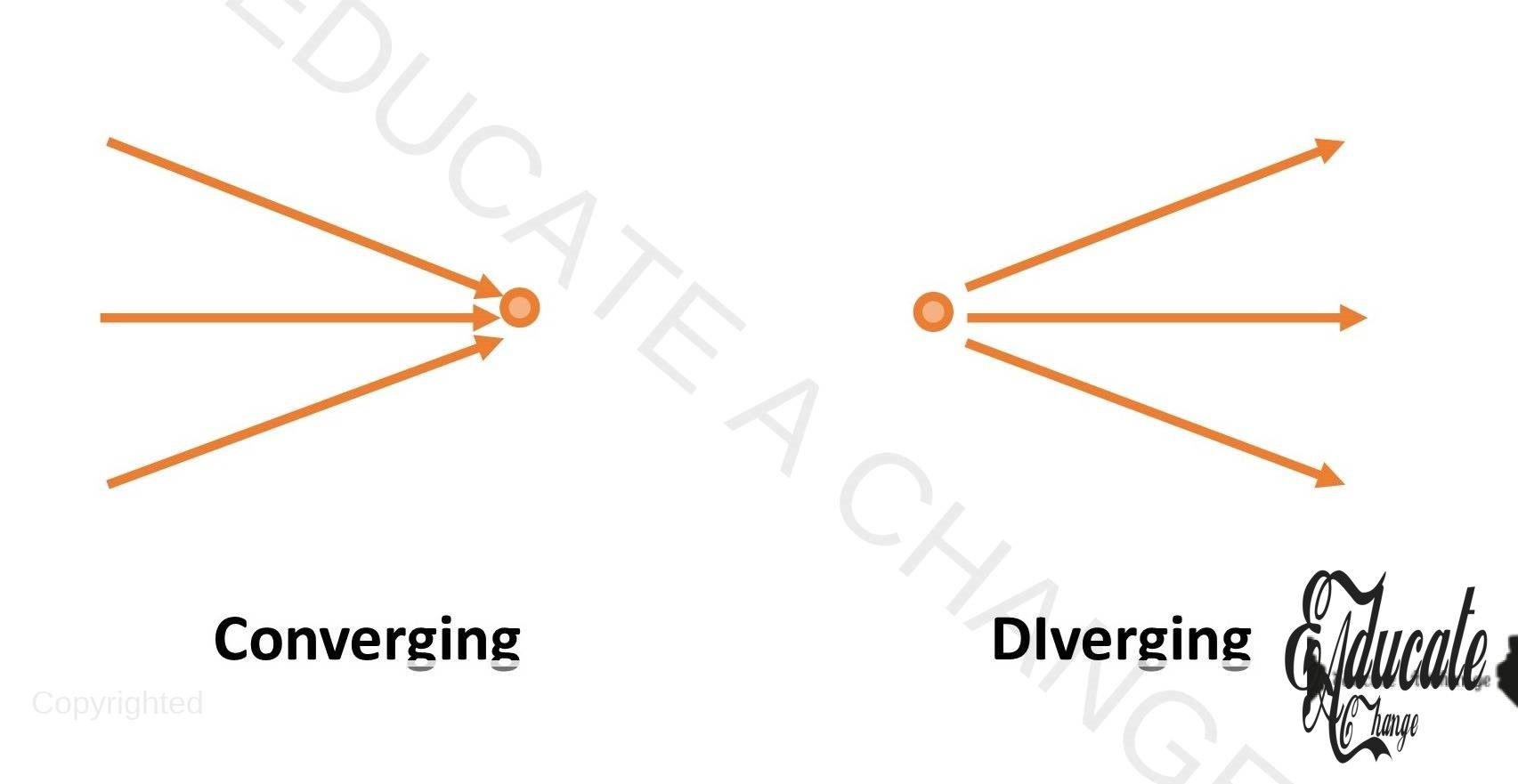
- When light rays gather at one point, we say they are converging.
- When light rays appear to scatter from one point, we say they are diverging.
Reflection of Light:
Incident ray:
The ray that initially falls on the surface.
Reflected ray:
The ray that bounces back/ reflects back from the surface.
Normal:
The perpendicular point to the surface between the incidence and reflected ray (diagram).
Angle of Incidence:
The angle between the incidence ray and normal.
Angle of Reflection:
The angle between the reflected ray and normal.
Laws of Reflection:
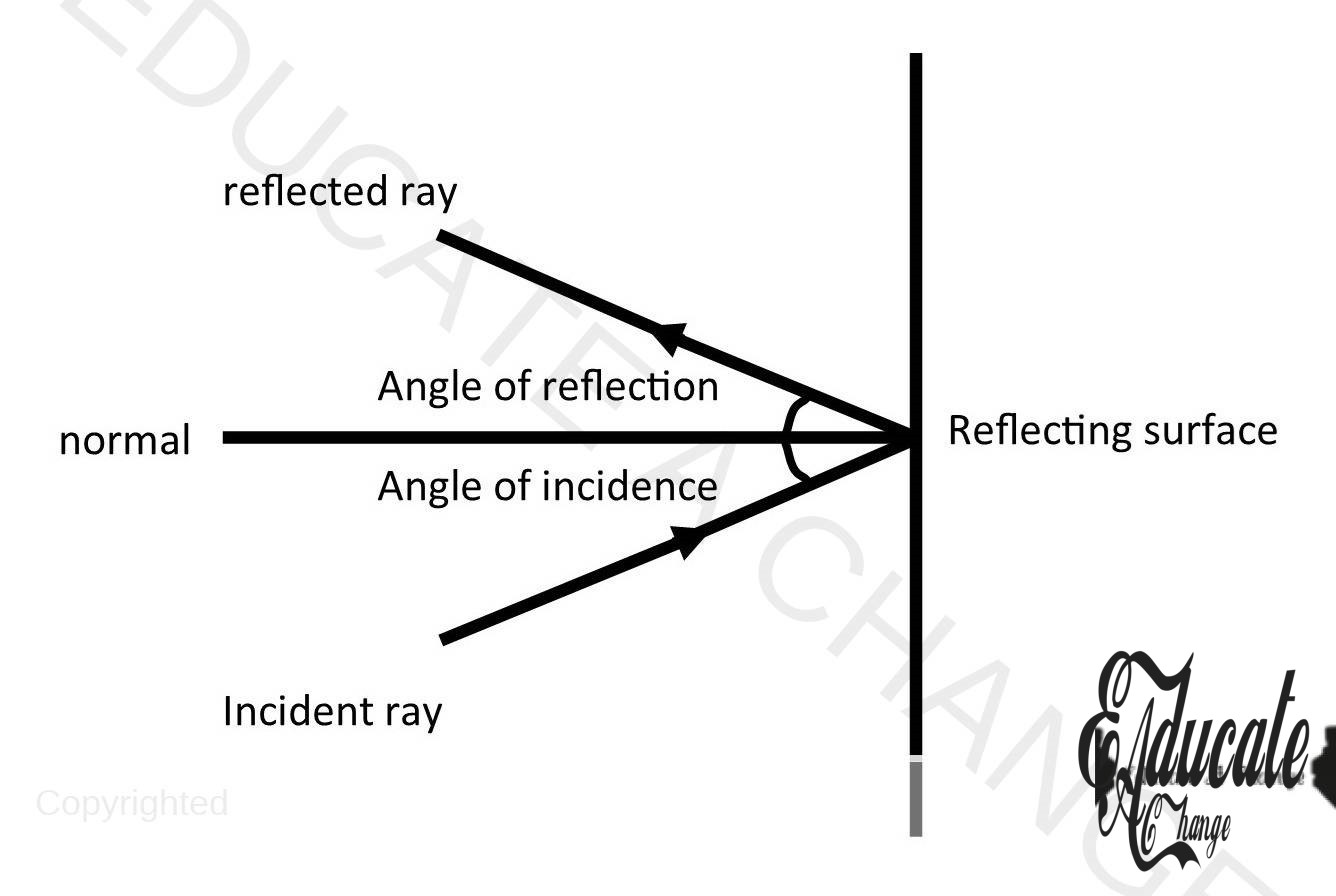
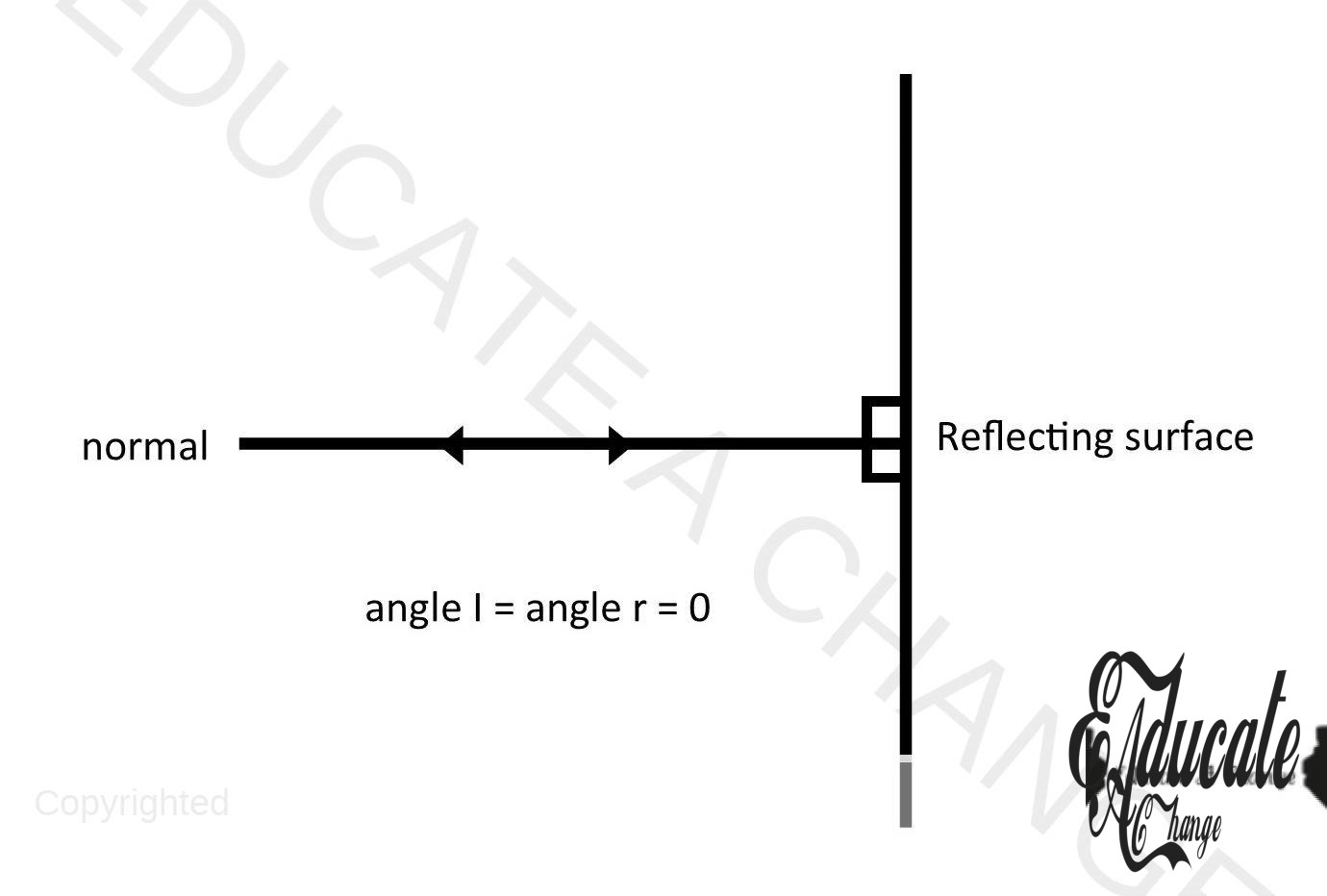
- Angle of incidence = angle of reflection
- (incase the angle is 0, the incidence and reflected ray will be on normal)
- Incidence ray, the reflected ray and normal all lie on the same plane.
Types of Reflection:
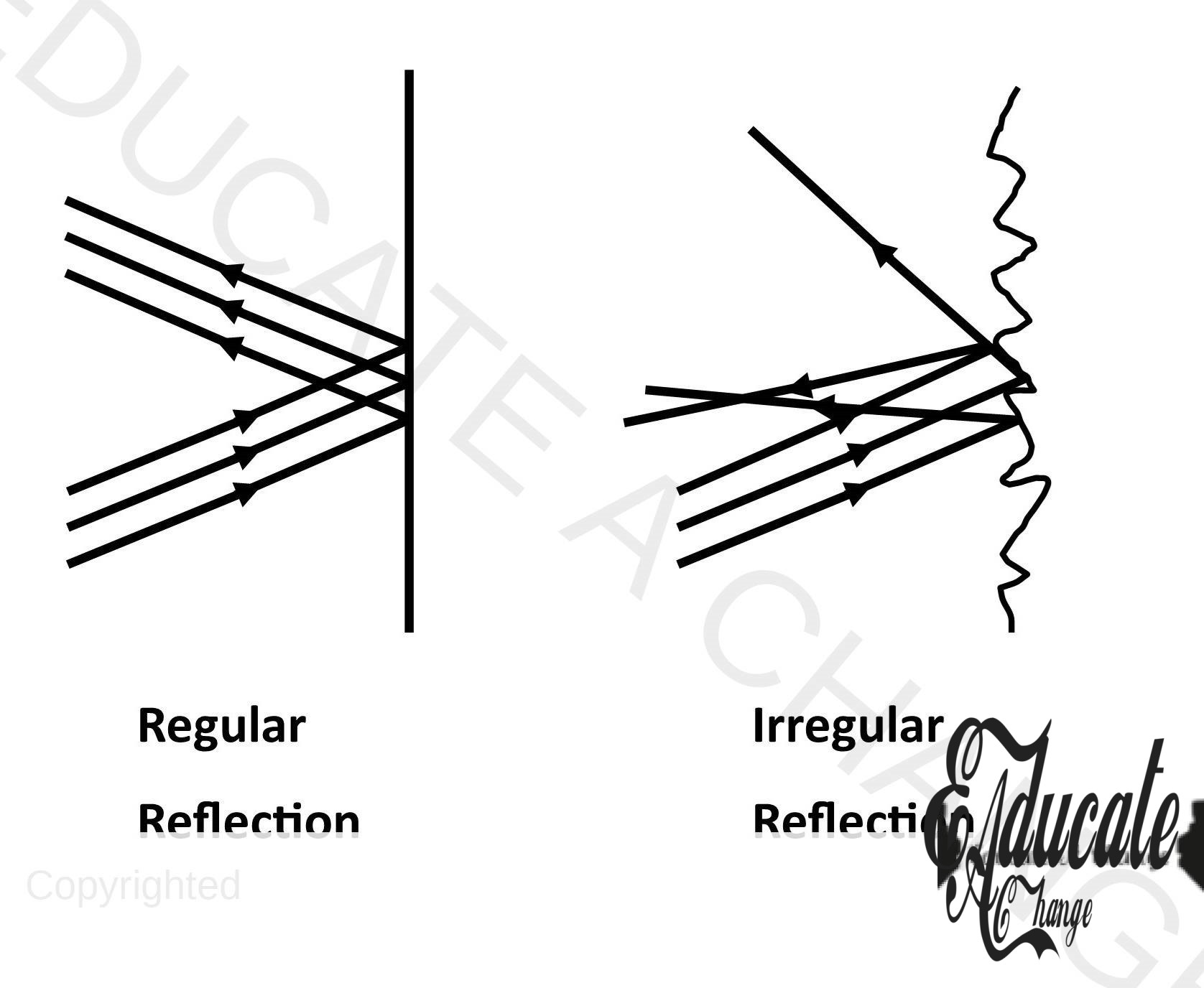
There are two types of reflection:
- Regular reflection:
- Reflection off smooth surfaces. The parallel incidence rays are reflected in a parallel way.
- Irregular reflection:
- Reflection off rough surfaces. The rays reflected are not parallel and are scattered.
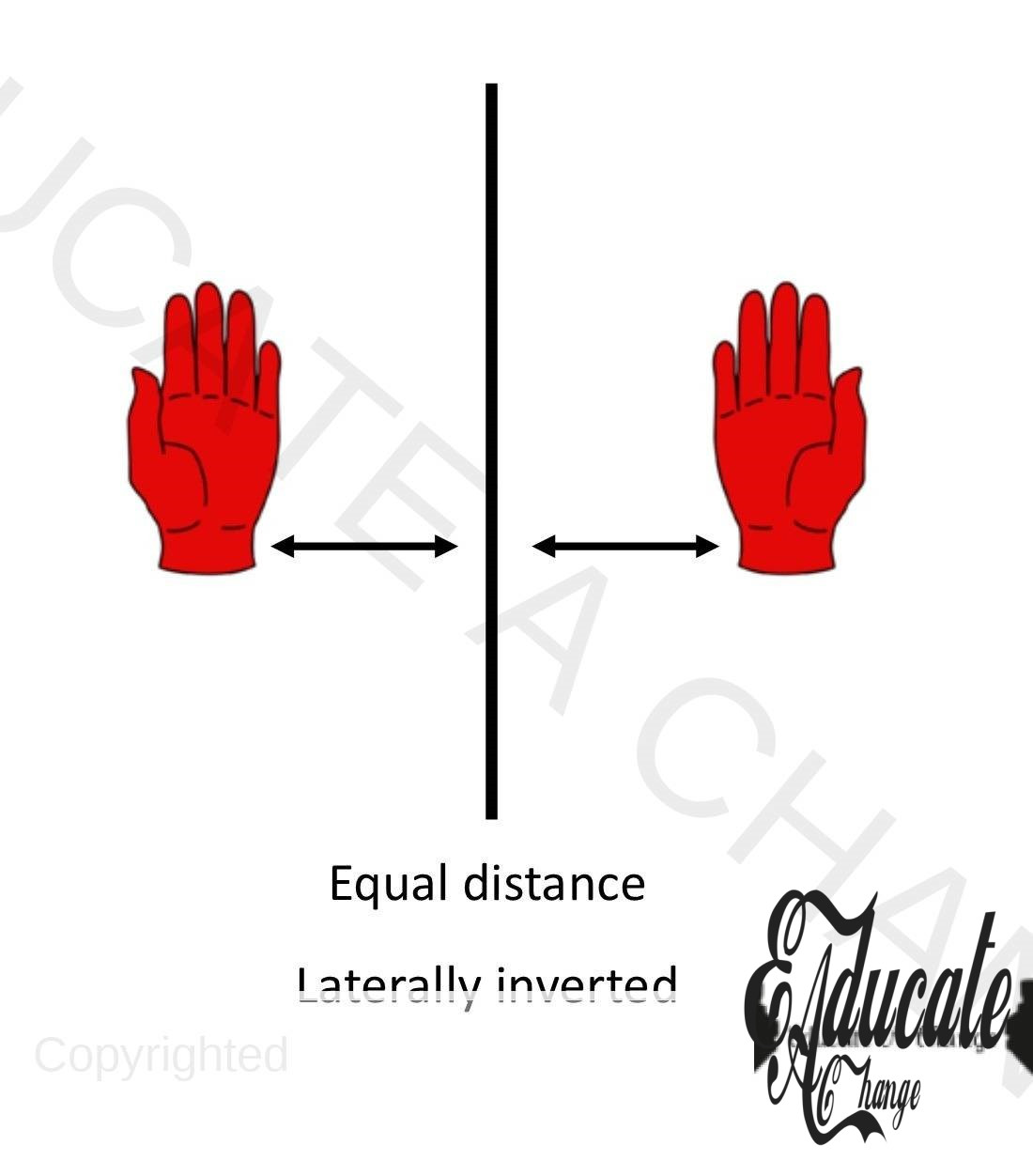
Properties of reflection image behind the mirror:
- Virtual as no energy is present,
- Same size,
- Same distance,
- Side change/ laterally inverted
How to draw reflection of an object:
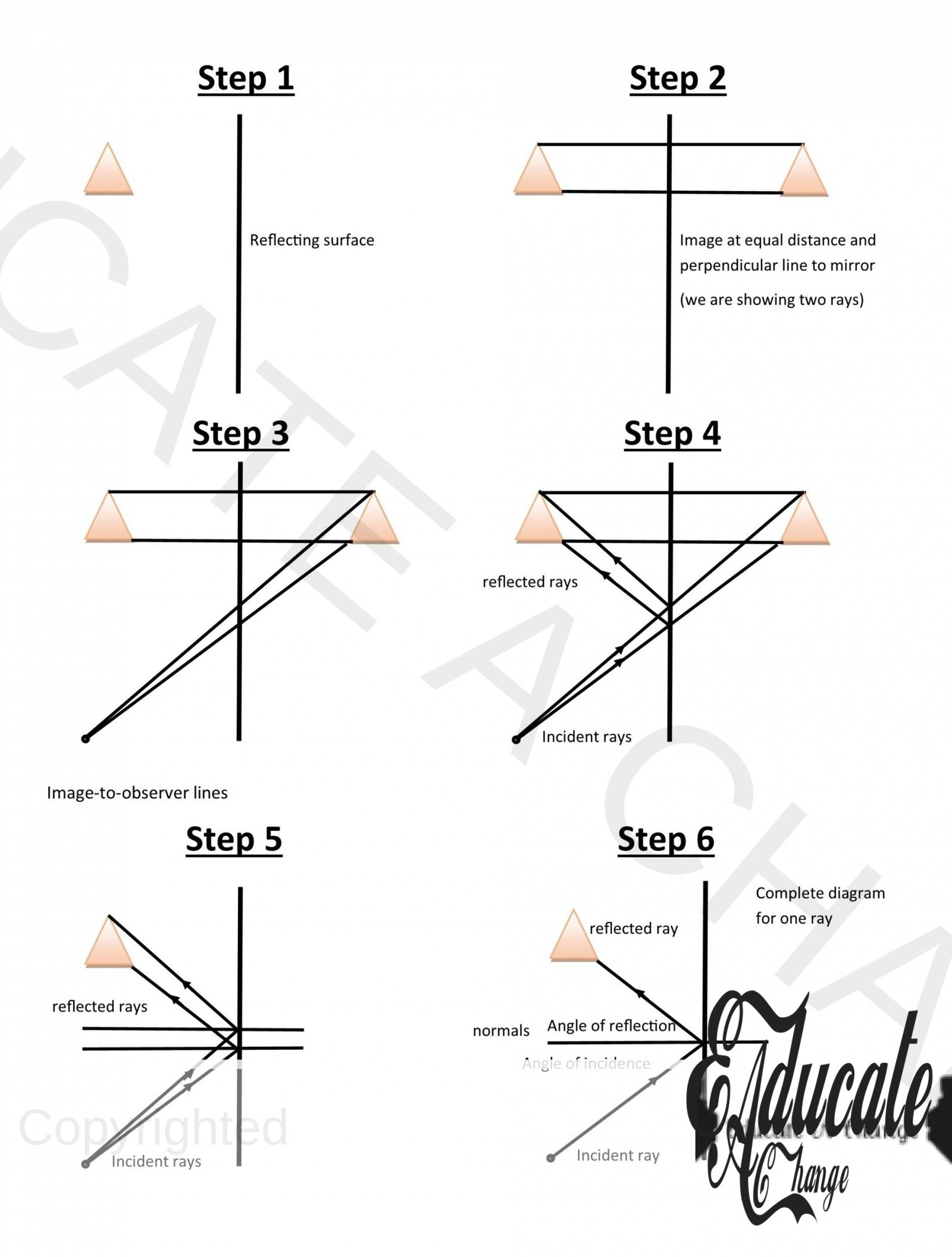
- Draw perpendicular line from the object to the mirror/reflecting surface. If mirror is not present there, extend the mirror. The line should have equal distance on both sides of the mirror. This is where our image is present.
- Draw the image-to-observer line. If the line crosses the mirror, then our observer can see the object in the mirror, otherwise not.
- Join object to the point on the mirror as incidence ray, and the other as reflected ray.
Case where the image cannot be seen by observer:
Consider the diagram:
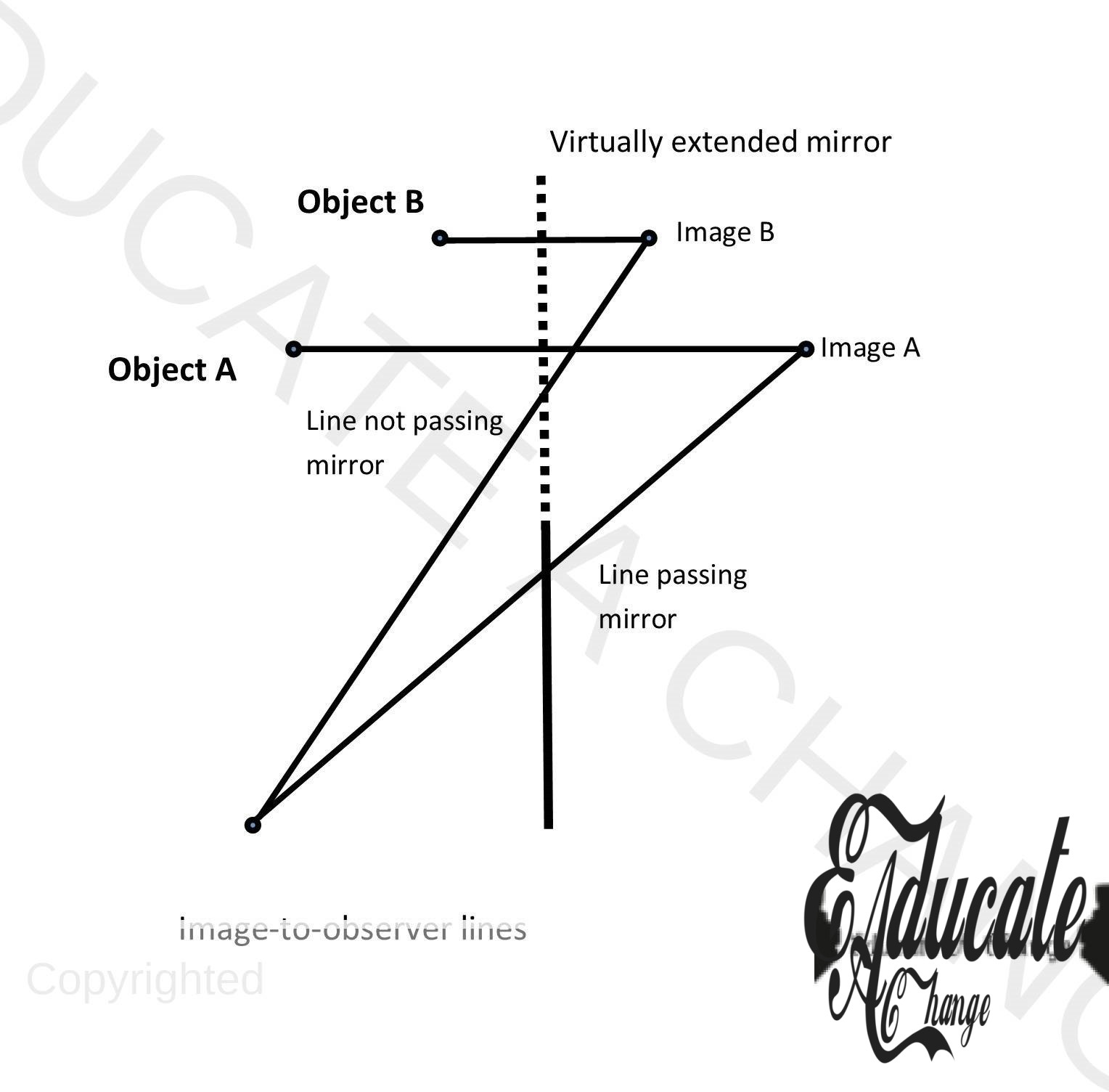
Since the image-to-observer line does not pass through the real mirror, the object B cannot be seen. Object A can be seen by the observer.
Refraction:
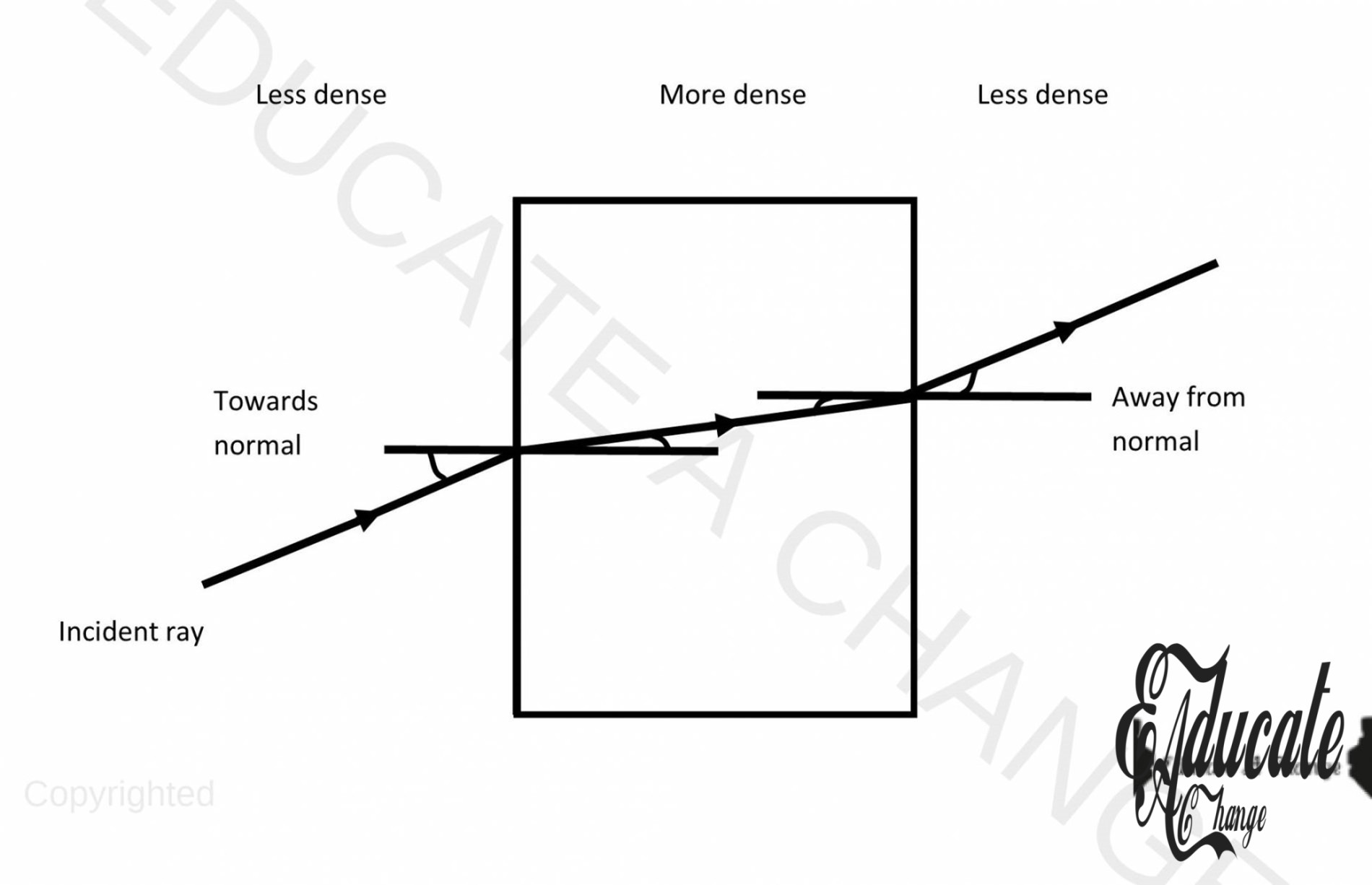
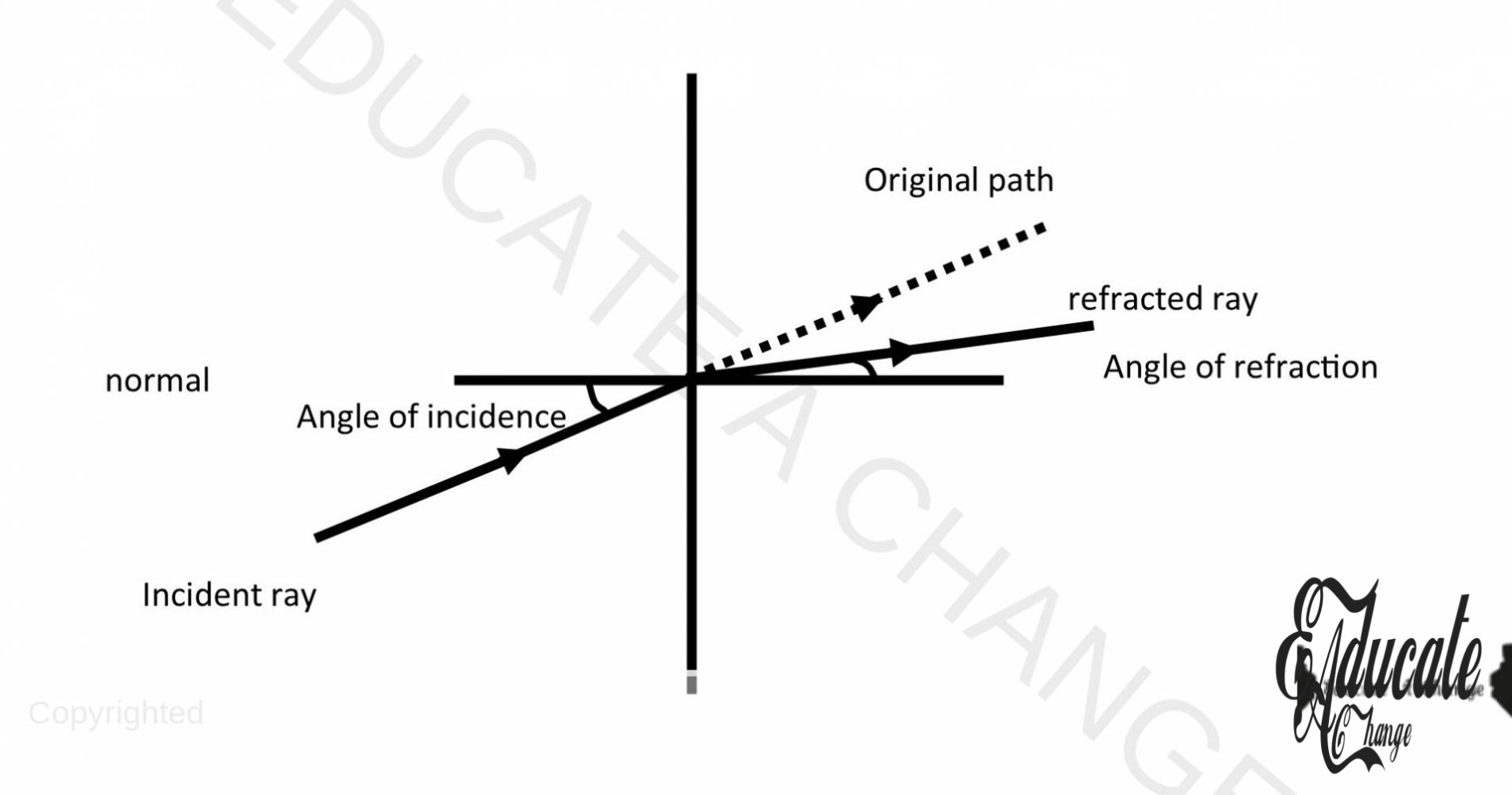
When light enters from one medium to another, it bends and changes its direction. This is called refraction.
Refracted ray:
The ray with the changed direction on the other side of the incidence ray.
Angle of Refraction:
The angle the refracted ray makes with the normal.
Critical Angle:
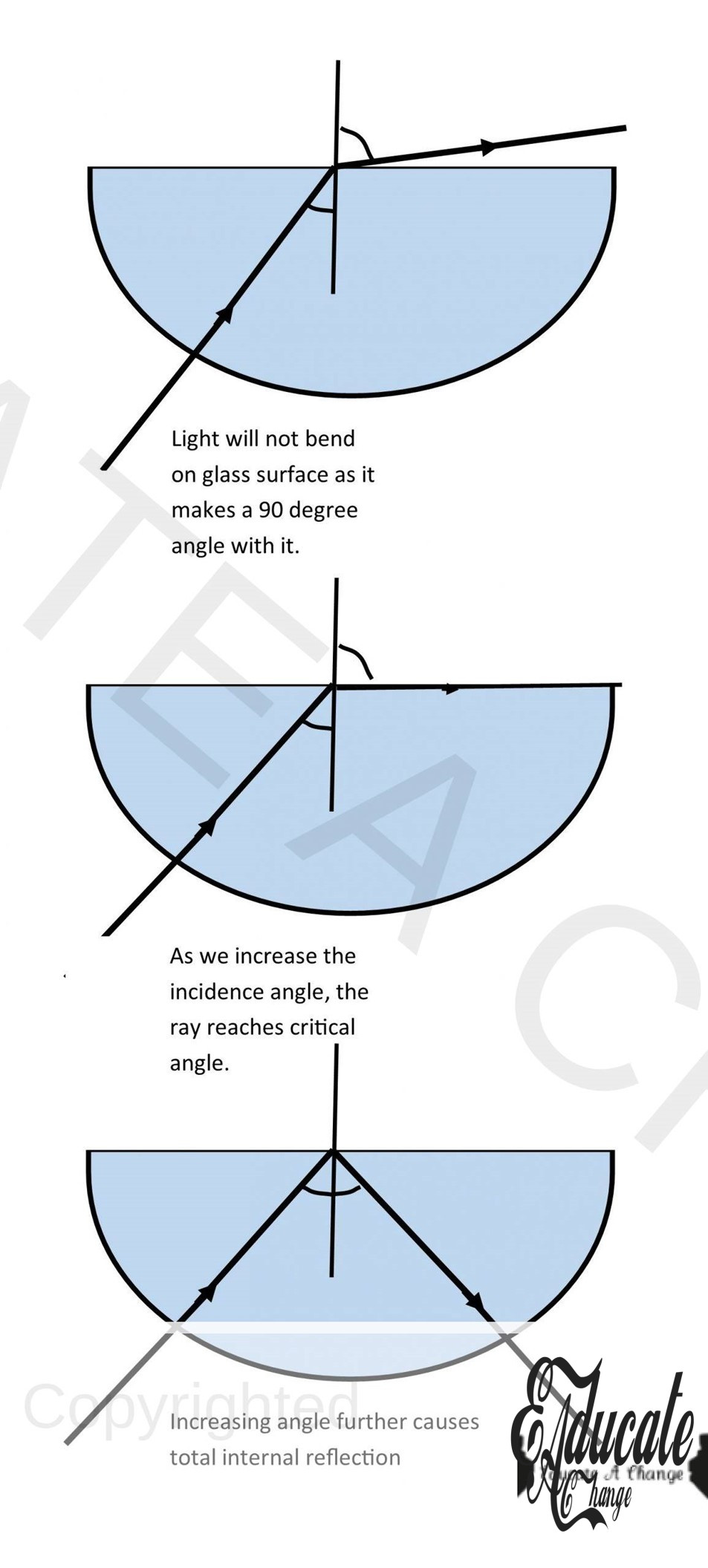
The angle of incidence when the refracted angle is 90 degrees.
Law of Refraction:
- Incident ray, normal and reflected ray all lie on the same plane.
- Refraction require two mediums.
- In dense medium, light’s speed slows down so it bends towards normal.
- When entering lighter medium, light bends away from the normal.
- At 90 degrees, since there is no incidence angle or refraction, light stays at normal.
- For two particular media, the ratio of Sin of Incident angle to Sin of refracted angle is equal to constant called refractive index of that material. (n).
- Refractive index is also equal to 1/ critical angle.
sin i / sin 3 (when light moves from dense to less dense, we will use sin r / sin i) =n = 1/critical angle, c
- Speed of light in air/vacuum = 3 x 10⁸m/s
- More the refractive index, more the bending.
- Refractive index = speed in air/speed in medium.
Total Internal Reflection:
A phenomenon when the incidence angle is more than the critical angle and the light will get internally reflected inside the object (sa.me medium)
Conditions for Total Internal Reflection:
- Light must be entering from denser to less dense medium,
- Angle of incidence must be greater than critical angle.
Uses:
Total internal reflection has many uses:
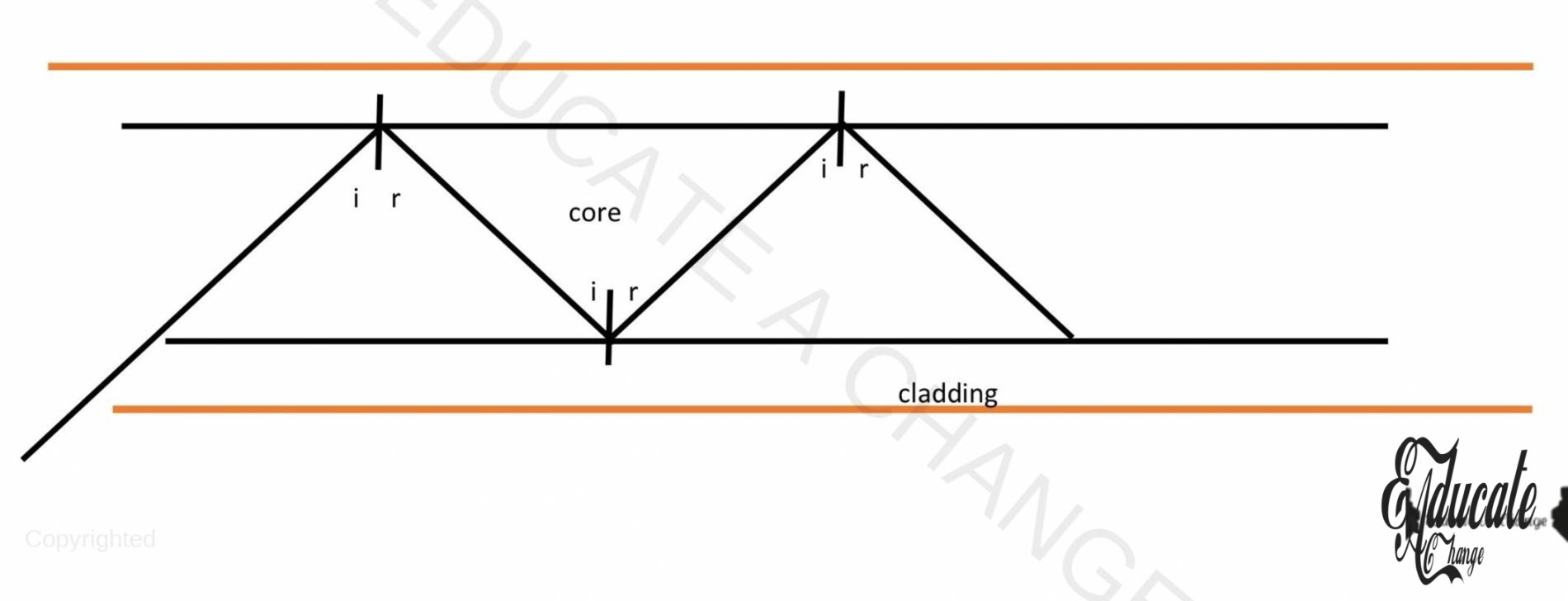
- Fiber optics:
- We know that the light is fast and using it to transmit data can increase bandwidths and speed. Hence, in fiber optics, light is transmitted from one end to the other using the principle of total internal reflection.
- Periscopes:
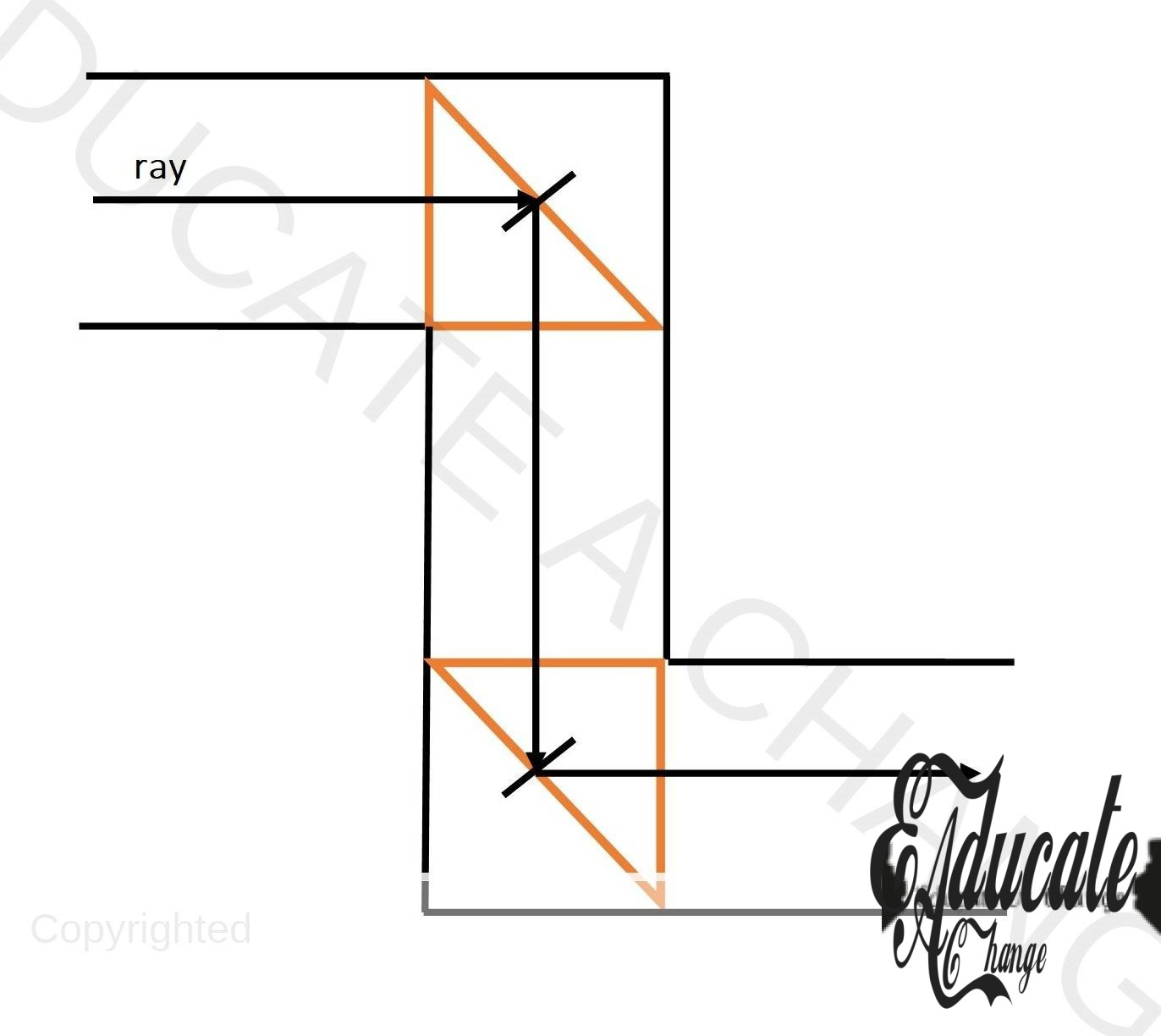
- Submarines use periscopes which also work on the principle of total internal reflection using two right angle prisms.
Lens:
There are two basic types of lens:
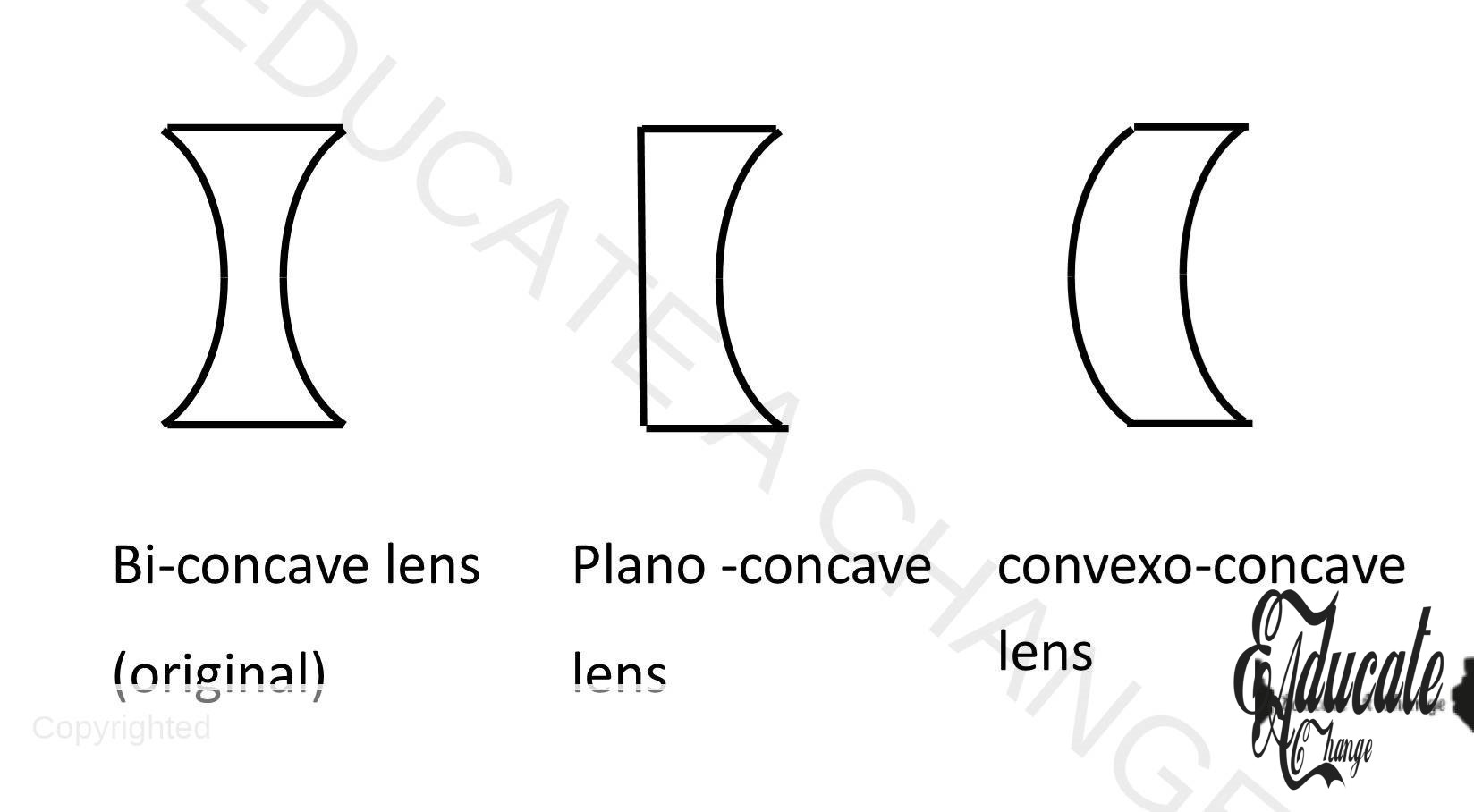
- Concave lens
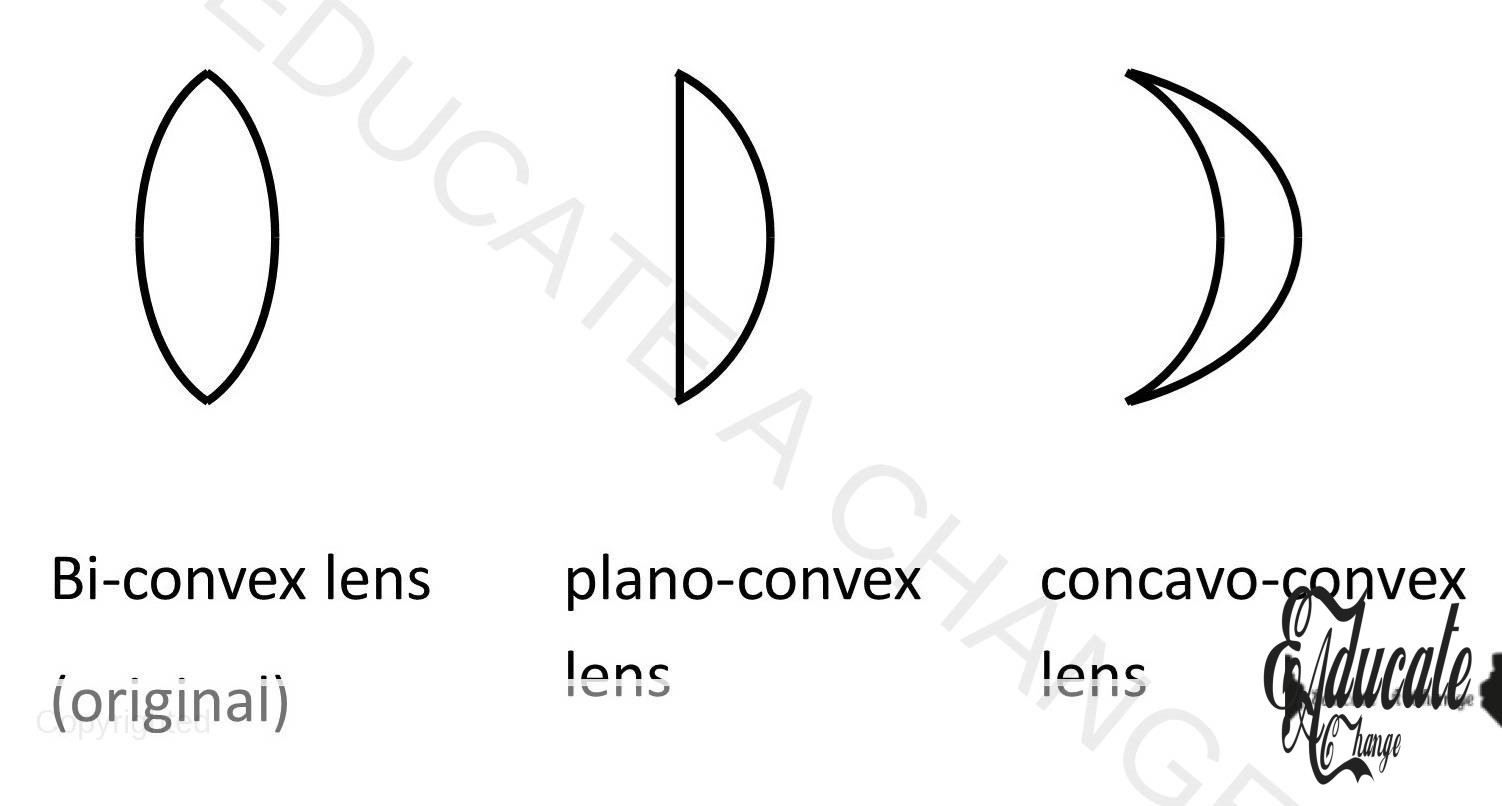
- Convex Lens
Concave Lens:
It is called the diverging lens as light is scattered from a point.
Convex Lens:
It is called the converging lens as light is converged to a point.
Properties:
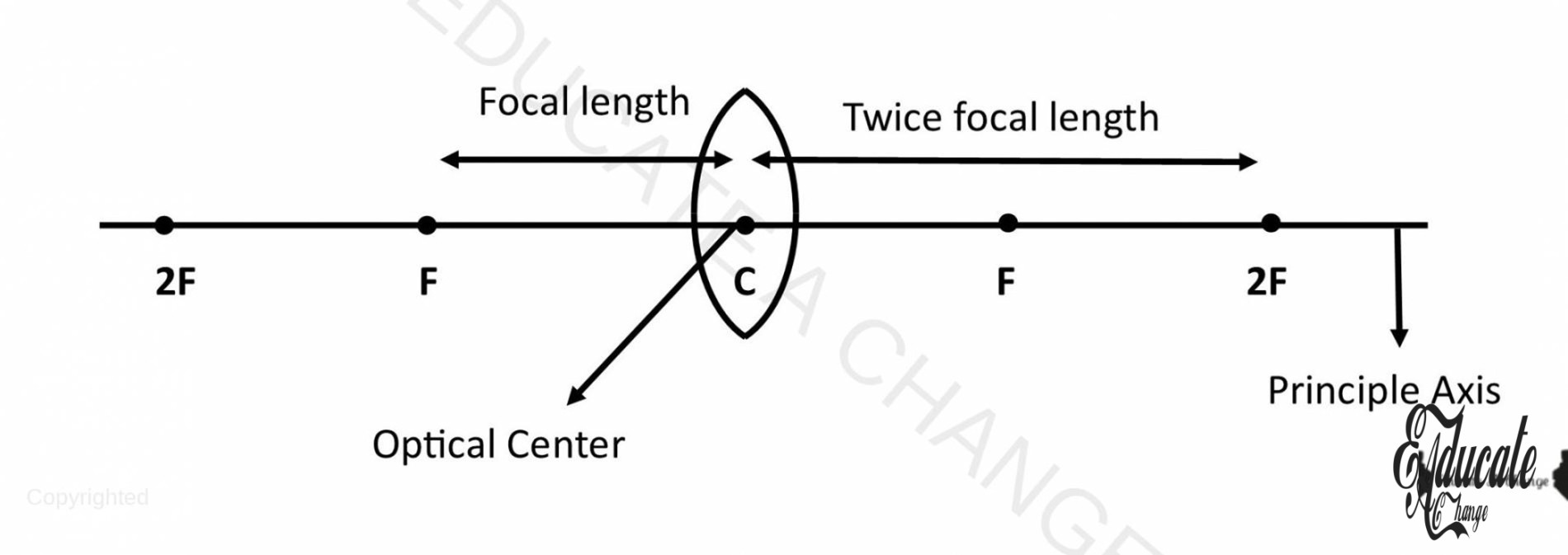
- Focal Length:
- The distance between the optical center and the focal point
- Focus Point:
- A point on the principle axis on both sides of the lens (which has equal distance from center, c).
Virtual and Real Image:
| Virtual | Real |
| Cannot be captured on a screen | Can be captured on a screen |
| Is not formed by passing real light | Is formed by real light |
| Always upright | Always inverted |
Image in Converging Lens:
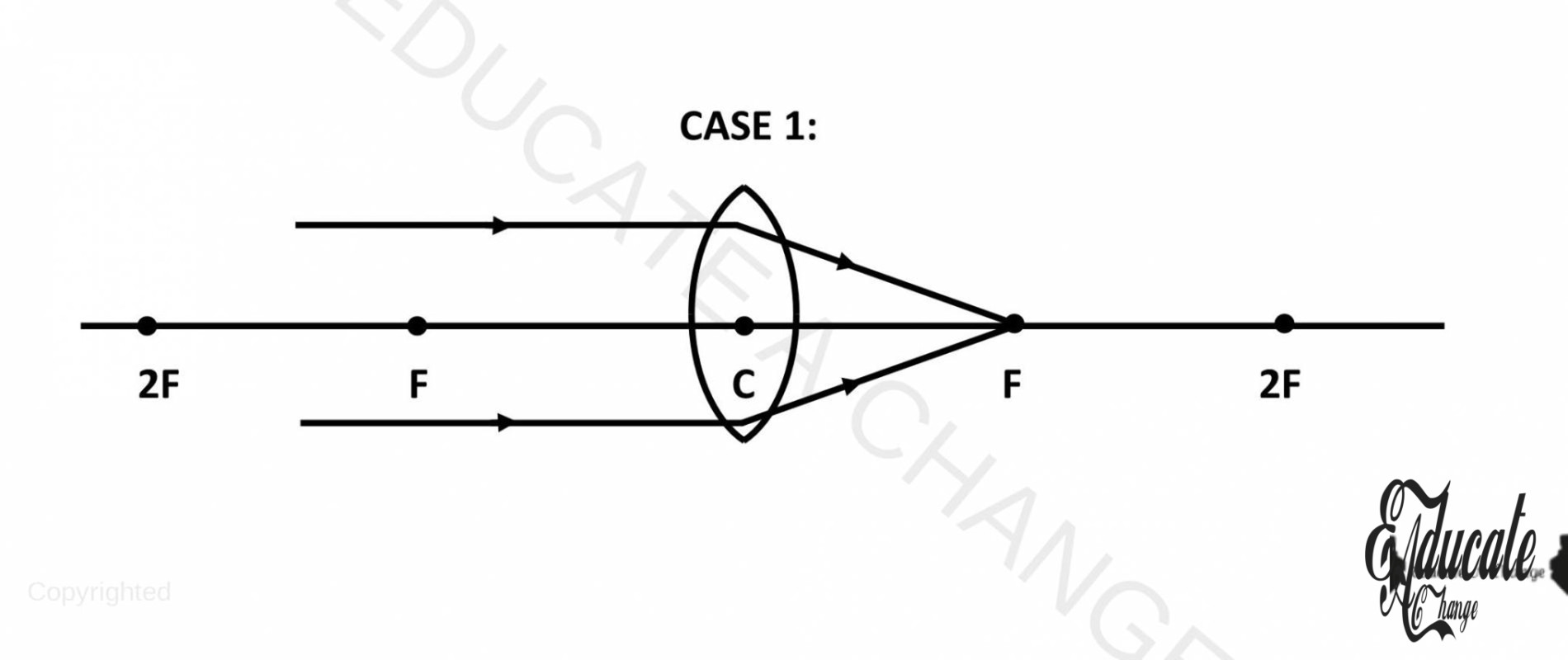
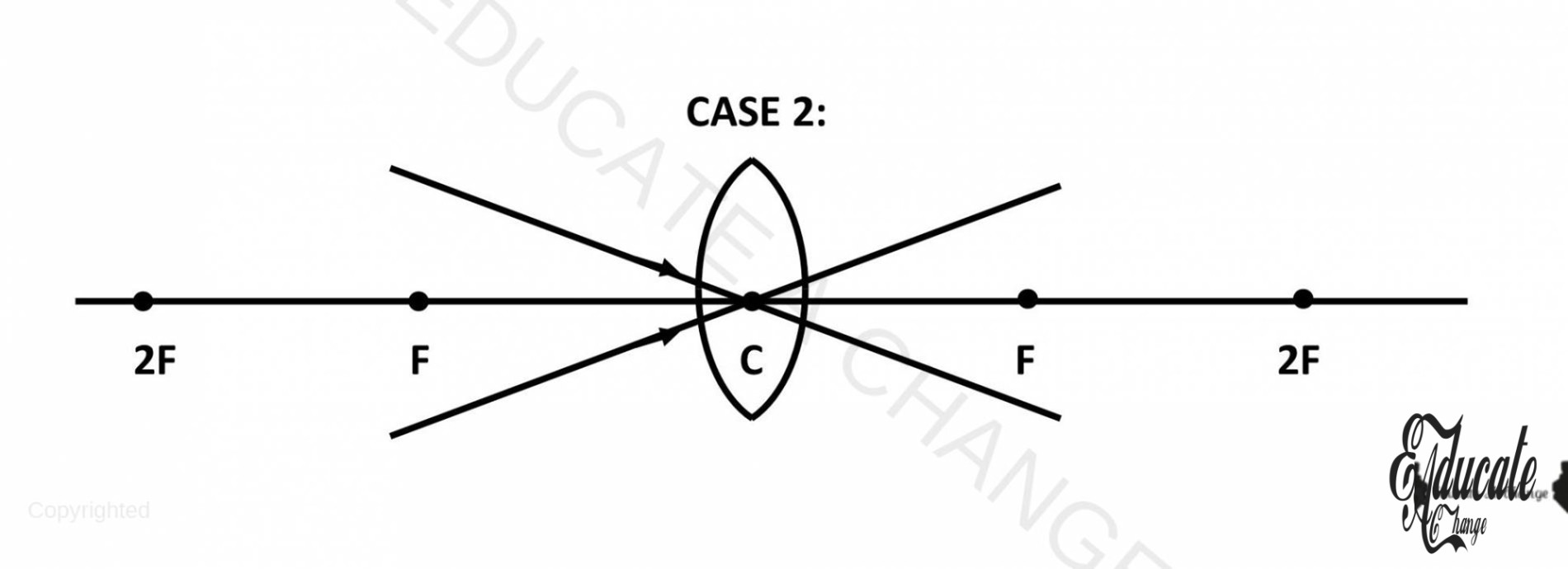
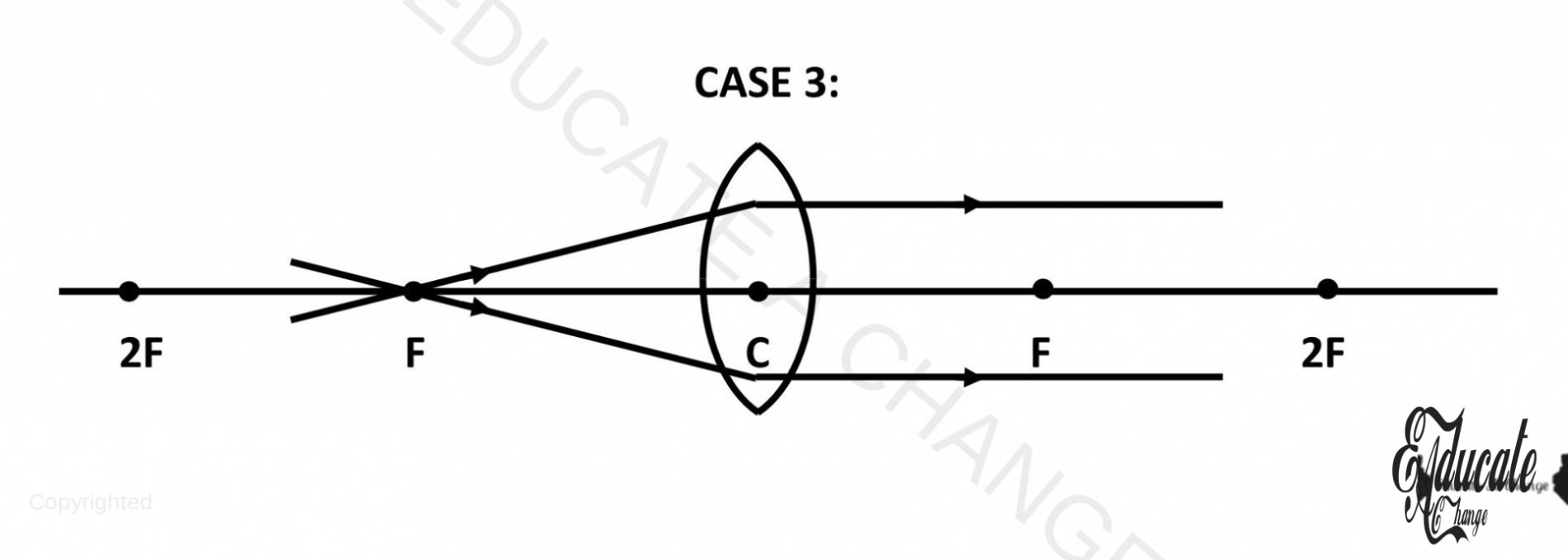
In order to draw the image of an object using converging lens, we use these three principles.
- Rays parallel to principle axis would pass the focus point on the other side.
- Rays of light passing the optical center will not bend.
- Any ray that passes the focus point and strikes the lens will become parallel to the principle axis.
We can use any two of these rules to create an image for an object. For example, consider the diagram. We have used the rule 1 and rule 2 to create the image of the object.
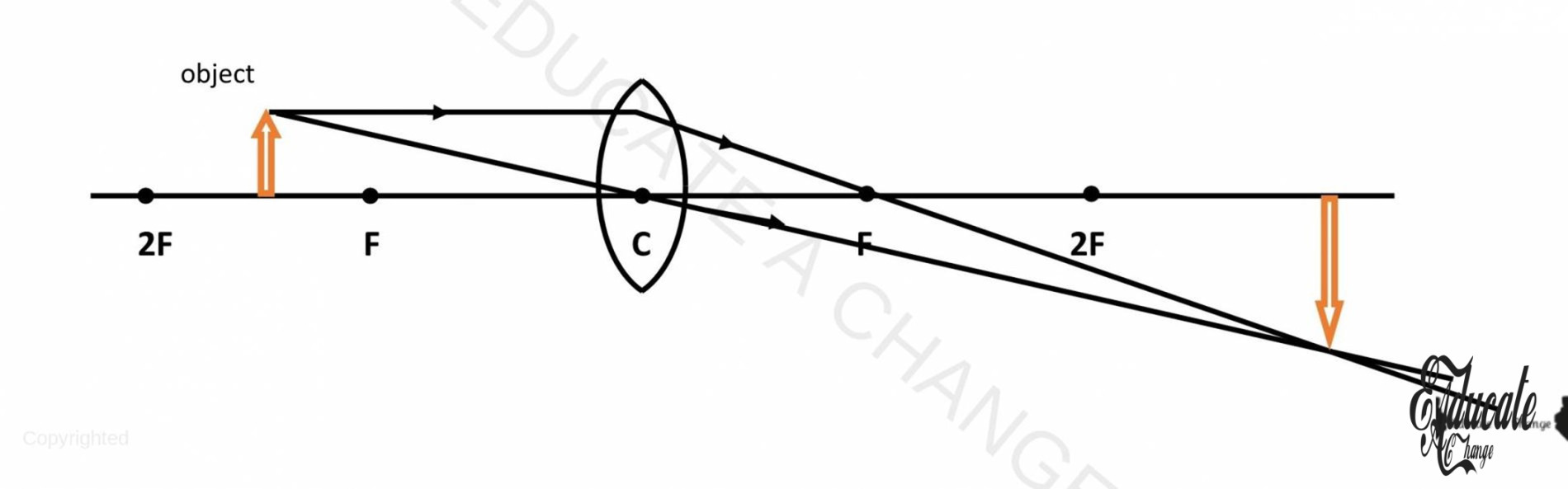
Image of diverging Lens:
The way light diverges can be seen in the diagram showing an image on the same side of the object.
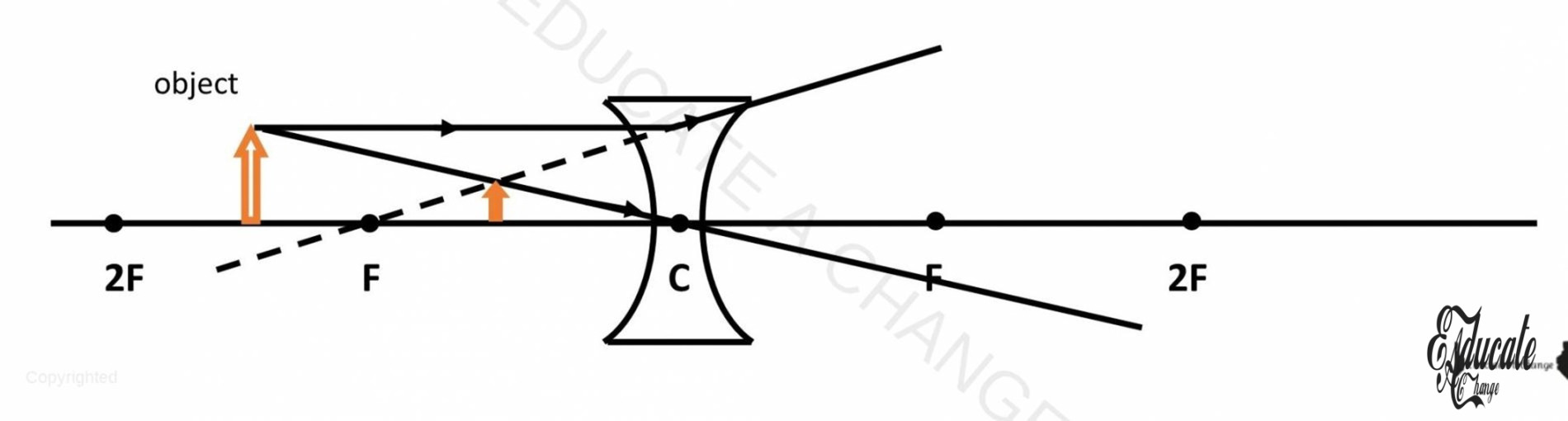
We virtually extend the diverged ray to pass the focal point, again using the same rules, we create the image of the object.
Linear Magnification:
Linear magnification is the ratio between the image size and the object size. m= image/object = distance between image and center / distance between object and center = v/u
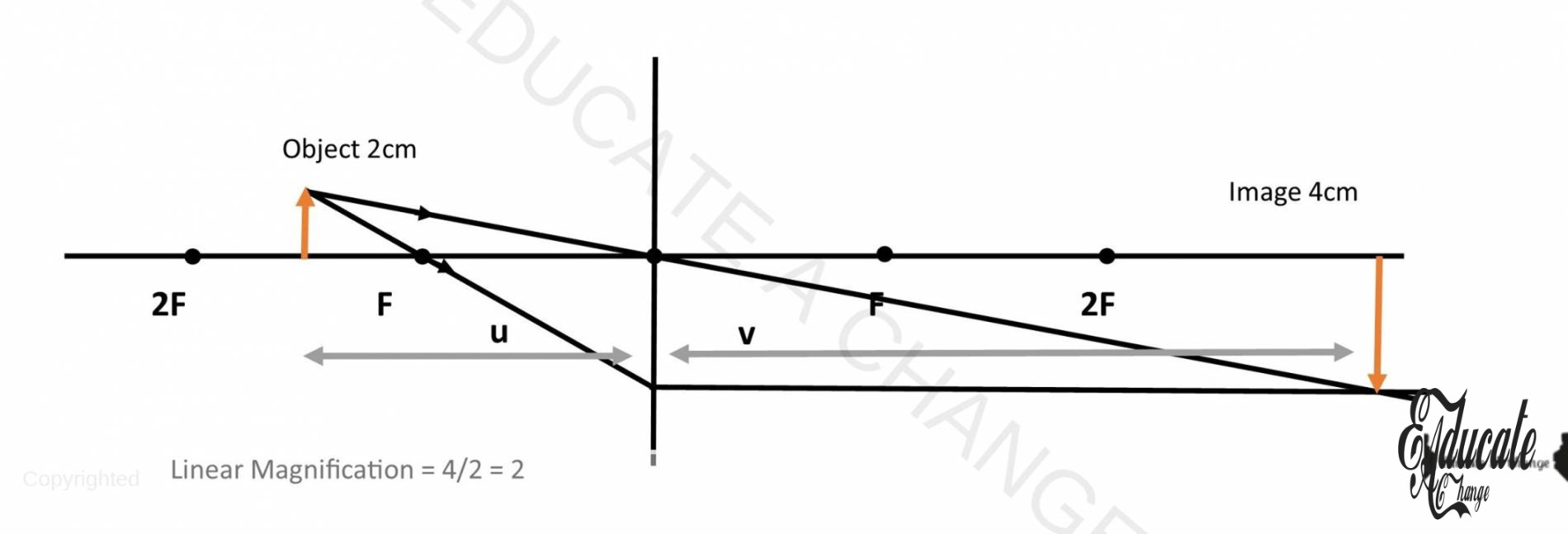
For example, here our object was 2 cm and image was 4 cm so linear magnification will be 4/2 = 2.
Cases of Linear Magnification:
There are six cases of linear magnification:
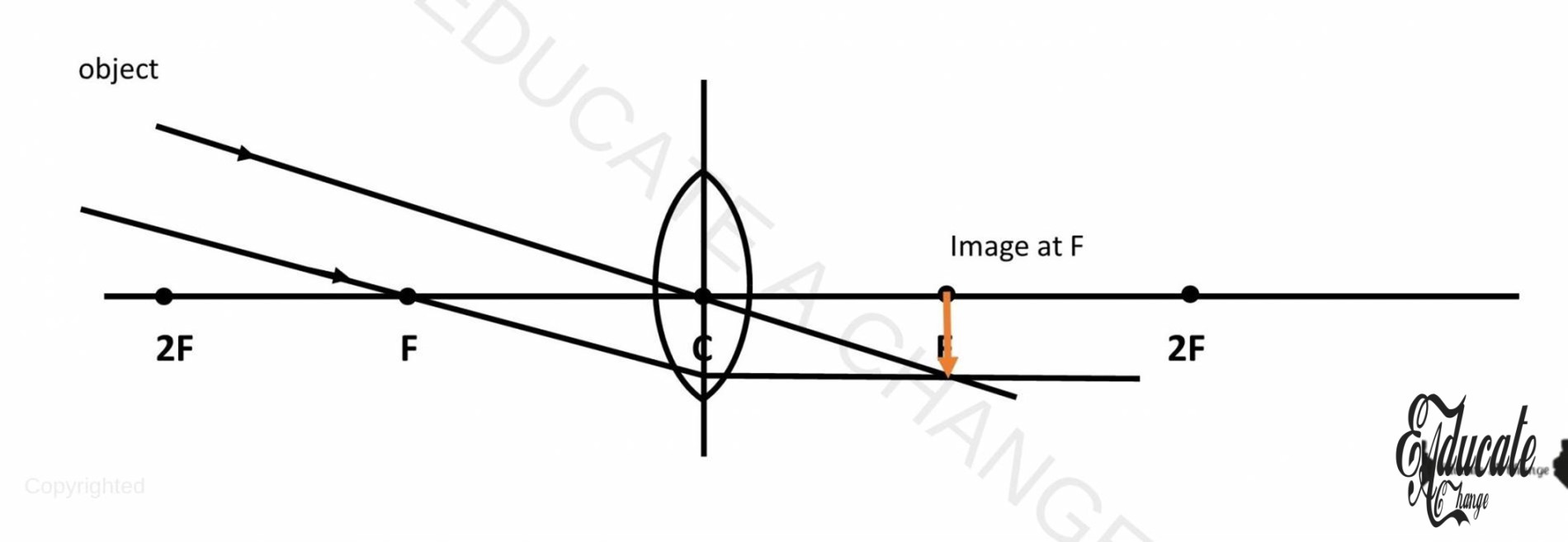
Case 1: Object on infinity:
- If we place an object on infinity or very far away, the image will be real, inverted and diminished and on F.
- This is used in telescopes since big planets can be diminished in size as image.
- U = ∞, v = F
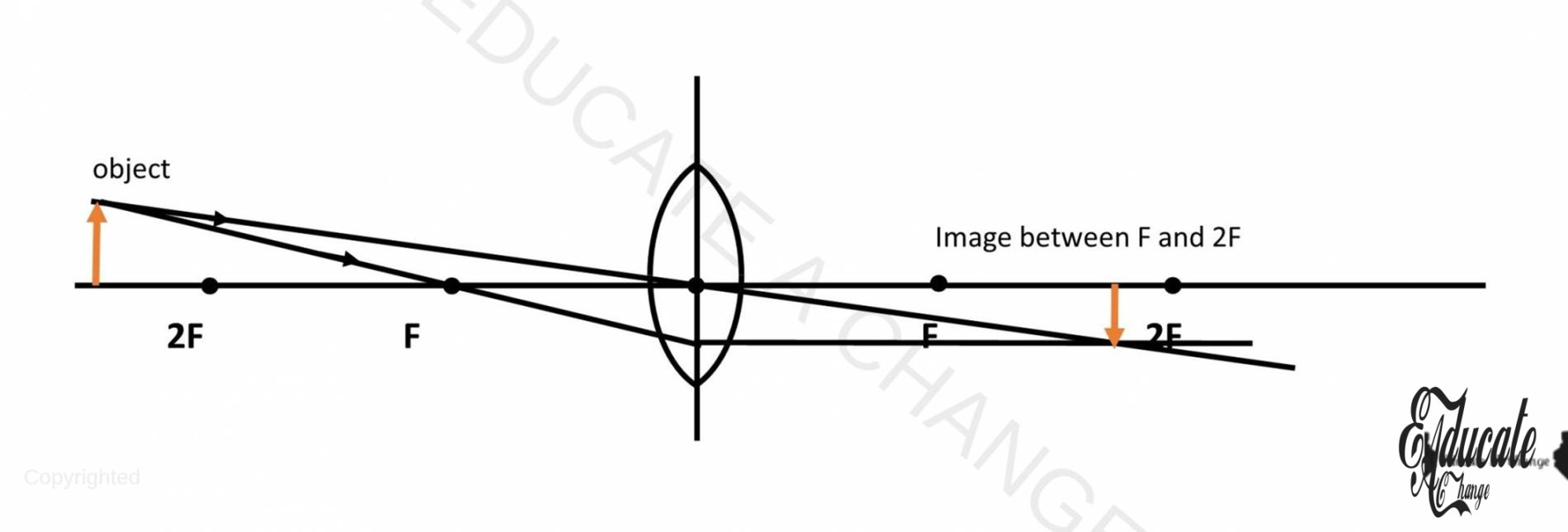
Case 2: Object away from 2F:
- If we place an object away from 2F, the image will be real, inverted and diminished and between F -2F.
- This is used in cameras and the same principle is used in our eyes.
- U >2F, F < V <2F
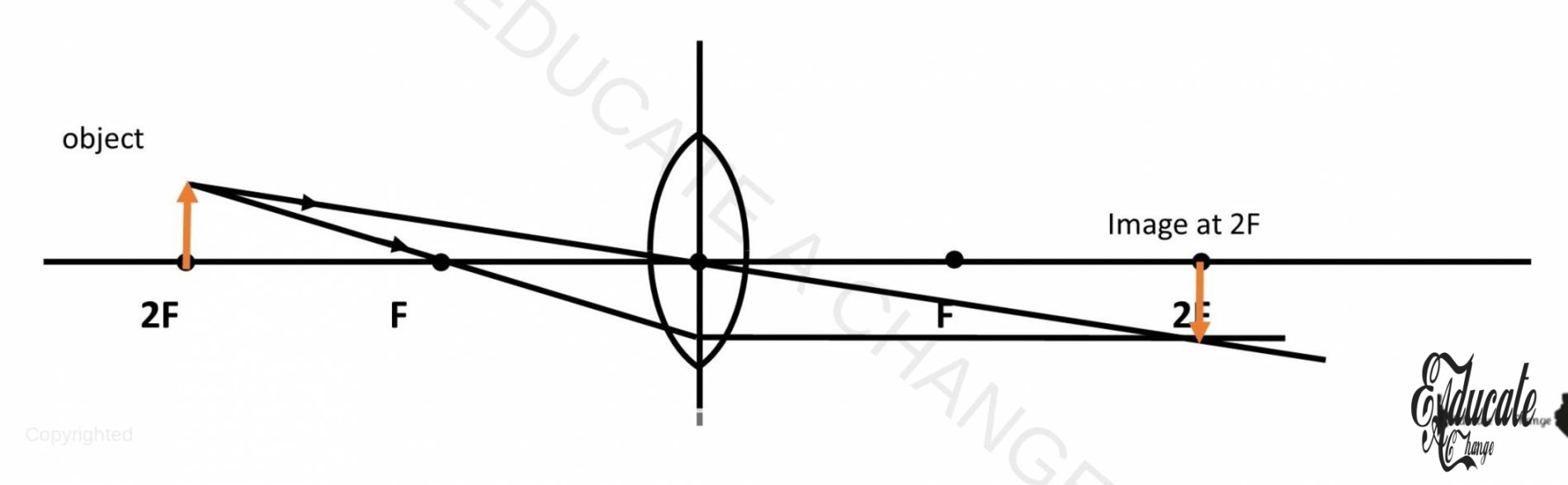
Case 3: Object on 2F:
- If we place an object on 2F, the image will be real, inverted and same sized on 2F.
- This is used in photocopiers to create same images of objects.
- U = 2F, V = 2F
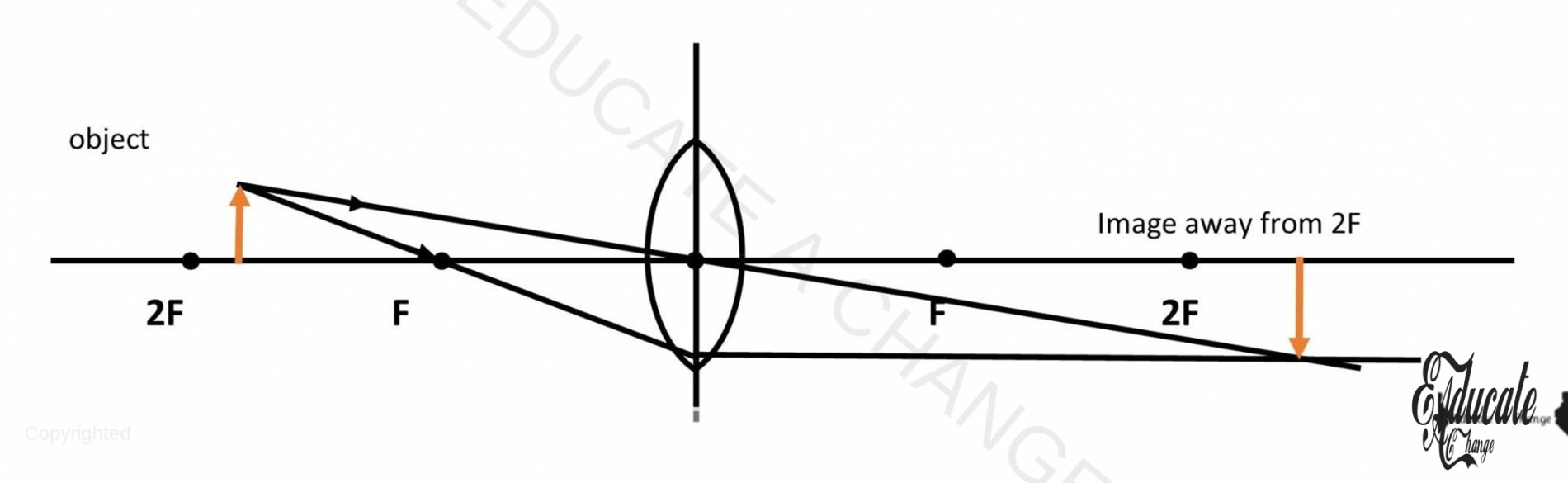
Case 4: Object between F and 2F:
- If we place an object between F and 2F, the image will be real, inverted and enlarged away from 2F.
- This is used in projectors to create larger images.
- F < U < 2F, V > 2F
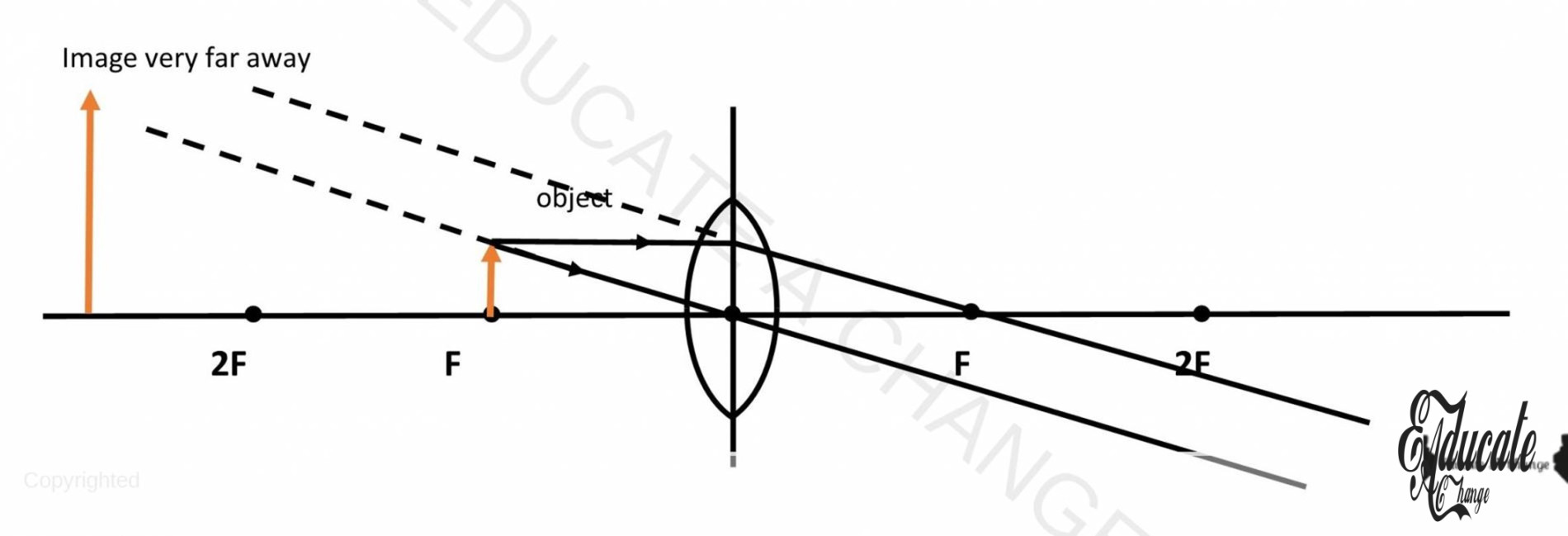
Case 5: Object on F:
- If we place an object on F, there won’t be any real image since the lines will become parallel and never meet. Only virtual image is created at a faraway place.
- This is used when we need parallel rays of light such as in studio lights or disco lights.
- U = F
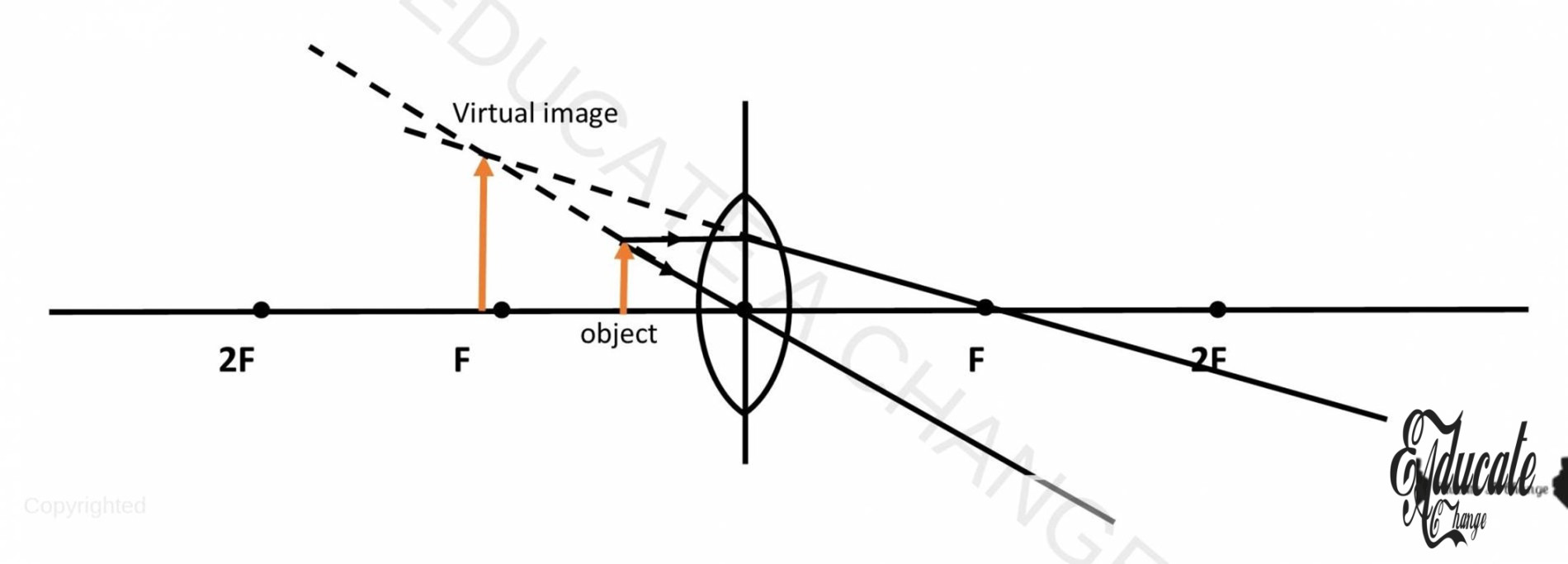
Case 6: Object between F and 2F:
- If we place an object between F and 2F, there won’t be any real image. However, our virtual image will be upright, and magnified.
- This is used in magnifying glass.
- U < F
Color Spectrum:
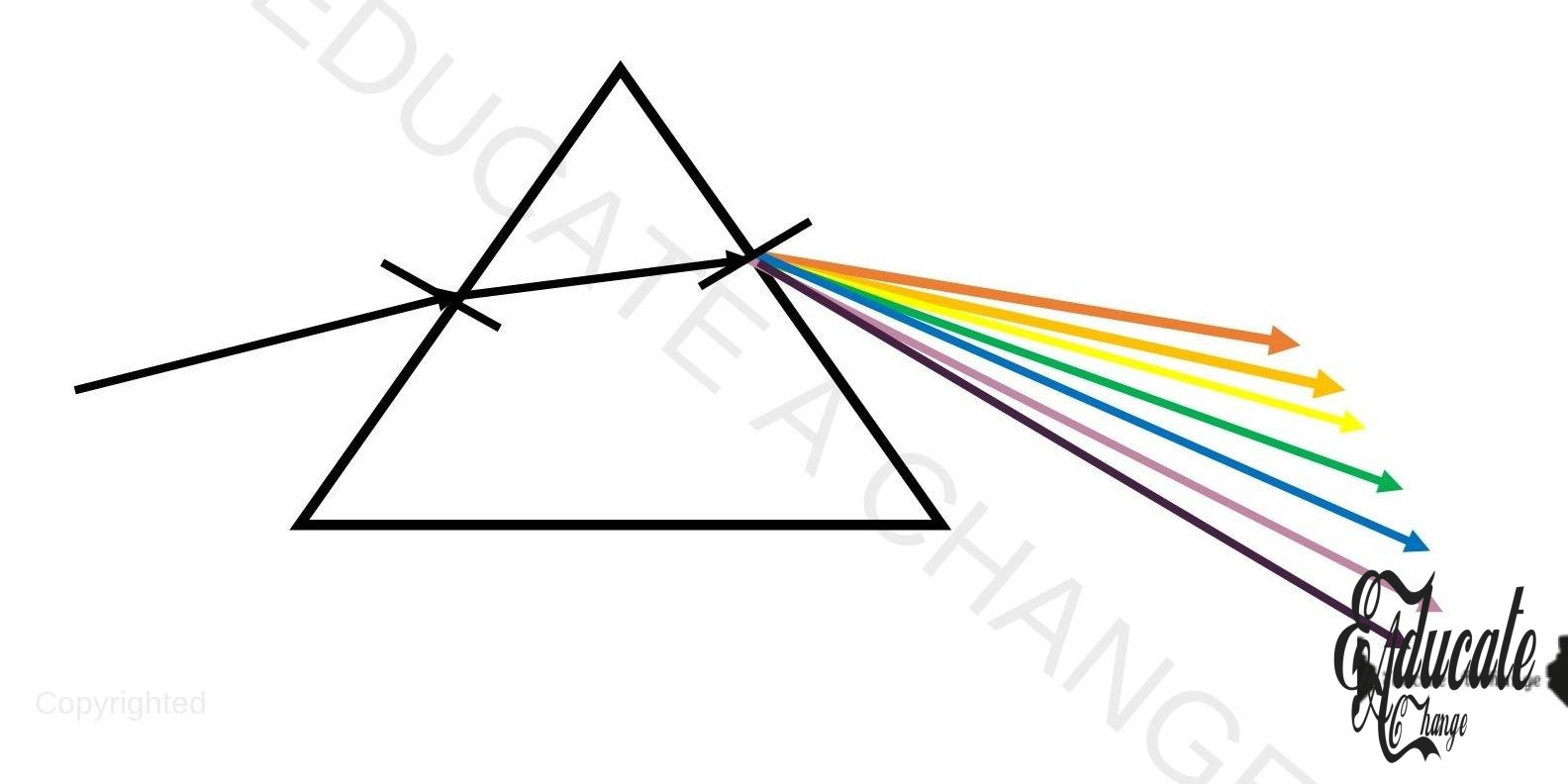
Different colors of light diverge with different angles when they hit a prism, causing white light to split into the rainbow colors. The order of diverging is as follows, starting from the least angle of deviation:
- Red
- Orange
- Yellow
- Green
- Blue
- Indigo
- Violet
Violet has the greatest angle of deviation.