
Permutations And Combinations (Copy)
New Notes
Definition of Factorial
- Factorial Notation:
- Represented by n!n!, where nn is a non-negative integer.
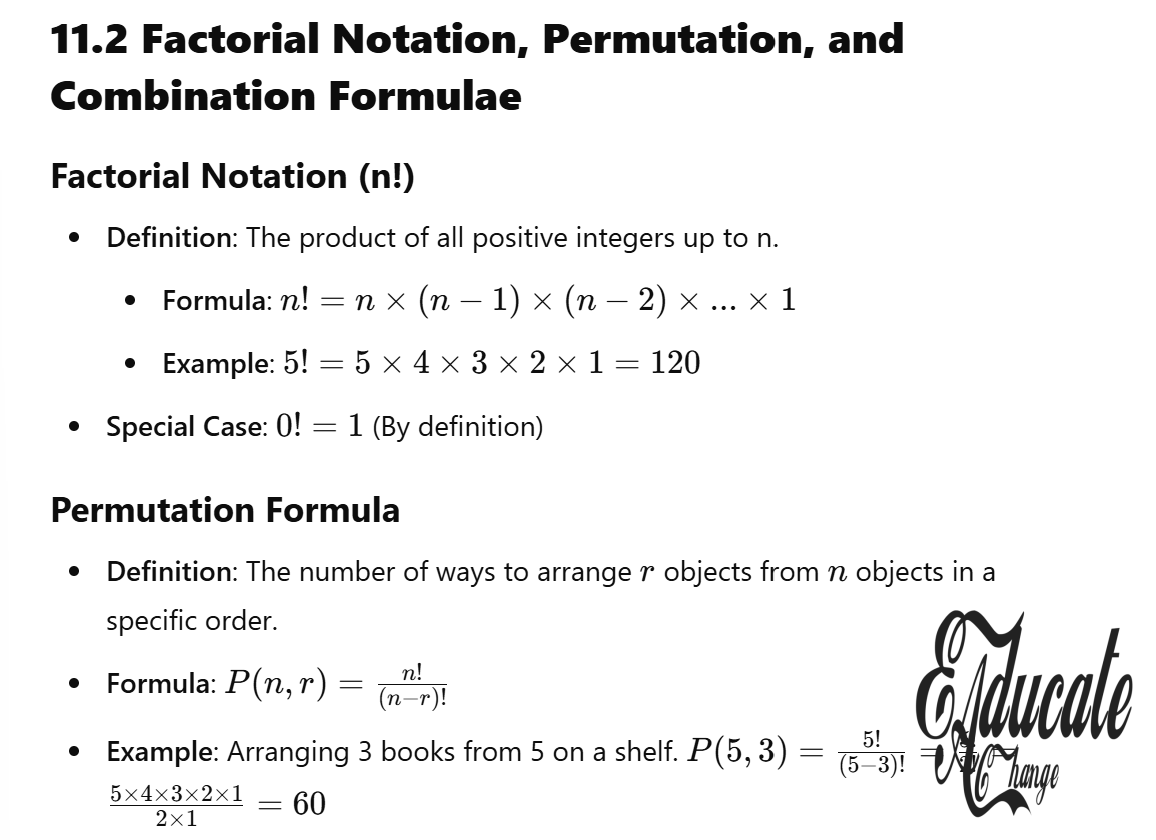
- Defined as the product of all positive integers from nn down to 11: n!=n×(n−1)×(n−2)×…×1n! = n times (n-1) times (n-2) times ldots times 1
- Special case: 0!=10! = 1 This is a convention used to maintain consistency in mathematical formulas.
Examples of Factorials
- Basic Calculations:
- 5!=5×4×3×2×1=1205! = 5 times 4 times 3 times 2 times 1 = 120
- 3!=3×2×1=63! = 3 times 2 times 1 = 6
- Worked Examples:
- Calculate 8!/3!8! / 3!: 8!=8×7×6×5×4×3×2×18! = 8 times 7 times 6 times 5 times 4 times 3 times 2 times 1 8!3!=8×7×6×5×4×3!3!=8×7×6×5×4=6720frac{8!}{3!} = frac{8 times 7 times 6 times 5 times 4 times 3!}{3!} = 8 times 7 times 6 times 5 times 4 = 6720
Key Properties of Factorials
- Recursive Formula:
- Any factorial can be expressed in terms of the previous factorial: n!=n×(n−1)!n! = n times (n-1)!
- Division of Factorials:
- Simplification of expressions involving factorials: n!(n−k)!=n×(n−1)×…×(n−k+1)frac{n!}{(n-k)!} = n times (n-1) times ldots times (n-k+1)
- Example: 7!5!=7×6=42frac{7!}{5!} = 7 times 6 = 42
- Combination with Factorials:
- Often used in permutations and combinations, where: (nr)=n!r!(n−r)!binom{n}{r} = frac{n!}{r!(n-r)!}
Applications of Factorials
- Permutations:
- The arrangement of nn items in sequence: P(n,r)=n!(n−r)!P(n, r) = frac{n!}{(n-r)!}
- Example:
- Number of ways to arrange 3 items out of 5: P(5,3)=5!(5−3)!=5×4×3×2×12×1=60P(5, 3) = frac{5!}{(5-3)!} = frac{5 times 4 times 3 times 2 times 1}{2 times 1} = 60
- Combinations:
- Selection of rr items from nn without regard to order: C(n,r)=n!r!(n−r)!C(n, r) = frac{n!}{r!(n-r)!}
- Example:
- Number of ways to choose 2 items from 4: C(4,2)=4!2!×(4−2)!=4×3×2×12×1×2×1=6C(4, 2) = frac{4!}{2! times (4-2)!} = frac{4 times 3 times 2 times 1}{2 times 1 times 2 times 1} = 6
Challenges with Large Factorials
- Factorials grow rapidly with nn, making them computationally intensive for large values.
- Examples:
- 10!=3,628,80010! = 3,628,800
- 20!=2,432,902,008,176,640,00020! = 2,432,902,008,176,640,000
Practical Problems and Solutions
- Simplification:
- To simplify large factorials, cancel common terms when dividing: n!(n−k)!=n×(n−1)×…×(n−k+1)frac{n!}{(n-k)!} = n times (n-1) times ldots times (n-k+1)
- Factorial Representation:
- Factorials can also be expressed in terms of repeated calculations: n!=n×(n−1)!n! = n times (n-1)!
- Using Factorials in Binomial Expansions:
- The coefficients in binomial expansion: (a+b)n=∑r=0n(nr)an−rbr(a+b)^n = sum_{r=0}^{n} binom{n}{r} a^{n-r} b^r
Worked Problems
Example 1: Factorial Simplification
Simplify:
9!7!frac{9!}{7!}
- Solution: Expand the factorials: 9!7!=9×8×7!7!=9×8=72frac{9!}{7!} = frac{9 times 8 times 7!}{7!} = 9 times 8 = 72
Example 2: Combination Problem
Find the number of ways to choose 3 items from 6 items.
- Solution: Use the combination formula: C(6,3)=6!3!×(6−3)!=6×5×43×2×1=20C(6, 3) = frac{6!}{3! times (6-3)!} = frac{6 times 5 times 4}{3 times 2 times 1} = 20
Exercises for Practice
- Calculate the following:
- 5!5!, 8!8!, 10!10!
- Simplify:
- 10!8!frac{10!}{8!}, 12!10!frac{12!}{10!}
- Solve for nn:
- n!(n−3)!=120frac{n!}{(n-3)!} = 120
- Find the number of permutations of 4 items from 7:
- P(7,4)P(7, 4)
- Compute the number of combinations of 5 items from 10:
- C(10,5)C(10, 5)
Conclusion
- Factorial notation simplifies the expression of large products.
- Widely used in probability, statistics, and algebra for permutations and combinations.
- Mastery of factorial properties and simplifications is critical for solving advanced mathematical problems.
Introduction to Arrangements
- Arrangements involve organizing a set of distinct items in a specific order.
- The concept of arrangements is a fundamental part of permutations in mathematics.
- Order of items is critical in arrangements; changing the order creates a different arrangement.
Key Concepts
Factorial Notation in Arrangements
- The total number of arrangements of nn distinct items in a line is given by: n!=n×(n−1)×(n−2)×…×1n! = n times (n-1) times (n-2) times ldots times 1
- Example:
- For 4 items: 4!=4×3×2×1=244! = 4 times 3 times 2 times 1 = 24
- Example:
Arranging a Subset of Items
- To arrange rr items from nn distinct items, use the formula: P(n,r)=n!(n−r)!P(n, r) = frac{n!}{(n-r)!}
- Example:
- For 3 items selected from 5: P(5,3)=5!(5−3)!=5×4×3×2×12×1=60P(5, 3) = frac{5!}{(5-3)!} = frac{5 times 4 times 3 times 2 times 1}{2 times 1} = 60
- Example:
Worked Examples
Example 1: Basic Arrangement
- Find the number of ways to arrange 3 books labeled AA, BB, and CC on a shelf.Solution:
- Using the factorial method: 3!=3×2×1=63! = 3 times 2 times 1 = 6
- Arrangements: ABC,ACB,BAC,BCA,CAB,CBAABC, ACB, BAC, BCA, CAB, CBA.
Example 2: Arranging Subsets
- Find the number of ways to arrange 2 letters from A,B,C,DA, B, C, D.Solution:
- Using the formula P(n,r)P(n, r): P(4,2)=4!(4−2)!=4×3×2×12×1=12P(4, 2) = frac{4!}{(4-2)!} = frac{4 times 3 times 2 times 1}{2 times 1} = 12
Applications of Arrangements
Arranging Items with Restrictions
- Sometimes arrangements involve specific conditions, such as fixing the position of one or more items.
Worked Example with Restrictions:
- Arrange the letters A,B,C,DA, B, C, D such that AA is always at the start.
- Fix AA in the first position, then arrange B,C,DB, C, D: 3!=63! = 6
- Total arrangements: ABCD,ABDC,ACBD,ACDB,ADBC,ADCBABCD, ABDC, ACBD, ACDB, ADBC, ADCB.
Special Cases in Arrangements
Items with Repetition
- If items are repeated, divide the total arrangements by the factorial of the repeated items: Total Arrangements=n!k1!⋅k2!⋅…text{Total Arrangements} = frac{n!}{k_1! cdot k_2! cdot ldots}
- Example:
- For the word MISSISSIPPIMISSISSIPPI: Total Letters=11,M=1, I=4, S=4, P=2text{Total Letters} = 11, quad M=1, , I=4, , S=4, , P=2 Arrangements=11!1!⋅4!⋅4!⋅2!text{Arrangements} = frac{11!}{1! cdot 4! cdot 4! cdot 2!}
- Example:
Circular Arrangements
- For nn items in a circle: Total Arrangements=(n−1)!text{Total Arrangements} = (n-1)!
Practice Problems
- Basic Factorial Calculation:
- Find 5!5! and 7!7!.
- Subsets of Arrangements:
- Calculate P(6,3)P(6, 3).
- Word Arrangements:
- How many ways can the letters of BANANABANANA be arranged?
- Restricted Arrangements:
- In how many ways can 5 people sit if two specific people must sit together?
Summary
- Arrangements are the ordered organization of items, governed by factorial notation and permutation formulas.
- Key distinctions include handling repetitions and applying restrictions.
- Practice builds familiarity with scenarios like arranging subsets or solving problems with restrictions.
Definition of Permutations
- Permutations:
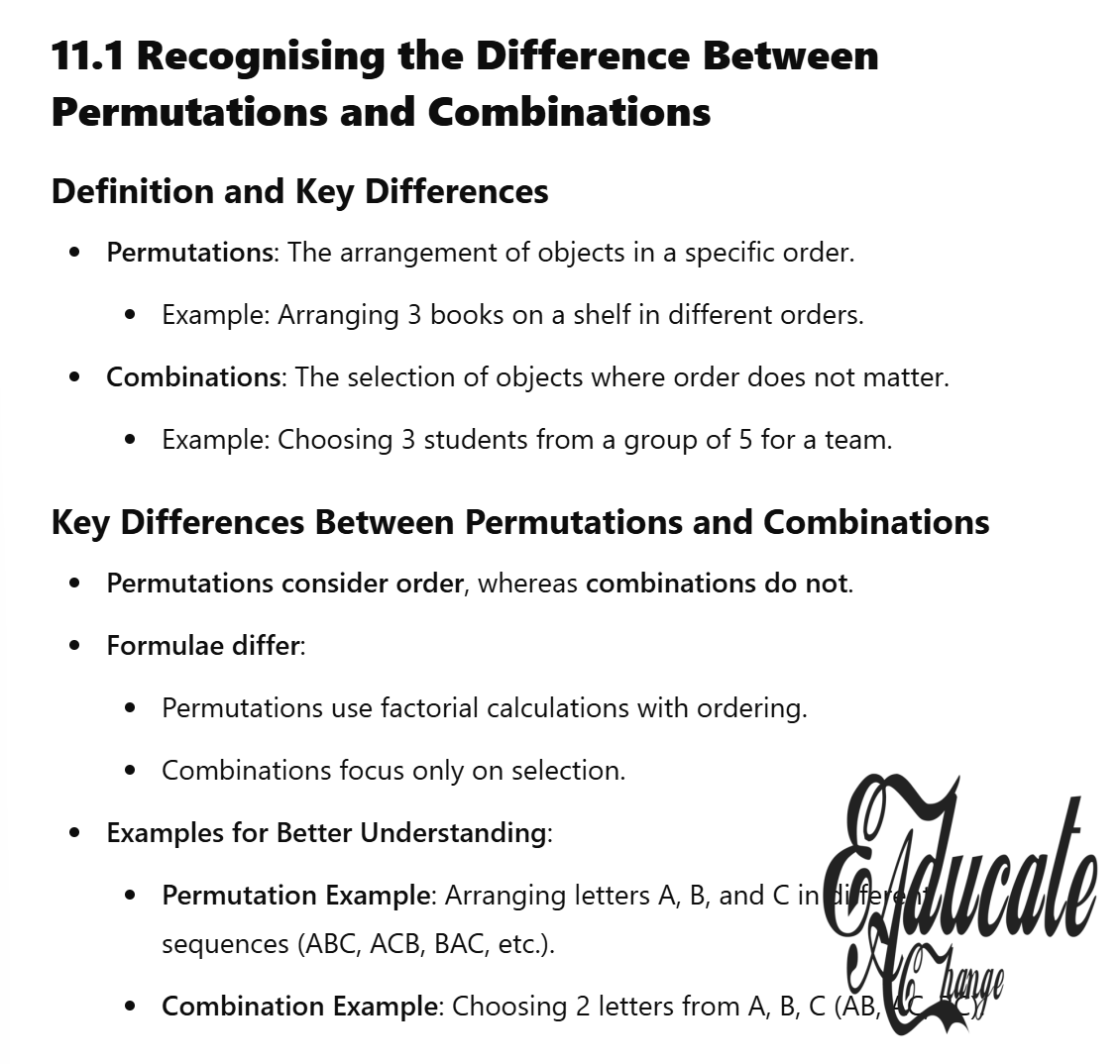
- The arrangement of a set of items where the order matters.
- Example: The arrangements of the letters A,B,CA, B, C are ABC,BAC,CAB,ACB,BCA,CBAABC, BAC, CAB, ACB, BCA, CBA.
- Notation:
- Represented as P(n,r)P(n, r) or nPr^nP_r.
- nn: Total number of items.
- rr: Number of items to arrange.
- Formula for Permutations:P(n,r)=n!(n−r)!P(n, r) = frac{n!}{(n – r)!}
- n!n!: The factorial of nn, defined as n×(n−1)×⋯×1n times (n – 1) times dots times 1.
- (n−r)!(n – r)!: Factorial of the difference between nn and rr.
Properties of Factorials
- Base Case:
- 0!=10! = 1: This is a convention to simplify factorial-based formulas.
- Explanation: A single item has exactly one way to be selected.
- Simplification:
- For any integer n>0n > 0: n!=n×(n−1)!n! = n times (n – 1)!
Worked Examples
Example 1: Calculating Permutations
Find the number of permutations of 3 items from a total of 8.
- Solution:
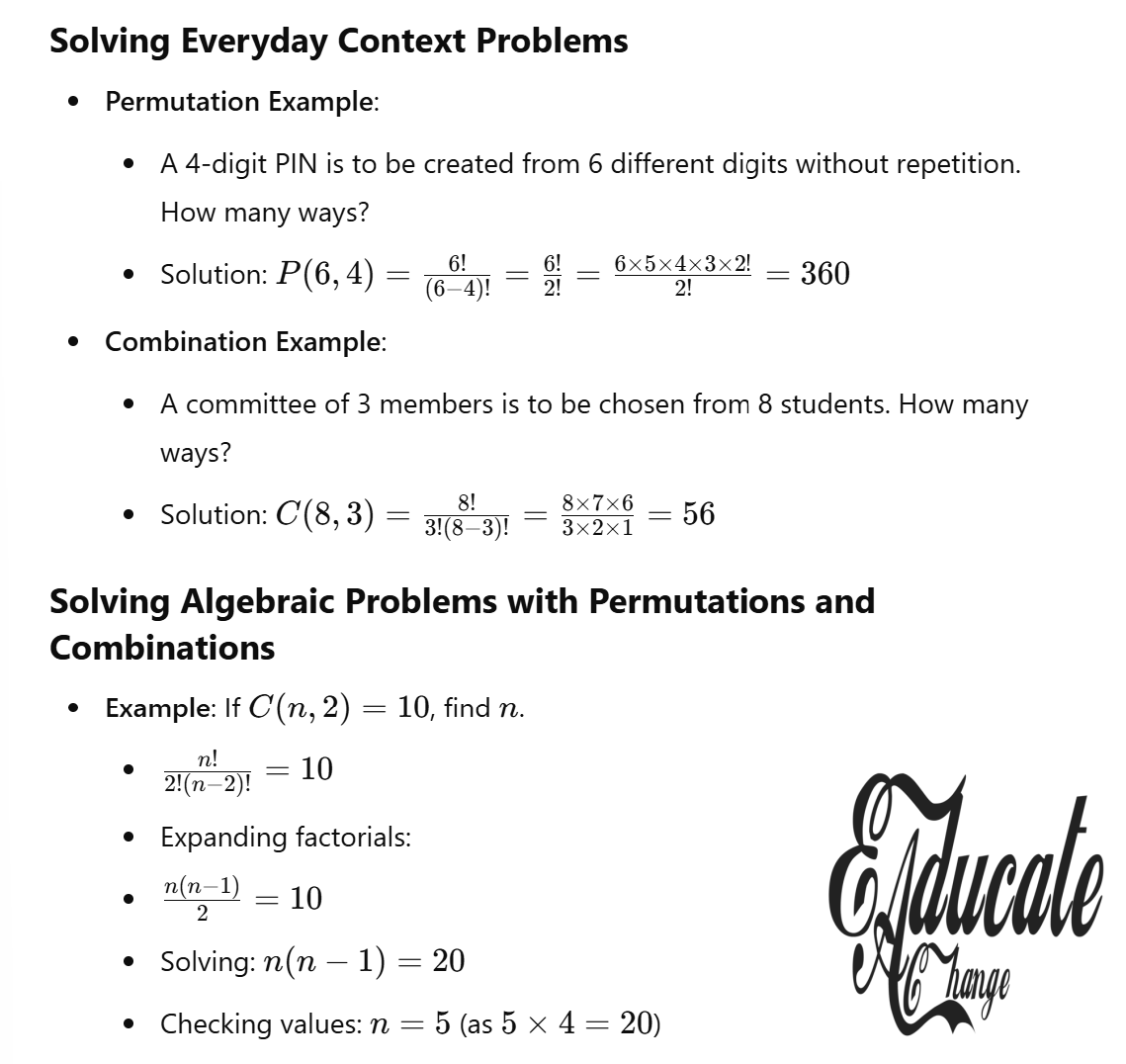
- Using the formula: P(8,3)=8!(8−3)!=8×7×6×5!5!P(8, 3) = frac{8!}{(8 – 3)!} = frac{8 times 7 times 6 times 5!}{5!}
- Cancel 5!5!: P(8,3)=8×7×6=336P(8, 3) = 8 times 7 times 6 = 336
Example 2: Permutations of All Items
Find the number of ways to arrange 6 items.
- Solution:
- Since all items are being arranged: P(6,6)=6!(6−6)!=6!0!=6!P(6, 6) = frac{6!}{(6 – 6)!} = frac{6!}{0!} = 6!
- Calculate: 6!=6×5×4×3×2×1=7206! = 6 times 5 times 4 times 3 times 2 times 1 = 720
Special Cases in Permutations
Case 1: Repeated Items
- If there are repeated items, divide by the factorial of the number of repetitions to avoid overcounting.
- Formula:Permutations with Repetition=n!p1!×p2!×⋯×pk!text{Permutations with Repetition} = frac{n!}{p_1! times p_2! times dots times p_k!}
- p1,p2,…,pkp_1, p_2, dots, p_k: Number of repeated items in each group.
- Example:
- Arrange the letters of “AAB”.
- Total letters = 3, repeated AA = 2.
- Permutations: 3!2!=62=3 (AAB, ABA, BAA).frac{3!}{2!} = frac{6}{2} = 3 , (text{AAB, ABA, BAA}).
Case 2: Circular Permutations
- For items arranged in a circle:Permutations=(n−1)!text{Permutations} = (n – 1)!
- Example:
- Arrange 4 people in a circle: Permutations=(4−1)!=3!=6.text{Permutations} = (4 – 1)! = 3! = 6.
Applications of Permutations
- Codes and Passwords:
- Used to calculate possible combinations of codes.
- Example:
- A password consists of 3 letters chosen from A,B,C,D,EA, B, C, D, E, followed by 2 digits chosen from 1,2,3,4,51, 2, 3, 4, 5.
- Total permutations: P(5,3)×P(5,2)=60×20=1200.P(5, 3) times P(5, 2) = 60 times 20 = 1200.
- Seating Arrangements:
- Calculating arrangements of people in rows or around tables.
Common Mistakes in Permutations
- Misidentifying Order:
- Ensure that the problem specifies the order of arrangement for permutations.
- Example: Arranging books on a shelf (order matters).
- Confusing with Combinations:
- Permutations consider the arrangement order, while combinations do not.
- Handling Repeated Items:
- Always divide by factorials of repeated items to avoid overcounting.
Exercises
- Find the number of permutations:
- P(7,4)P(7, 4),
- P(10,3)P(10, 3),
- Arrange 6 books on a shelf.
- A security code consists of 2 letters followed by 3 digits. How many codes can be generated if:
- No repetition is allowed?
- Letters and digits can repeat?
- Find the number of arrangements of the letters in “BANANA”.
Summary
- Permutations involve arranging items where order matters.
- Formula: P(n,r)=n!(n−r)!P(n, r) = frac{n!}{(n – r)!}
- Applications range from seating arrangements to generating codes and solving complex counting problems.
Introduction
- Combinations:
- A way to select items from a group where the order of selection does not matter.
- Commonly used in problems where arrangement or sequence is irrelevant.
- Key Difference from Permutations:
- In permutations, the arrangement matters.
- In combinations, only the selection matters.
General Formula for Combinations
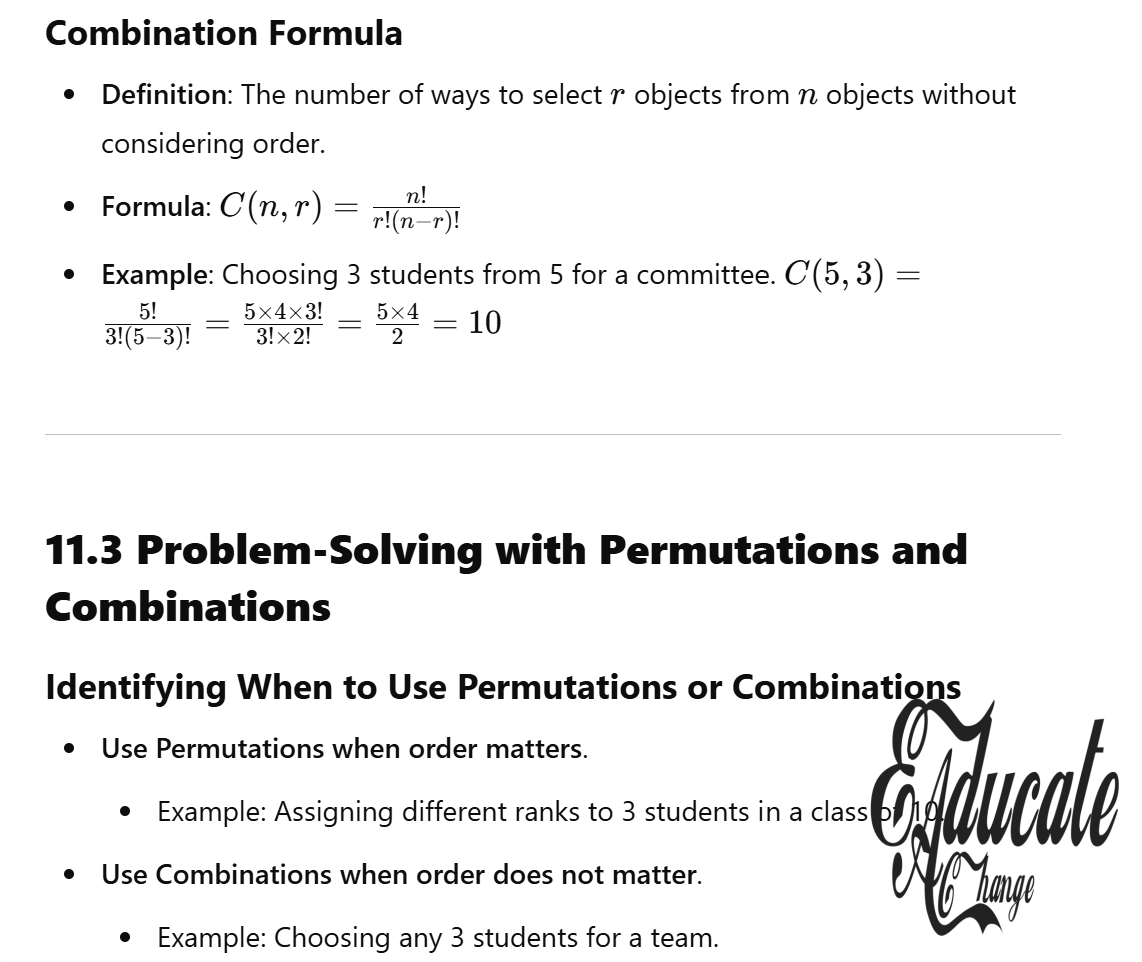
- Formula:C(n,r)=n!r!⋅(n−r)!C(n, r) = frac{n!}{r! cdot (n-r)!}
- C(n,r)C(n, r): Number of combinations (read as “n choose r”).
- n!n!: Factorial of the total number of items.
- r!r!: Factorial of the selected items.
- (n−r)!(n-r)!: Factorial of the remaining items.
- Properties:
- C(n,r)=C(n,n−r)C(n, r) = C(n, n-r): Choosing rr items from nn is the same as leaving n−rn-r items out.
- C(n,0)=1C(n, 0) = 1: There is only one way to choose nothing.
- C(n,n)=1C(n, n) = 1: There is only one way to choose all items.
Worked Examples
Example 1: Basic Combination
- Find the number of ways to choose 3 items from 5 items.
- Solution: C(5,3)=5!3!⋅(5−3)!=1206⋅2=10C(5, 3) = frac{5!}{3! cdot (5-3)!} = frac{120}{6 cdot 2} = 10
Example 2: Team Selection
- A team of 4 is chosen from 6 players. Find the total number of teams.
- Solution: C(6,4)=6!4!⋅2!=72024⋅2=15C(6, 4) = frac{6!}{4! cdot 2!} = frac{720}{24 cdot 2} = 15
Example 3: Complement Property
- Verify C(10,3)=C(10,7)C(10, 3) = C(10, 7).
- Solution:
- C(10,3)=10!3!⋅7!=120C(10, 3) = frac{10!}{3! cdot 7!} = 120.
- C(10,7)=10!7!⋅3!=120C(10, 7) = frac{10!}{7! cdot 3!} = 120.
- Solution:
Applications of Combinations
1. Selecting Groups
- Problem:
- A committee of 5 people is to be chosen from 10 members. How many ways can this be done?
- Solution: C(10,5)=10!5!⋅5!=252C(10, 5) = frac{10!}{5! cdot 5!} = 252
2. Subset Selection
- Problem:
- How many subsets of size 3 can be formed from a set of 7 items?
- Solution: C(7,3)=7!3!⋅4!=35C(7, 3) = frac{7!}{3! cdot 4!} = 35
3. Combinatorial Proofs
- Property:
- Show that C(n,r)+C(n,r+1)=C(n+1,r+1)C(n, r) + C(n, r+1) = C(n+1, r+1).
- Proof: Expand the combinations using factorials and verify equality.
Special Cases in Combinations
- Zero and All Selection:
- C(n,0)=1C(n, 0) = 1: Only one way to choose nothing.
- C(n,n)=1C(n, n) = 1: Only one way to choose everything.
- Repetition in Selection:
- When items can be repeated, a different formula is used (not covered under simple combinations).
Advanced Examples
Example 4: Conditional Selection
- A group of 7 includes 4 men and 3 women. Find the number of ways to choose 2 men and 2 women.
- Solution: C(4,2)⋅C(3,2)=4!2!⋅2!⋅3!2!⋅1!=6⋅3=18C(4, 2) cdot C(3, 2) = frac{4!}{2! cdot 2!} cdot frac{3!}{2! cdot 1!} = 6 cdot 3 = 18
Example 5: Combined Groups
- A committee of 5 is formed from 6 doctors and 4 engineers. Find the number of ways if at least 3 must be engineers.
- Solution:
- Case 1: 3 engineers, 2 doctors: C(4,3)⋅C(6,2)=4⋅15=60C(4, 3) cdot C(6, 2) = 4 cdot 15 = 60
- Case 2: 4 engineers, 1 doctor: C(4,4)⋅C(6,1)=1⋅6=6C(4, 4) cdot C(6, 1) = 1 cdot 6 = 6
- Total: 60+6=6660 + 6 = 66
- Solution:
Visual Representation
- Use Pascal’s triangle for combinations:
- Each row corresponds to nn.
- Each entry is C(n,r)C(n, r).
- Example for n=4n = 4: C(4,0),C(4,1),C(4,2),C(4,3),C(4,4)=1,4,6,4,1C(4, 0), C(4, 1), C(4, 2), C(4, 3), C(4, 4) = 1, 4, 6, 4, 1
Practice Problems
- Calculate:
- C(8,3)C(8, 3),
- C(12,5)C(12, 5).
- Solve:
- How many ways can 4 books be chosen from 10 books?
- How many groups of 3 students can be formed from a class of 15?
- Prove:
- C(n,r)=C(n,n−r)C(n, r) = C(n, n-r).
- ∑r=0nC(n,r)=2nsum_{r=0}^{n} C(n, r) = 2^n.
Summary
- Combinations provide a systematic way to count selections without considering the order.
- The formula: C(n,r)=n!r!⋅(n−r)!C(n, r) = frac{n!}{r! cdot (n-r)!} simplifies calculations and supports real-world problem-solving in grouping and selections.
- Mastery of combinations requires understanding their properties and relationships, such as symmetry and Pascal’s triangle.