
Series (Copy)
New Notes
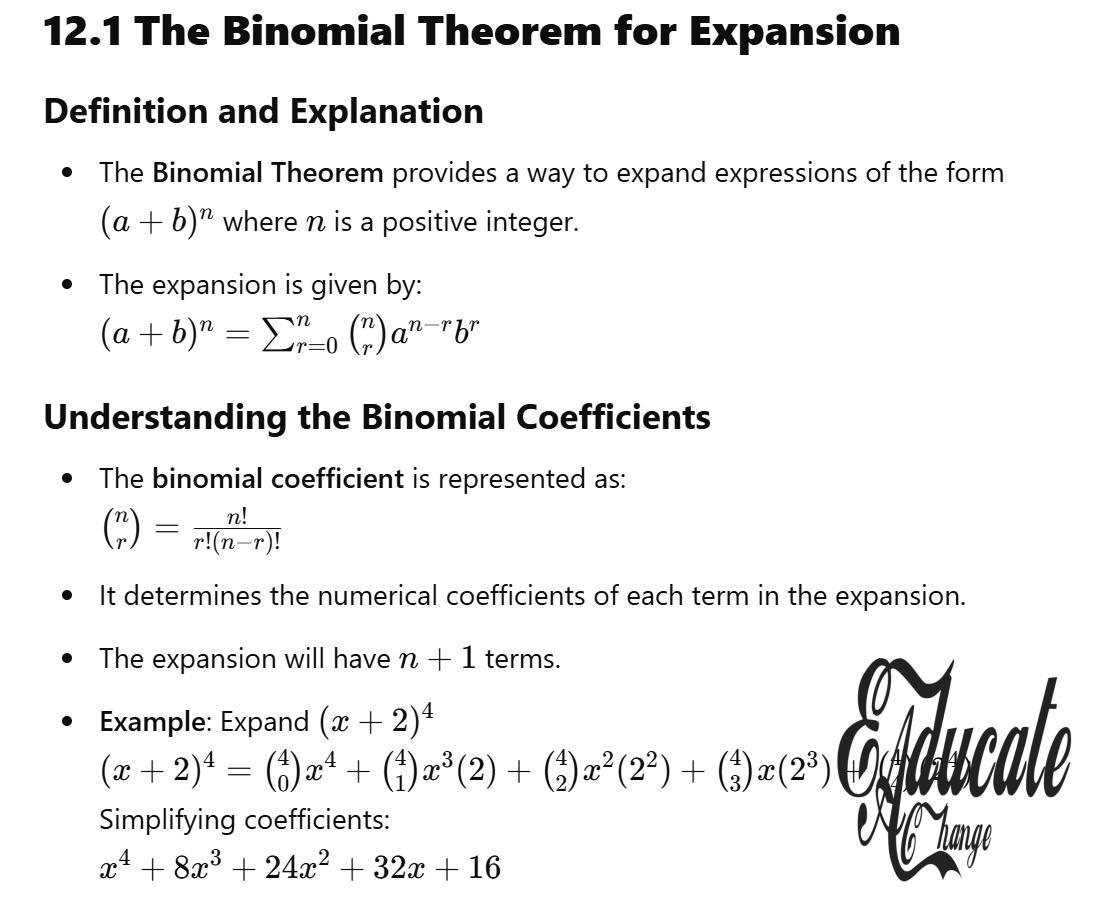

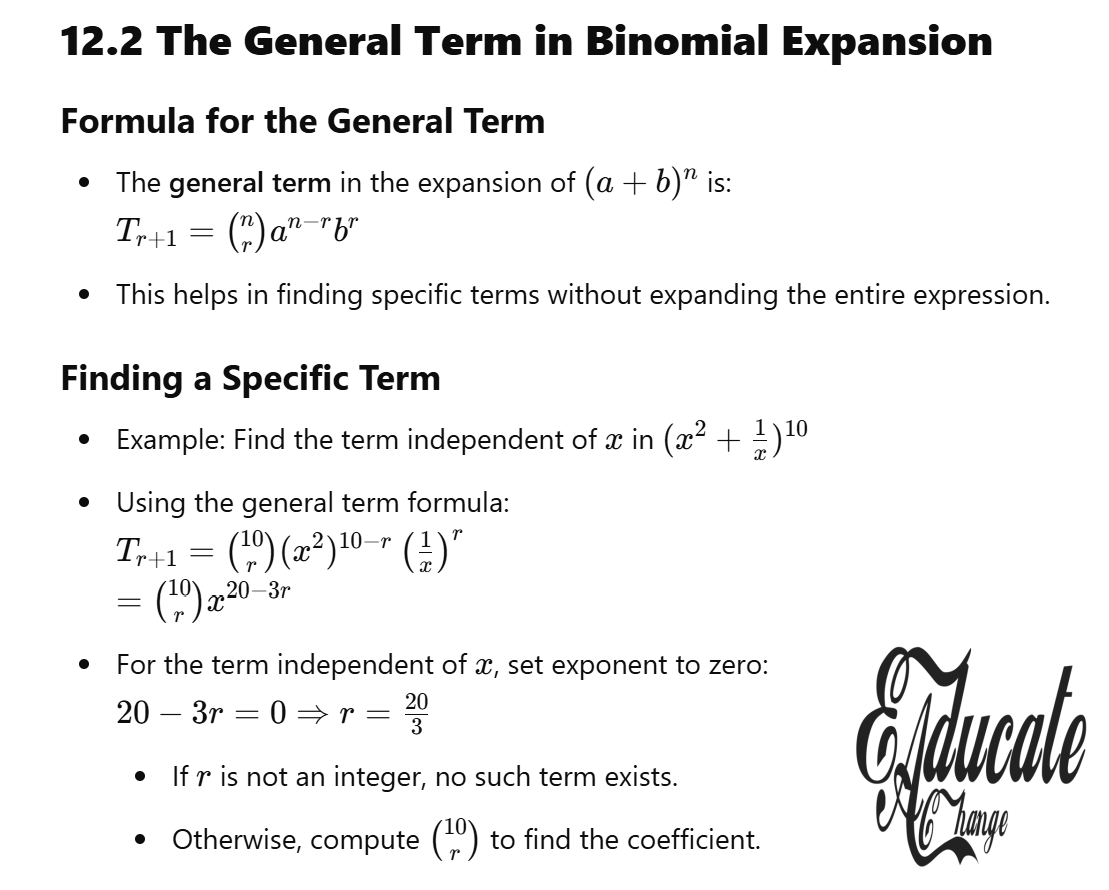
Introduction to Pascal’s Triangle
- Definition:
- Pascal’s Triangle is a triangular array of numbers where each row corresponds to the coefficients of the binomial expansion.
- It provides a visual representation and structure for combinations and powers of binomial expressions.
- Formation Rules:
- Each row starts and ends with the number 1.
- Each internal number is the sum of the two numbers directly above it in the previous row.
Example:
- First few rows of Pascal’s Triangle:
Row 0:          1
Row 1:         1   1
Row 2:        1   2   1
Row 3:       1   3   3   1
Row 4:      1   4   6   4   1
Connection to Binomial Expansion
- Binomial Expression:
- The coefficients in the expansion of (a+b)n(a + b)^n are derived from the nnth row of Pascal’s Triangle.
- General Expansion Formula: (a+b)n=∑k=0n(nk)an−kbk(a + b)^n = sum_{k=0}^n binom{n}{k} a^{n-k} b^k where:
- (nk)=n!k!(n−k)!binom{n}{k} = frac{n!}{k!(n-k)!}, the kkth element in the nnth row of Pascal’s Triangle.
Example of Binomial Expansion Using Pascal’s Triangle:
- For (a+b)3(a + b)^3:
- Coefficients from Row 3: 1,3,3,11, 3, 3, 1.
- Expansion: (a+b)3=a3+3a2b+3ab2+b3(a + b)^3 = a^3 + 3a^2b + 3ab^2 + b^3
Patterns in Pascal’s Triangle
- Symmetry:
- Each row is symmetrical. For example:
- Row 4: 1,4,6,4,11, 4, 6, 4, 1.
- Each row is symmetrical. For example:
- Sum of Rows:
- The sum of the elements in the nnth row is 2n2^n.
- Example:
- Row 3: 1+3+3+1=8=231 + 3 + 3 + 1 = 8 = 2^3.
- Powers of 2:
- Each row represents the powers of 2:
- 20,21,22,…2^0, 2^1, 2^2, ldots.
- Each row represents the powers of 2:
- Triangular Numbers:
- The second diagonal contains triangular numbers: 1,3,6,10,…1, 3, 6, 10, ldots
- Combinatorial Properties:
- Each element represents the number of combinations:
- (nk)binom{n}{k}, where kk is the column index.
- Each element represents the number of combinations:
Applications of Pascal’s Triangle
- Binomial Theorem:
- Simplifies the expansion of powers of binomials.
- Probability and Combinations:
- Used to calculate probabilities in binomial distributions.
- Geometry:
- Contains patterns such as triangular and tetrahedral numbers.
- Pascal’s Identity:
- (nk)=(n−1k−1)+(n−1k)binom{n}{k} = binom{n-1}{k-1} + binom{n-1}{k}.
Worked Examples
Example 1: Expanding a Binomial Using Pascal’s Triangle
- Expand (2+x)4(2 + x)^4.
- Coefficients from Row 4: 1,4,6,4,11, 4, 6, 4, 1.
- Expansion: (2+x)4=1(2)4+4(2)3x+6(2)2×2+4(2)x3+1×4(2 + x)^4 = 1(2)^4 + 4(2)^3x + 6(2)^2x^2 + 4(2)x^3 + 1x^4 =16+32x+24×2+8×3+x4= 16 + 32x + 24x^2 + 8x^3 + x^4
Example 2: Calculating a Specific Coefficient
- Find the coefficient of x3x^3 in (1+2x)5(1 + 2x)^5.
- Row 5: 1,5,10,10,5,11, 5, 10, 10, 5, 1.
- Coefficient of x3x^3: 10×(1)2×(2x)3=10×1×8×3=80×310 times (1)^2 times (2x)^3 = 10 times 1 times 8x^3 = 80x^3
- Coefficient: 8080.
Exercise Ideas
- Write the next two rows of Pascal’s Triangle.
- Expand (3−x)3(3 – x)^3 using Pascal’s Triangle.
- Prove the symmetry property of Pascal’s Triangle using the binomial theorem.
Classroom Discussion
- Explore patterns such as sums of rows, triangular numbers, and Fibonacci numbers.
- Relate Pascal’s Triangle to real-life problems involving combinations and probabilities.
Summary
- Pascal’s Triangle is a foundational tool in mathematics, offering insights into binomial expansions, combinatorics, and geometry.
- Understanding its patterns and properties facilitates problem-solving in algebra, probability, and beyond.
Introduction to Pascal’s Triangle
- Definition:
- Pascal’s Triangle is a triangular array of numbers where each row corresponds to the coefficients of the binomial expansion.
- It provides a visual representation and structure for combinations and powers of binomial expressions.
- Formation Rules:
- Each row starts and ends with the number 1.
- Each internal number is the sum of the two numbers directly above it in the previous row.
Example:
- First few rows of Pascal’s Triangle:
Row 0:          1
Row 1:         1   1
Row 2:        1   2   1
Row 3:       1   3   3   1
Row 4:      1   4   6   4   1
Connection to Binomial Expansion
- Binomial Expression:
- The coefficients in the expansion of (a+b)n(a + b)^n are derived from the nnth row of Pascal’s Triangle.
- General Expansion Formula: (a+b)n=∑k=0n(nk)an−kbk(a + b)^n = sum_{k=0}^n binom{n}{k} a^{n-k} b^k where:
- (nk)=n!k!(n−k)!binom{n}{k} = frac{n!}{k!(n-k)!}, the kkth element in the nnth row of Pascal’s Triangle.
Example of Binomial Expansion Using Pascal’s Triangle:
- For (a+b)3(a + b)^3:
- Coefficients from Row 3: 1,3,3,11, 3, 3, 1.
- Expansion: (a+b)3=a3+3a2b+3ab2+b3(a + b)^3 = a^3 + 3a^2b + 3ab^2 + b^3
Patterns in Pascal’s Triangle
- Symmetry:
- Each row is symmetrical. For example:
- Row 4: 1,4,6,4,11, 4, 6, 4, 1.
- Each row is symmetrical. For example:
- Sum of Rows:
- The sum of the elements in the nnth row is 2n2^n.
- Example:
- Row 3: 1+3+3+1=8=231 + 3 + 3 + 1 = 8 = 2^3.
- Powers of 2:
- Each row represents the powers of 2:
- 20,21,22,…2^0, 2^1, 2^2, ldots.
- Each row represents the powers of 2:
- Triangular Numbers:
- The second diagonal contains triangular numbers: 1,3,6,10,…1, 3, 6, 10, ldots
- Combinatorial Properties:
- Each element represents the number of combinations:
- (nk)binom{n}{k}, where kk is the column index.
- Each element represents the number of combinations:
Applications of Pascal’s Triangle
- Binomial Theorem:
- Simplifies the expansion of powers of binomials.
- Probability and Combinations:
- Used to calculate probabilities in binomial distributions.
- Geometry:
- Contains patterns such as triangular and tetrahedral numbers.
- Pascal’s Identity:
- (nk)=(n−1k−1)+(n−1k)binom{n}{k} = binom{n-1}{k-1} + binom{n-1}{k}.
Worked Examples
Example 1: Expanding a Binomial Using Pascal’s Triangle
- Expand (2+x)4(2 + x)^4.
- Coefficients from Row 4: 1,4,6,4,11, 4, 6, 4, 1.
- Expansion: (2+x)4=1(2)4+4(2)3x+6(2)2×2+4(2)x3+1×4(2 + x)^4 = 1(2)^4 + 4(2)^3x + 6(2)^2x^2 + 4(2)x^3 + 1x^4 =16+32x+24×2+8×3+x4= 16 + 32x + 24x^2 + 8x^3 + x^4
Example 2: Calculating a Specific Coefficient
- Find the coefficient of x3x^3 in (1+2x)5(1 + 2x)^5.
- Row 5: 1,5,10,10,5,11, 5, 10, 10, 5, 1.
- Coefficient of x3x^3: 10×(1)2×(2x)3=10×1×8×3=80×310 times (1)^2 times (2x)^3 = 10 times 1 times 8x^3 = 80x^3
- Coefficient: 8080.
Exercise Ideas
- Write the next two rows of Pascal’s Triangle.
- Expand (3−x)3(3 – x)^3 using Pascal’s Triangle.
- Prove the symmetry property of Pascal’s Triangle using the binomial theorem.
Classroom Discussion
- Explore patterns such as sums of rows, triangular numbers, and Fibonacci numbers.
- Relate Pascal’s Triangle to real-life problems involving combinations and probabilities.
Summary
- Pascal’s Triangle is a foundational tool in mathematics, offering insights into binomial expansions, combinatorics, and geometry.
- Understanding its patterns and properties facilitates problem-solving in algebra, probability, and beyond.
Introduction
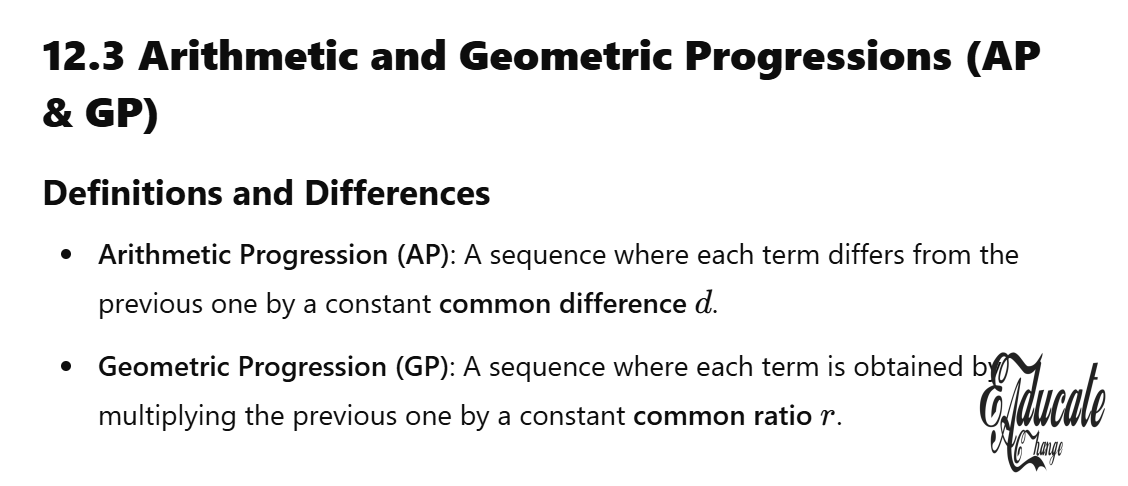
- Arithmetic Progression (AP):
- A sequence of numbers where each term after the first is obtained by adding a constant value (common difference) to the previous term.
- Examples:
- 5,8,11,14,…5, 8, 11, 14, ldots (common difference = 33).
- 10,7,4,1,…10, 7, 4, 1, ldots (common difference = −3-3).
Key Components of an AP
- First Term (aa):
- The initial value of the sequence.
- Common Difference (dd):
- The constant value added to each term to obtain the next term.
- Formula: d=Second Term−First Termd = text{Second Term} – text{First Term}
- General Form:
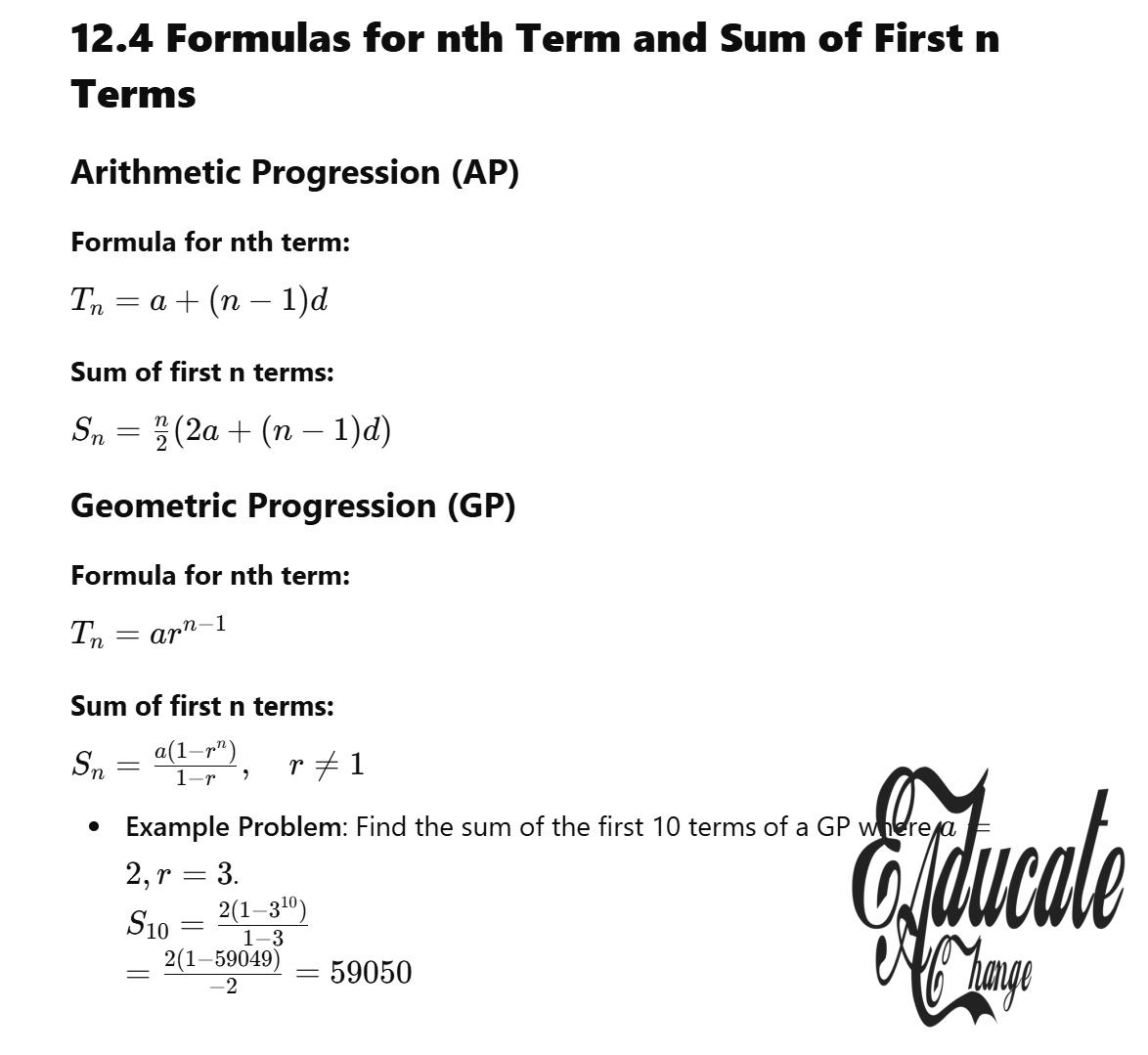
- The nn-th term (TnT_n) of an AP: Tn=a+(n−1)dT_n = a + (n-1)d
Examples and Applications
Example 1: Finding the Common Difference
- Sequence: 7,13,19,…7, 13, 19, ldots.
- Solution: d=13−7=6d = 13 – 7 = 6
Example 2: Calculating the 10th Term
- Given:
- First term (aa) = 44,
- Common difference (dd) = 33.
- Find T10T_{10}.
- Solution: T10=a+(10−1)d=4+9⋅3=31T_{10} = a + (10-1)d = 4 + 9 cdot 3 = 31
Sum of an AP
- Sum of the First nn Terms (SnS_n):
- Formula:Sn=n2(a+l)S_n = frac{n}{2}(a + l)where:
- ll: Last term (l=a+(n−1)dl = a + (n-1)d).
- Alternate Formula:Sn=n2[2a+(n−1)d]S_n = frac{n}{2}[2a + (n-1)d]
- Formula:Sn=n2(a+l)S_n = frac{n}{2}(a + l)where:
- Derivation of Formula:
- Add the series forwards and backwards: Sn=a+(a+d)+(a+2d)+…+lS_n = a + (a + d) + (a + 2d) + ldots + l Sn=l+(l−d)+(l−2d)+…+aS_n = l + (l – d) + (l – 2d) + ldots + a Adding these equations eliminates the common difference, leading to: 2Sn=n(a+l)2S_n = n(a + l)
Worked Examples
Example 3: Calculating the Sum
- Find the sum of the first 10 terms of the AP: 3,7,11,…3, 7, 11, ldots.
- Solution:
- First term (aa) = 33,
- Common difference (dd) = 7−3=47 – 3 = 4,
- Number of terms (nn) = 1010.
- Use the sum formula: Sn=n2[2a+(n−1)d]S_n = frac{n}{2}[2a + (n-1)d] Substitute values: S10=102[2(3)+(10−1)(4)]=5[6+36]=5⋅42=210S_{10} = frac{10}{2}[2(3) + (10-1)(4)] = 5[6 + 36] = 5 cdot 42 = 210
Example 4: Finding the Number of Terms
- Given:
- First term (aa) = 22,
- Common difference (dd) = 33,
- Last term (ll) = 5050.
- Find nn.
- Solution:
- Use the nn-th term formula: l=a+(n−1)dl = a + (n-1)d Rearrange to find nn: n=l−ad+1=50−23+1=17n = frac{l – a}{d} + 1 = frac{50 – 2}{3} + 1 = 17
Special Cases in Arithmetic Progression
- Finding Missing Terms:
- If some terms are missing in the sequence, use the nn-th term formula to solve for the unknowns.
- Reverse Progression:
- A sequence where the common difference is negative.
Applications of Arithmetic Progressions
- Real-World Problems:
- Calculating loan repayments.
- Determining cumulative growth or decline.
- Solving problems involving consecutive integers.
- Problem Example:
- A ladder with 10 steps has a height difference of 5 cm between each step. The first step is 15 cm high. Find the height of the 10th step.
- Solution: T10=a+(n−1)d=15+(10−1)(5)=15+45=60 cm.T_{10} = a + (n-1)d = 15 + (10-1)(5) = 15 + 45 = 60 , text{cm}.
Practice Problems
- Find the 15th term of the sequence 2,5,8,…2, 5, 8, ldots.
- Determine the sum of the first 20 terms of the sequence 10,20,30,…10, 20, 30, ldots.
- If the first term is 77 and the 10th term is 3434, find the common difference.
- Solve for nn if a=3a = 3, d=4d = 4, and Sn=150S_n = 150.
Summary
- Arithmetic Progression is a foundational concept in sequences and series.
- Key formulas:
- Tn=a+(n−1)dT_n = a + (n-1)d,
- Sn=n2(a+l)S_n = frac{n}{2}(a + l) or Sn=n2[2a+(n−1)d]S_n = frac{n}{2}[2a + (n-1)d].
- Applications span multiple domains, from theoretical problems to practical real-life scenarios.
Introduction
- A geometric progression (GP) is a sequence of numbers where each term after the first is obtained by multiplying the previous term by a constant factor called the common ratio (rr).
- Example: 2,6,18,54,…2, 6, 18, 54, ldots (r=3r = 3).
- Key notation:
- aa: The first term of the sequence.
- rr: The common ratio.
- General form: Terms: a,ar,ar2,ar3,…text{Terms: } a, ar, ar^2, ar^3, ldots n-th term: Tn=arn−1.text{n-th term: } T_n = ar^{n-1}.
Formulae for Key Calculations
- Finding the n-th Term:Tn=arn−1T_n = ar^{n-1}
- Example:
- Find the 5th term of a GP where a=3a = 3 and r=2r = 2. T5=3⋅25−1=3⋅16=48T_5 = 3 cdot 2^{5-1} = 3 cdot 16 = 48
- Example:
- Sum of the First nn Terms:
- For r≠1r neq 1:Sn=a1−rn1−rS_n = a frac{1 – r^n}{1 – r}
- For r=1r = 1:Sn=naS_n = na
- Example:
- Find the sum of the first 4 terms of a GP where a=5a = 5 and r=3r = 3: S4=51−341−3=51−81−2=5⋅40=200S_4 = 5 frac{1 – 3^4}{1 – 3} = 5 frac{1 – 81}{-2} = 5 cdot 40 = 200
- Sum to Infinity:
- For −1<r<1-1 < r < 1:S∞=a1−rS_infty = frac{a}{1 – r}
- Example:
- Find the sum to infinity for a GP where a=8a = 8 and r=0.5r = 0.5: S∞=81−0.5=80.5=16S_infty = frac{8}{1 – 0.5} = frac{8}{0.5} = 16
Types of Geometric Progressions
- Finite GP:
- A sequence with a fixed number of terms.
- Example: 3,6,12,243, 6, 12, 24 (4 terms).
- Infinite GP:
- A sequence with infinitely many terms.
- Example: 1,12,14,18,…1, frac{1}{2}, frac{1}{4}, frac{1}{8}, ldots.
- Convergent GP:
- An infinite GP where the terms approach zero as n→∞n to infty.
- Condition: ∣r∣<1|r| < 1.
- Divergent GP:
- An infinite GP where the terms grow without bound or oscillate.
- Condition: ∣r∣≥1|r| geq 1.
Applications of Geometric Progressions
- Finance:
- Interest calculations and annuities.
- Example: A recurring deposit with a fixed interest rate forms a GP.
- Physics:
- Analyzing radioactive decay or sound intensity.
- Engineering:
- Stress distributions in materials often follow a geometric progression.
- Population Studies:
- Predicting population growth under constant growth rates.
Worked Examples
Example 1: Common Ratio
- Find rr for a GP where T2=18T_2 = 18 and T3=54T_3 = 54.
- Solution: r=T3T2=5418=3r = frac{T_3}{T_2} = frac{54}{18} = 3
Example 2: Sum of First 6 Terms
- Calculate S6S_6 for a GP where a=2a = 2 and r=0.5r = 0.5.
- Solution: S6=21−(0.5)61−0.5=21−0.0156250.5=2⋅1.96875=3.9375S_6 = 2 frac{1 – (0.5)^6}{1 – 0.5} = 2 frac{1 – 0.015625}{0.5} = 2 cdot 1.96875 = 3.9375
Example 3: Convergent GP
- For a=5a = 5 and r=0.2r = 0.2, find S∞S_infty.
- Solution: S∞=51−0.2=50.8=6.25S_infty = frac{5}{1 – 0.2} = frac{5}{0.8} = 6.25
Example 4: Divergent GP
- A GP with a=4a = 4 and r=2r = 2 is divergent because ∣r∣>1|r| > 1.
- The sum to infinity does not exist.
Special Cases in Geometric Progressions
- Negative Common Ratio:
- The sequence oscillates.
- Example: 2,−4,8,−16,…2, -4, 8, -16, ldots.
- Zero Common Ratio:
- The sequence becomes constant after the first term.
- Example: 5,0,0,0,…5, 0, 0, 0, ldots.
- Reciprocal Terms:
- If terms of a GP are reciprocals, their product is constant.
Practice Problems
- Find the 10th term of a GP with a=3a = 3 and r=0.5r = 0.5.
- Calculate the sum of the first 7 terms of a GP with a=10a = 10 and r=0.8r = 0.8.
- Prove that the sum to infinity for a GP with a=6a = 6 and r=0.3r = 0.3 is 8.57.
- A ball drops from a height of 12 meters and rebounds to 23frac{2}{3} of its previous height. Find the total distance traveled by the ball.
Summary
- A geometric progression is characterized by a constant ratio between successive terms.
- Key formulas include:
- Tn=arn−1T_n = ar^{n-1},
- Sn=a1−rn1−rS_n = a frac{1 – r^n}{1 – r} (r≠1r neq 1),
- S∞=a1−rS_infty = frac{a}{1 – r} (∣r∣<1|r| < 1).
- GPs are widely applicable across various disciplines, making them essential in mathematical modeling and analysis.
Introduction
- Infinite Geometric Progression:
- A geometric progression (GP) where the number of terms extends to infinity.
- Represented as: S=a+ar+ar2+ar3+…S = a + ar + ar^2 + ar^3 + ldots
- aa: First term, rr: Common ratio.
- Convergence:
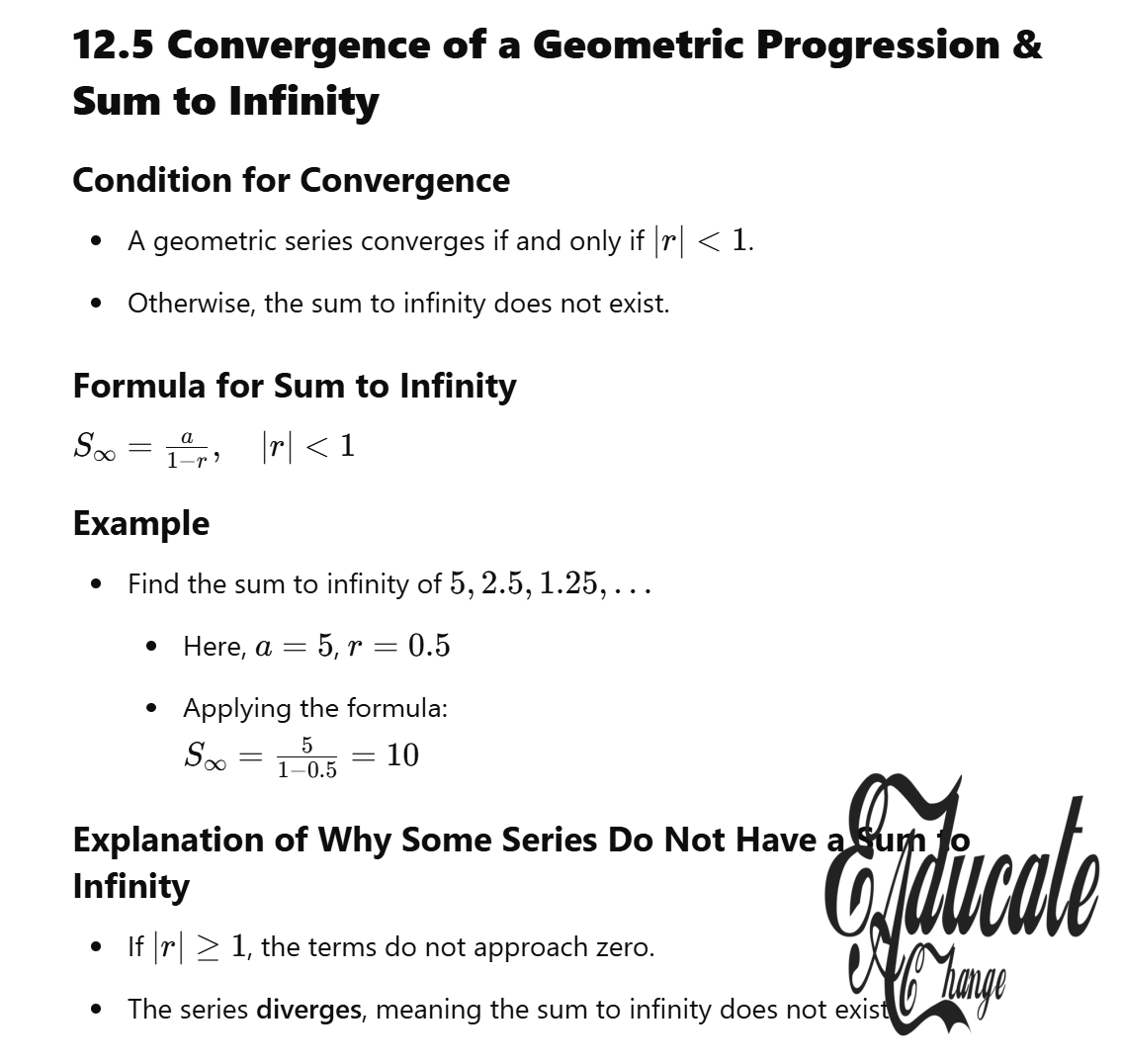
- An infinite geometric series converges if ∣r∣<1|r| < 1. In this case, the sum approaches a finite value.
- If ∣r∣≥1|r| geq 1, the series diverges, meaning the sum grows indefinitely or oscillates without settling.
Sum to Infinity
- Formula for Sum to Infinity:S∞=a1−r,where ∣r∣<1S_infty = frac{a}{1 – r}, quad text{where } |r| < 1
- S∞S_infty: Sum to infinity.
- aa: First term.
- rr: Common ratio.
- Derivation:
- Start with the sum of nn terms: Sn=a+ar+ar2+…+arn−1S_n = a + ar + ar^2 + ldots + ar^{n-1}
- Multiply by rr: rSn=ar+ar2+…+arnrS_n = ar + ar^2 + ldots + ar^n
- Subtract: Sn−rSn=a−arnS_n – rS_n = a – ar^n Sn(1−r)=a(1−rn)S_n (1 – r) = a (1 – r^n)
- As n→∞n to infty, rn→0r^n to 0 if ∣r∣<1|r| < 1: S∞=a1−r.S_infty = frac{a}{1 – r}.
Examples
Example 1: Simple GP
- Find the sum to infinity for a=5a = 5 and r=0.5r = 0.5.
- Solution: S∞=51−0.5=50.5=10S_infty = frac{5}{1 – 0.5} = frac{5}{0.5} = 10
Example 2: Diverging Series
- Determine if the series 2,4,8,16,…2, 4, 8, 16, ldots converges.
- Solution:
- r=42=2r = frac{4}{2} = 2, which is ∣r∣>1|r| > 1.
- The series diverges.
- Solution:
Example 3: Recurring Decimal Representation
- Represent 0.3‾0.overline{3} as an infinite GP and find its sum.
- Solution:
- Decimal: 0.333…=0.3+0.03+0.003+…0.333ldots = 0.3 + 0.03 + 0.003 + ldots.
- GP: a=0.3,r=0.1a = 0.3, r = 0.1.
S∞=0.31−0.1=0.30.9=13.S_infty = frac{0.3}{1 – 0.1} = frac{0.3}{0.9} = frac{1}{3}.
- Solution:
Convergence and Divergence
- Conditions for Convergence:
- ∣r∣<1|r| < 1: The series sum approaches a finite value.
- Divergence:
- ∣r∣≥1|r| geq 1: The series either grows indefinitely or oscillates.
Geometric Visualization
- Example with a Square:
- Divide a square of side length 22 into smaller rectangles repeatedly, each time reducing the next section by a common ratio rr.
- The total area of the rectangles converges to the area of the square.
Applications
- Physics:
- Analyzing decay processes with a constant proportional reduction.
- Finance:
- Calculating the present value of perpetuities.
- Mathematics:
- Representing recurring decimals as fractions.
Worked Problems
- Sum of Infinite Series:
- Find S∞S_infty for a=10a = 10, r=−0.2r = -0.2. S∞=101−(−0.2)=101.2=253.S_infty = frac{10}{1 – (-0.2)} = frac{10}{1.2} = frac{25}{3}.
- Convergence Check:
- Series: 3,−6,12,−24,…3, -6, 12, -24, ldots.
- r=−63=−2r = frac{-6}{3} = -2, so ∣r∣=2>1|r| = 2 > 1. The series diverges.
- Sum of a Recurring Decimal:
- Decimal: 0.12‾=0.12+0.0012+0.000012+…0.overline{12} = 0.12 + 0.0012 + 0.000012 + ldots.
- GP: a=0.12,r=0.01a = 0.12, r = 0.01. S∞=0.121−0.01=0.120.99=433.S_infty = frac{0.12}{1 – 0.01} = frac{0.12}{0.99} = frac{4}{33}.
Key Observations
- Convergence depends solely on the value of rr.
- The smaller ∣r∣|r|, the faster the series converges.
- Divergence occurs when ∣r∣≥1|r| geq 1, making the sum undefined or oscillatory.
Practice Questions
- Determine if the following series converge:
- 1,0.5,0.25,…1, 0.5, 0.25, ldots.
- 2,4,8,…2, 4, 8, ldots.
- −1,0.5,−0.25,…-1, 0.5, -0.25, ldots.
- Find the sum to infinity for:
- a=7,r=0.2a = 7, r = 0.2.
- a=12,r=−0.5a = 12, r = -0.5.
- Represent 0.75‾0.overline{75} as a fraction using a geometric series.
Conclusion
- Infinite geometric progressions provide a concise method to analyze sums of infinitely many terms.
- The sum to infinity formula simplifies problems across mathematics, physics, and finance.
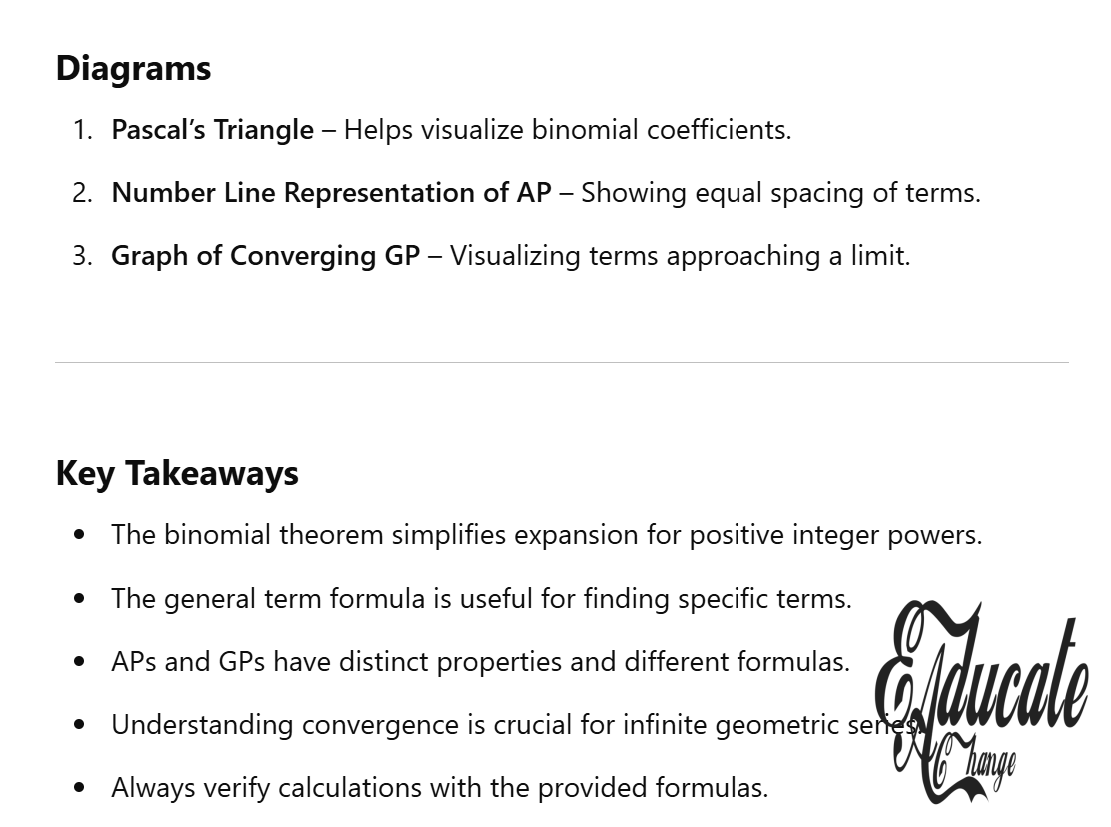
- Convergence is key for meaningful results, with ∣r∣<1|r| < 1 ensuring finite sums.
Introduction to Mixed Progressions
- Definition:
- Certain problems involve both arithmetic and geometric progressions.
- Arithmetic progression (AP) involves a constant difference between terms.
- Geometric progression (GP) involves a constant ratio between terms.
- Key Characteristics:
- Identifying which progression is used depends on the nature of the relationship between terms.
- Some problems may transition between AP and GP within the same dataset.
Formulas and Key Equations
- Arithmetic Progression:
- aa: First term.
- dd: Common difference.
- nn: Number of terms.
- ll: Last term.
- Nth Term: un=a+(n−1)du_n = a + (n – 1)d
- Sum of Terms: Sn=n2[2a+(n−1)d]S_n = frac{n}{2}[2a + (n – 1)d] or: Sn=n2(a+l)S_n = frac{n}{2}(a + l)
- Geometric Progression:
- aa: First term.
- rr: Common ratio.
- Nth Term: un=arn−1u_n = ar^{n-1}
- Sum of Terms:
- For nn terms: Sn=a1−rn1−rif r≠1S_n = afrac{1 – r^n}{1 – r} quad text{if } r neq 1
- Infinite sum (for ∣r∣<1|r| < 1): S∞=a1−rS_infty = frac{a}{1 – r}
Combining AP and GP
- Mixed progressions require careful differentiation:
- Identify whether the problem’s terms follow AP or GP patterns.
- Solve separately for each progression’s contributions to sums or sequences.
Example Problem:
- The first term of a sequence is part of an AP, and the second term transitions into a GP.
- Strategy:
- Use AP formulas to find initial terms.
- Transition to GP formulas to calculate the remaining sequence.
Special Cases in Mixed Progressions
- Sum of a Series Containing Both AP and GP:
- Add the AP and GP contributions individually.
- Consider whether the GP converges (for infinite sums).
Example:
- Given:
- AP: a=2a = 2, d=3d = 3.
- GP begins at n=6n = 6 with r=2r = 2.
- Find:
- Sum of the first 10 terms.
- Solution:
- Calculate AP terms:
- u1=2,u2=5,…,u5=14u_1 = 2, u_2 = 5, ldots, u_5 = 14.
- Sum: SAP=52[2×2+(5−1)3]=40S_{text{AP}} = frac{5}{2}[2 times 2 + (5 – 1)3] = 40
- Transition to GP:
- First GP term: u6=28u_6 = 28.
- SGP=28+56+…S_{text{GP}} = 28 + 56 + ldots (up to n=10n = 10).
- Use Sn=a1−rn1−rS_n = afrac{1 – r^n}{1 – r}.
- Calculate AP terms:
Problems Involving Overlap Between Progressions
Example 1: Shared Terms
- When terms of an AP align with specific terms of a GP:
- Use both progression rules to solve for shared unknowns.
- Problem:
- The 3rd term of an AP is equal to the 1st term of a GP.
- Find the common difference of the AP and the common ratio of the GP.
- Solution:
- AP: u3=a+2du_3 = a + 2d.
- GP: u1=aru_1 = ar.
- Equate: a+2d=ara + 2d = ar Solve for dd and rr.
Mixed Infinite Series
- When an infinite GP contributes to an arithmetic progression:
- Use the convergence condition for the GP: ∣r∣<1|r| < 1
Example:
- An AP adds an infinite GP’s sum to each term.
- Given:
- a=3,d=2a = 3, d = 2 for AP.
- GP starts at a=1,r=12a = 1, r = frac{1}{2}.
- Find:
- Sum of the AP combined with the infinite GP.
- Solution:
- AP sum: SAP=n2[2×3+(n−1)2].S_{text{AP}} = frac{n}{2}[2 times 3 + (n – 1)2].
- GP sum: S∞=11−12=2.S_infty = frac{1}{1 – frac{1}{2}} = 2.
- Total series: Add SAPS_{text{AP}} and S∞S_infty.
Challenge Questions
- Identify Progression Types:
- Analyze given sequences to determine if they follow AP, GP, or a combination.
- Predict Next Terms:
- Extend sequences based on observed patterns.
- Shared Terms Between Progressions:
- Solve equations derived from shared terms to find a,d,ra, d, r.
- Convergence in Mixed Series:
- Verify whether a series converges when combining AP and infinite GP.
Summary
- Mixed Progressions:
- Combine AP and GP rules for complex sequences.
- Solve shared or overlapping terms systematically.
- Infinite Contributions:
- Use convergence rules to manage infinite GP terms.
- Applications:
- Mixed series problems appear in physics, economics, and engineering, where growth or decay patterns intersect with linear progressions.