
Trigonometry (Copy)
New Notes
Introduction to Trigonometry for Acute Angles
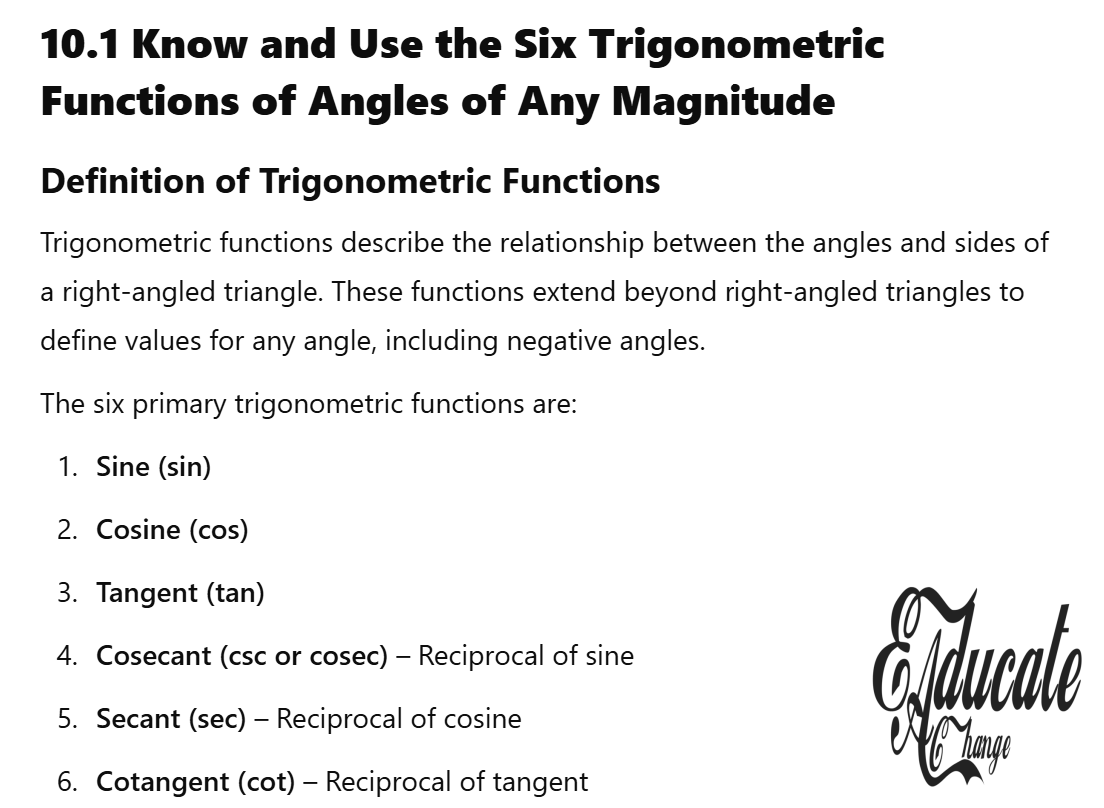
- Trigonometric Functions:
- Sine (sinsin), cosine (coscos), and tangent (tantan) are defined based on a right-angled triangle.
- These functions relate the ratios of specific sides of the triangle.
- Key Definitions:
- Sine: sinθ=Opposite sideHypotenusesin theta = frac{text{Opposite side}}{text{Hypotenuse}}
- Cosine: cosθ=Adjacent sideHypotenusecos theta = frac{text{Adjacent side}}{text{Hypotenuse}}
- Tangent: tanθ=Opposite sideAdjacent sidetan theta = frac{text{Opposite side}}{text{Adjacent side}}
- Complementary Relationship:sinθ=cos(90∘−θ)sin theta = cos (90^circ – theta) cosθ=sin(90∘−θ)cos theta = sin (90^circ – theta)
Important Trigonometric Identities
- Pythagorean Identity:
- Derived from the Pythagorean theorem: sin2θ+cos2θ=1sin^2 theta + cos^2 theta = 1
- Relationship with Tangent:
- Using sine and cosine: tanθ=sinθcosθtan theta = frac{sin theta}{cos theta}
Exact Values for Special Angles
- Trigonometric Ratios for 30°, 45°, and 60°:
- Derived from standard geometric triangles:
- 45°:
- Triangle with two equal sides of length 11.
- Hypotenuse: 2sqrt{2}
- Ratios: sin45∘=cos45∘=12,tan45∘=1sin 45^circ = cos 45^circ = frac{1}{sqrt{2}}, quad tan 45^circ = 1
- 30° and 60°:
- Equilateral triangle split in half.
- Ratios: sin30∘=12,cos30∘=32,tan30∘=13sin 30^circ = frac{1}{2}, quad cos 30^circ = frac{sqrt{3}}{2}, quad tan 30^circ = frac{1}{sqrt{3}} sin60∘=32,cos60∘=12,tan60∘=3sin 60^circ = frac{sqrt{3}}{2}, quad cos 60^circ = frac{1}{2}, quad tan 60^circ = sqrt{3}
- 45°:
- Derived from standard geometric triangles:
Worked Examples
Example 1: Pythagorean Identity
Verify that sin260∘+cos260∘=1sin^2 60^circ + cos^2 60^circ = 1.
- Solution: sin260∘=(32)2=34,cos260∘=(12)2=14sin^2 60^circ = left(frac{sqrt{3}}{2}right)^2 = frac{3}{4}, quad cos^2 60^circ = left(frac{1}{2}right)^2 = frac{1}{4} sin260∘+cos260∘=34+14=1sin^2 60^circ + cos^2 60^circ = frac{3}{4} + frac{1}{4} = 1
Example 2: Tangent Relationship
Find tan45∘tan 45^circ using sin45∘sin 45^circ and cos45∘cos 45^circ.
- Solution: tan45∘=sin45∘cos45∘=1212=1tan 45^circ = frac{sin 45^circ}{cos 45^circ} = frac{frac{1}{sqrt{2}}}{frac{1}{sqrt{2}}} = 1
Example 3: Complementary Angles
Show that sin30∘=cos60∘sin 30^circ = cos 60^circ.
- Solution:
- From definitions: sin30∘=12,cos60∘=12sin 30^circ = frac{1}{2}, quad cos 60^circ = frac{1}{2}
- Hence, sin30∘=cos60∘sin 30^circ = cos 60^circ.
Applications
- Right-Angled Triangle Problems:
- Solve for missing sides or angles using trigonometric ratios.
- Example:
- A right-angled triangle has a hypotenuse of 1010 cm and an angle of 30∘30^circ. Find the opposite side.
- Solution: sin30∘=OppositeHypotenuse⇒Opposite=10×sin30∘=10×12=5 cm.sin 30^circ = frac{text{Opposite}}{text{Hypotenuse}} quad Rightarrow quad text{Opposite} = 10 times sin 30^circ = 10 times frac{1}{2} = 5 , text{cm}.
- Angles of Elevation and Depression:
- Use trigonometric ratios to solve practical problems involving heights and distances.
Exercises
- Evaluate the following:
- sin45∘,cos45∘,tan45∘sin 45^circ, cos 45^circ, tan 45^circ.
- sin30∘,cos30∘,tan30∘sin 30^circ, cos 30^circ, tan 30^circ.
- Prove the identity:sin2θ+cos2θ=1for θ=45∘.sin^2 theta + cos^2 theta = 1 quad text{for} , theta = 45^circ.
- A ladder is leaning against a wall, forming an angle of 60∘60^circ with the ground. If the ladder is 55 m long, find the height it reaches on the wall.
- Calculate:
- tan60∘tan 60^circ using sin60∘sin 60^circ and cos60∘cos 60^circ.
- Verify the identity: tan230∘+1=sec230∘.tan^2 30^circ + 1 = sec^2 30^circ.
Summary
- Acute angles (0∘<θ<90∘0^circ < theta < 90^circ) are fundamental in trigonometry, forming the basis for understanding angles in any quadrant.
- Key Formulas:
- sinθ=OppositeHypotenuse,cosθ=AdjacentHypotenuse,tanθ=OppositeAdjacentsin theta = frac{text{Opposite}}{text{Hypotenuse}}, quad cos theta = frac{text{Adjacent}}{text{Hypotenuse}}, quad tan theta = frac{text{Opposite}}{text{Adjacent}}.
- Pythagorean identity: sin2θ+cos2θ=1.sin^2 theta + cos^2 theta = 1.
- Applications include solving right-angled triangles and modeling real-world problems like heights, distances, and angles of elevation.
Introduction
- Definition of an Angle:
- An angle measures the rotation of a line OPOP around a fixed point OO.
- It is measured starting from the positive x-axis.
- Rotation Directions:
- Anticlockwise: Positive angles.
- Clockwise: Negative angles.
Cartesian Plane and Quadrants
- The Cartesian plane is divided into four quadrants:
- First Quadrant: 0∘<θ<90∘0^circ < theta < 90^circ or 0 to π2 radians0 , text{to} , frac{pi}{2} , text{radians}.
- Second Quadrant: 90∘<θ<180∘90^circ < theta < 180^circ or π2 to π radiansfrac{pi}{2} , text{to} , pi , text{radians}.
- Third Quadrant: 180∘<θ<270∘180^circ < theta < 270^circ or π to 3π2 radianspi , text{to} , frac{3pi}{2} , text{radians}.
- Fourth Quadrant: 270∘<θ<360∘270^circ < theta < 360^circ or 3π2 to 2π radiansfrac{3pi}{2} , text{to} , 2pi , text{radians}.
- The angle is said to lie in the quadrant where the terminal side of OPOP is positioned.
Acute and Reference Angles
- Acute Angle:
- The smallest angle the terminal side makes with the x-axis.
- It is always between 0∘0^circ and 90∘90^circ.
- Reference Angle:
- For any angle, the reference angle is the acute angle it forms with the x-axis.
- Helps simplify trigonometric calculations for non-acute angles.
Worked Examples
Example 1: Identifying Quadrants
- Angle: 240∘240^circ:
- It is measured anticlockwise.
- Lies in the third quadrant.
- Acute angle: 240∘−180∘=60∘240^circ – 180^circ = 60^circ.
- Angle: −70∘-70^circ:
- Clockwise rotation.
- Lies in the fourth quadrant.
- Acute angle: 70∘70^circ.
Example 2: Angles Greater than 360∘360^circ
- Angle: 490∘490^circ:
- Perform a complete revolution (490∘−360∘=130∘490^circ – 360^circ = 130^circ).
- Lies in the second quadrant.
- Acute angle: 180∘−130∘=50∘180^circ – 130^circ = 50^circ.
General Properties of Angles
- Full Revolution:
- A full rotation around the circle is 360∘360^circ or 2π radians2pi , text{radians}.
- Relationship Between Radians and Degrees:
- 360∘=2π360^circ = 2pi radians.
- 1 radian=180∘π1 , text{radian} = frac{180^circ}{pi}.
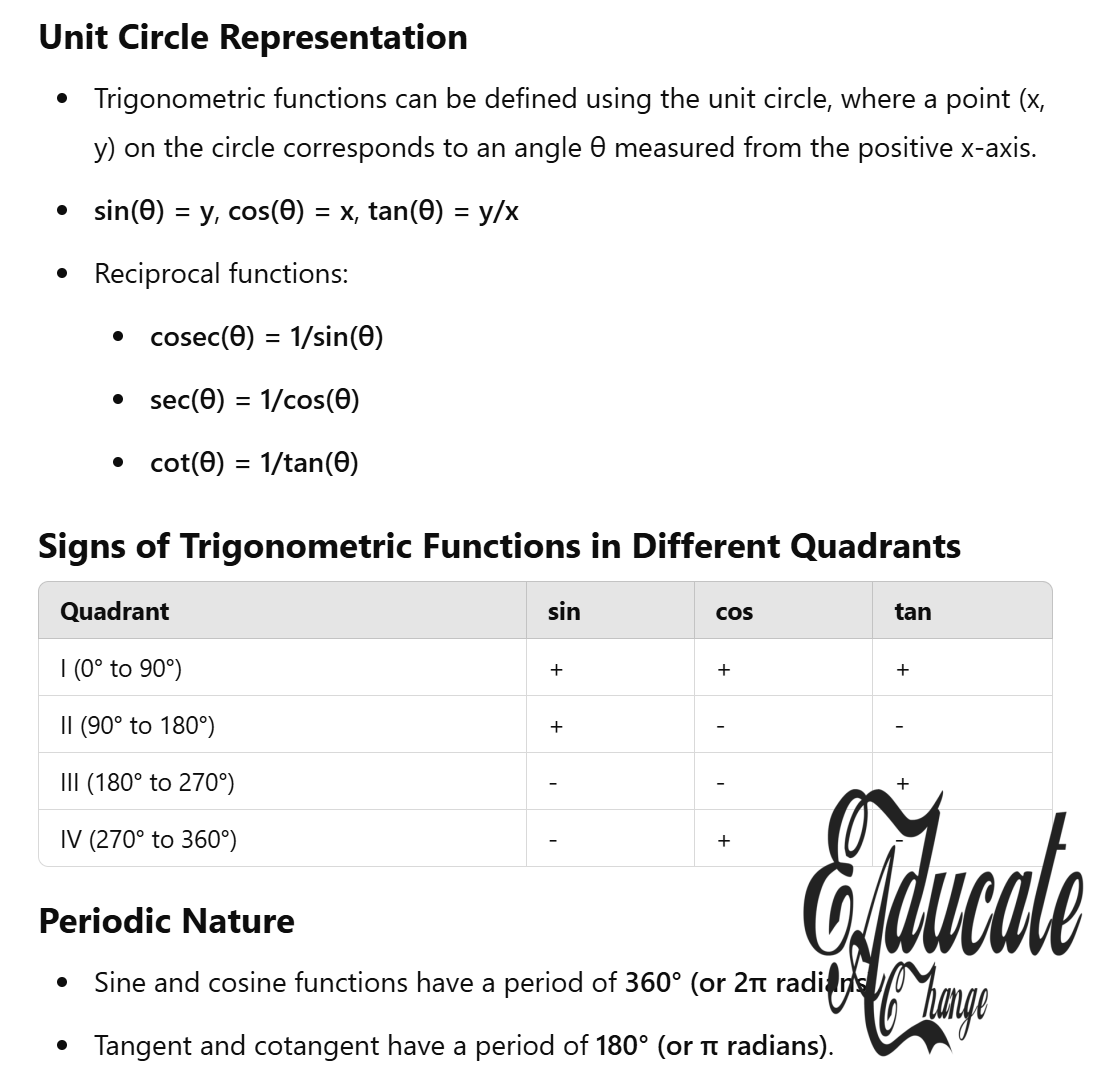
- Signs in Quadrants:
- Trigonometric functions have different signs based on the quadrant:
- First Quadrant:
- sinsin, coscos, tantan: All positive.
- Second Quadrant:
- sinsin: Positive; coscos, tantan: Negative.
- Third Quadrant:
- tantan: Positive; sinsin, coscos: Negative.
- Fourth Quadrant:
- coscos: Positive; sinsin, tantan: Negative.
- First Quadrant:
- Trigonometric functions have different signs based on the quadrant:
Visual Representation
- Draw angles on a Cartesian plane to understand their position and quadrant.
- Use unit circle principles to verify signs and values of trigonometric functions.
Trigonometric Functions for General Angles
- Sine (sinθsin theta):
- Ratio of the y-coordinate of the terminal point to the radius.
- Cosine (cosθcos theta):
- Ratio of the x-coordinate of the terminal point to the radius.
- Tangent (tanθtan theta):
- Ratio of sine to cosine: tanθ=sinθcosθ.tan theta = frac{sin theta}{cos theta}.
- Reciprocal Functions:
- Cosecant (cscθcsc theta), secant (secθsec theta), cotangent (cotθcot theta).
Key Observations
- Trigonometric functions are periodic, repeating values after 360∘360^circ or 2π radians2pi , text{radians}.
- Use reduction formulas for simplifications:
- sin(360∘−θ)=−sinθsin(360^circ – theta) = -sin theta,
- cos(360∘−θ)=cosθcos(360^circ – theta) = cos theta.
Practice Problems
- Identify the quadrant and reference angle for:
- 120∘120^circ,
- −150∘-150^circ,
- 540∘540^circ.
- Calculate exact values:
- sin(210∘)sin(210^circ),
- cos(−300∘)cos(-300^circ),
- tan(450∘)tan(450^circ).
- Prove:sin2θ+cos2θ=1for general angles.sin^2 theta + cos^2 theta = 1 quad text{for general angles}.
Applications
- Angles are fundamental in:
- Navigation: Bearings and directions.
- Physics: Rotational motion and wave analysis.
- Engineering: Calculating stress and torque.
Summary
- General angles include all rotations, positive and negative.
- Use Cartesian planes and quadrant signs for accurate trigonometric evaluations.
- Trigonometric relationships and reduction formulas simplify calculations.
Introduction
- Trigonometric ratios (sinsin, coscos, tantan) can be extended to all angles, positive and negative.
- Defined for angles in the four quadrants of the Cartesian plane.
- Ratios are based on coordinates of a point P(x,y)P(x, y) on the terminal arm of the angle.
General Definitions of Trigonometric Ratios
- Consider a point P(x,y)P(x, y) on the Cartesian plane and the origin OO. The radius (rr) is the distance from OO to PP: r=x2+y2r = sqrt{x^2 + y^2}
- Sine: sinθ=yrsin theta = frac{y}{r}
- Cosine: cosθ=xrcos theta = frac{x}{r}
- Tangent: tanθ=yx,provided x≠0tan theta = frac{y}{x}, quad text{provided } x neq 0
Signs of Trigonometric Ratios in Quadrants
- First Quadrant (0∘<θ<90∘0^circ < theta < 90^circ):
- x>0,y>0,r>0x > 0, y > 0, r > 0.
- All ratios are positive: sinθ>0sin theta > 0, cosθ>0cos theta > 0, tanθ>0tan theta > 0.
- Second Quadrant (90∘<θ<180∘90^circ < theta < 180^circ):
- x<0,y>0,r>0x < 0, y > 0, r > 0.
- sinθ>0sin theta > 0, cosθ<0cos theta < 0, tanθ<0tan theta < 0.
- Third Quadrant (180∘<θ<270∘180^circ < theta < 270^circ):
- x<0,y<0,r>0x < 0, y < 0, r > 0.
- sinθ<0sin theta < 0, cosθ<0cos theta < 0, tanθ>0tan theta > 0.
- Fourth Quadrant (270∘<θ<360∘270^circ < theta < 360^circ):
- x>0,y<0,r>0x > 0, y < 0, r > 0.
- sinθ<0sin theta < 0, cosθ>0cos theta > 0, tanθ<0tan theta < 0.
Key Observations
- Reference Angles:
- Simplify calculations for angles in all quadrants by finding the acute angle the terminal arm makes with the x-axis.
- Periodic Nature:
- Trigonometric functions are periodic:
- sinθ,cosθsin theta, cos theta: Period 2π2pi.
- tanθtan theta: Period πpi.
- Trigonometric functions are periodic:
- Reduction Formulas:
- Relate trigonometric functions of angles outside 0∘0^circ to 90∘90^circ:
- sin(180∘−θ)=sinθsin (180^circ – theta) = sin theta.
- cos(180∘−θ)=−cosθcos (180^circ – theta) = -cos theta.
- tan(180∘+θ)=tanθtan (180^circ + theta) = tan theta.
- Relate trigonometric functions of angles outside 0∘0^circ to 90∘90^circ:
Worked Examples
Example 1: Calculating Trigonometric Ratios
Given a point P(−3,4)P(-3, 4) and angle θtheta in the second quadrant:
- Calculate rr: r=(−3)2+42=9+16=5r = sqrt{(-3)^2 + 4^2} = sqrt{9 + 16} = 5
- Ratios:
- sinθ=yr=45sin theta = frac{y}{r} = frac{4}{5},
- cosθ=xr=−35cos theta = frac{x}{r} = frac{-3}{5},
- tanθ=yx=4−3=−43tan theta = frac{y}{x} = frac{4}{-3} = -frac{4}{3}.
Example 2: Using Quadrants
Express sin(210∘)sin(210^circ) and cos(210∘)cos(210^circ) in terms of acute angles.
- 210∘210^circ lies in the third quadrant.
- Reference angle: 210∘−180∘=30∘210^circ – 180^circ = 30^circ.
- Ratios:
- sin(210∘)=−sin(30∘)=−12sin(210^circ) = -sin(30^circ) = -frac{1}{2},
- cos(210∘)=−cos(30∘)=−32cos(210^circ) = -cos(30^circ) = -frac{sqrt{3}}{2}.
Example 3: Ratios for Reflex Angles
Evaluate tan(300∘)tan(300^circ):
- 300∘300^circ lies in the fourth quadrant.
- Reference angle: 360∘−300∘=60∘360^circ – 300^circ = 60^circ.
- Ratio: tan(300∘)=−tan(60∘)=−3.tan(300^circ) = -tan(60^circ) = -sqrt{3}.
Trigonometric Identities
- Pythagorean Identity:sin2θ+cos2θ=1sin^2 theta + cos^2 theta = 1
- Tangent-Secant Identity:1+tan2θ=sec2θ1 + tan^2 theta = sec^2 theta
- Cotangent-Cosecant Identity:1+cot2θ=csc2θ1 + cot^2 theta = csc^2 theta
Applications
- Physics and Engineering:
- Analyze rotational motion and forces.
- Describe waveforms and oscillatory motion.
- Navigation:
- Solve bearing problems using general angles.
- Geometry:
- Calculate areas and lengths in sectors and segments.
Practice Problems
- Determine the trigonometric ratios for a point (−7,24)(-7, 24) on the terminal arm of an angle.
- Express cos(150∘)cos(150^circ) in terms of an acute angle.
- Solve for θtheta if sinθ=−0.5sin theta = -0.5 and θtheta lies in the third quadrant.
Summary
- General definitions extend trigonometric ratios to all angles.
- The signs of ratios depend on the quadrant of the angle.
- Reference angles and reduction formulas simplify trigonometric calculations for non-acute angles.
Introduction
- Trigonometric functions like sine (sinsin), cosine (coscos), and tangent (tantan) are periodic and have distinct graphical characteristics.
- Understanding their periodicity, amplitude, and behavior is crucial for solving equations and analyzing patterns in applied mathematics.
Graphs of sinxsin x and cosxcos x
Characteristics of sinxsin x
- Shape: Starts at 0, rises to 1, falls to -1, and returns to 0.
- Period: One complete cycle occurs over 360∘360^circ or 2π2pi radians.
- Amplitude: Maximum vertical distance from the x-axis is 1.
- Key Points:
- At x=0x = 0, sinx=0sin x = 0.
- At x=90∘x = 90^circ or π/2pi/2 radians, sinx=1sin x = 1.
- At x=180∘x = 180^circ or πpi radians, sinx=0sin x = 0.
- At x=270∘x = 270^circ or 3π/23pi/2 radians, sinx=−1sin x = -1.
- At x=360∘x = 360^circ or 2π2pi radians, sinx=0sin x = 0.
Characteristics of cosxcos x
- Shape: Starts at 1, falls to -1, and returns to 1.
- Period: Also 360∘360^circ or 2π2pi radians.
- Amplitude: Same as sinxsin x, with a maximum of 1.
- Key Points:
- At x=0x = 0, cosx=1cos x = 1.
- At x=90∘x = 90^circ or π/2pi/2 radians, cosx=0cos x = 0.
- At x=180∘x = 180^circ or πpi radians, cosx=−1cos x = -1.
- At x=270∘x = 270^circ or 3π/23pi/2 radians, cosx=0cos x = 0.
- At x=360∘x = 360^circ or 2π2pi radians, cosx=1cos x = 1.
Properties
- Both are periodic functions:
- Period of 360∘360^circ or 2π2pi radians.
- Their graphs repeat indefinitely.
- Amplitude remains constant.
Graph of tanxtan x
Characteristics
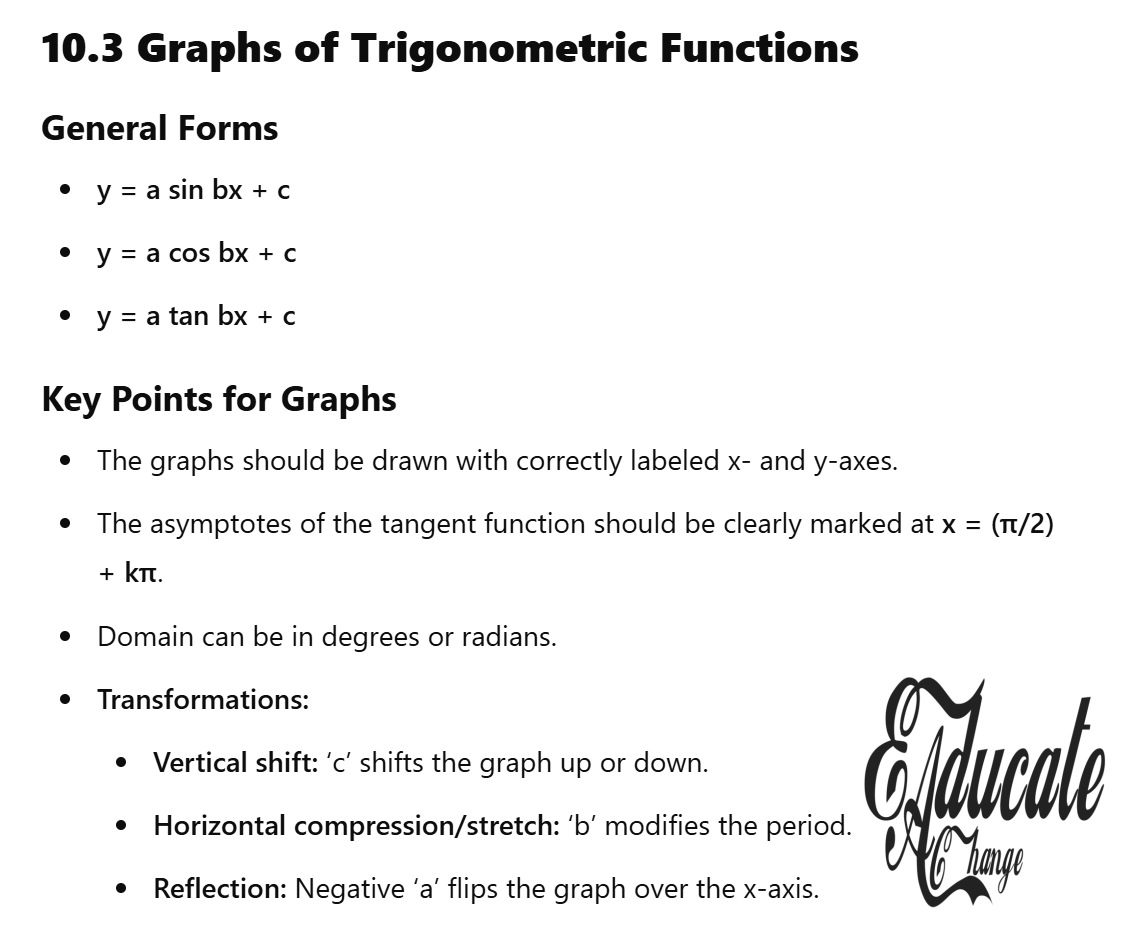
- Shape: A series of repeating curves with asymptotes.
- Period: Repeats every 180∘180^circ or πpi radians.
- Key Points:
- At x=0x = 0, tanx=0tan x = 0.
- At x=45∘x = 45^circ or π/4pi/4, tanx=1tan x = 1.
- At x=90∘x = 90^circ or π/2pi/2, the graph has a vertical asymptote (undefined).
- At x=135∘x = 135^circ or 3π/43pi/4, tanx=−1tan x = -1.
- Repeats at x=180∘x = 180^circ or πpi.
Properties
- Asymptotes: Occur where cosx=0cos x = 0, as tanx=sinx/cosxtan x = sin x / cos x.
- No amplitude since the graph extends infinitely.
Amplitude and Period
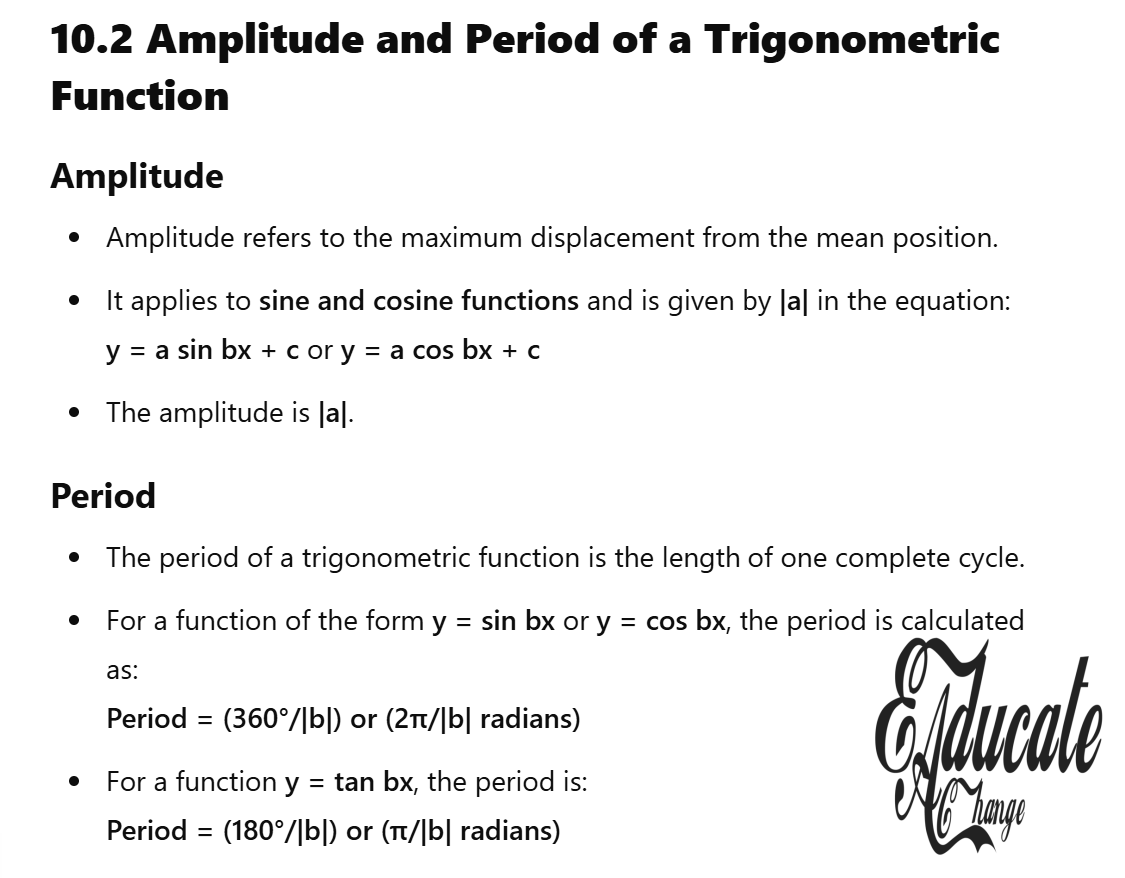
Amplitude
- Refers to the maximum displacement from the principal axis.
- For sinxsin x and cosxcos x, the amplitude is 1 (standard functions).
Period
- The interval required for one full cycle.
- sinxsin x and cosxcos x: Period =360∘= 360^circ or 2π2pi.
- tanxtan x: Period =180∘= 180^circ or πpi.
Transformations of Trigonometric Graphs
Vertical Stretch/Compression
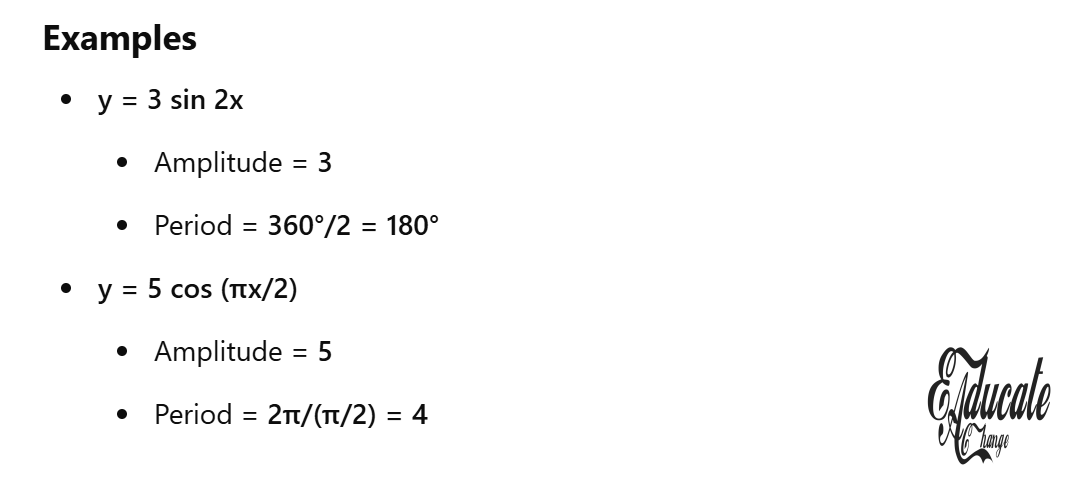
- Equation: y=asinxy = a sin x, y=acosxy = a cos x.
- Changes the amplitude.
- For a>1a > 1: Graph is stretched vertically.
- For 0<a<10 < a < 1: Graph is compressed vertically.
- Example:
- y=2sinxy = 2sin x: Amplitude = 2.
Horizontal Stretch/Compression
- Equation: y=sin(bx)y = sin(bx), y=cos(bx)y = cos(bx).
- Changes the period.
- Period = 360∘bfrac{360^circ}{b} or 2πbfrac{2pi}{b} radians.
- Example:
- y=sin(2x)y = sin(2x): Period = 180∘180^circ or πpi.
Vertical Translation
- Equation: y=sinx+cy = sin x + c, y=cosx+cy = cos x + c.
- Moves the graph up (c>0c > 0) or down (c<0c < 0).
- Example:
- y=sinx+1y = sin x + 1: Entire graph is shifted up by 1 unit.
Phase Shift
- Equation: y=sin(x−d)y = sin(x – d), y=cos(x−d)y = cos(x – d).
- Shifts the graph horizontally by dd units.
- Right if d>0d > 0, left if d<0d < 0.
- Example:
- y=sin(x−90∘)y = sin(x – 90^circ): Graph is shifted right by 90∘90^circ.
Applications
- Modeling Periodic Phenomena:
- Waves, sound, and light intensities.
- Engineering and Signal Processing:
- Used to analyze alternating current (AC) signals.
- Physics:
- Describing oscillations and rotations.
- Astronomy:
- Predicting celestial movements.
Practice Problems
- Sketch the graphs of:
- y=2sinxy = 2sin x,
- y=sin(2x)y = sin(2x),
- y=sinx+1y = sin x + 1.
- Determine the amplitude, period, and phase shift for:
- y=3sin(2x−90∘)y = 3sin(2x – 90^circ),
- y=cos(x+30∘)y = cos(x + 30^circ).
- Analyze the intersection points of:
- y=sinxy = sin x,
- y=cosxy = cos x.
Summary
- sinxsin x and cosxcos x: Periodic with a period of 360∘360^circ, amplitude 1.
- tanxtan x: Periodic with a period of 180∘180^circ, no amplitude.
- Transformations modify amplitude, period, phase, or vertical position.
- These graphs are foundational in science, engineering, and applied mathematics.
Introduction
- Purpose of Graphs:
- Visual representation of functions aids in understanding their behavior.
- Useful for analyzing roots, turning points, asymptotes, and periodicity.
- Focus:
- This chapter addresses techniques for sketching, analyzing, and interpreting the graphs of various forms of y=f(x)y = f(x).
Graphing Basics
1. Coordinates
- Key Points:
- Intercepts with axes (x-intercept, y-intercept).
- Specific values or features like turning points or asymptotes.
2. Symmetry
- Odd Function:
- f(−x)=−f(x)f(-x) = -f(x); symmetric about the origin.
- Even Function:
- f(−x)=f(x)f(-x) = f(x); symmetric about the y-axis.
3. Domain and Range
- Domain: Set of all possible xx-values.
- Range: Set of all possible yy-values.
4. Transformation of Graphs
- Vertical and horizontal translations, reflections, stretches, and compressions.
Standard Graph Forms
Linear Functions
- General Form: y=mx+cy = mx + c
- mm: Slope.
- cc: Y-intercept.
- Straight-line graph; slope determines steepness.
Quadratic Functions
- General Form: y=ax2+bx+cy = ax^2 + bx + c
- Parabola shape; a>0a > 0 opens upwards, a<0a < 0 opens downwards.
- Vertex: Turning point of the parabola.
Cubic Functions
- General Form: y=ax3+bx2+cx+dy = ax^3 + bx^2 + cx + d
- S-shaped graph; symmetric if b=0b = 0.
Techniques for Graph Sketching
1. Finding Key Features
- Identify intercepts, turning points, and asymptotes.
- Determine domain and range.
2. Differentiation for Behavior
- Use f′(x)f'(x) to find:
- Stationary points: Where f′(x)=0f'(x) = 0.
- Increasing/Decreasing Intervals: Where f′(x)>0f'(x) > 0 or f′(x)<0f'(x) < 0.
3. Second Derivative
- Use f′′(x)f”(x) to determine the nature of stationary points:
- f′′(x)>0f”(x) > 0: Minimum.
- f′′(x)<0f”(x) < 0: Maximum.
Graph Transformations
1. Translations
- Vertical:
- y=f(x)+ky = f(x) + k: Moves up by kk units.
- Horizontal:
- y=f(x−h)y = f(x – h): Moves right by hh units.
2. Reflections
- About x-axis: y=−f(x)y = -f(x).
- About y-axis: y=f(−x)y = f(-x).
3. Stretch and Compression
- Vertical Stretch:
- y=af(x)y = af(x): Stretches by factor aa.
- Horizontal Stretch:
- y=f(kx)y = f(kx): Compresses if k>1k > 1.
4. Combined Transformations
- Apply transformations sequentially:
- E.g., y=af(kx−h)+cy = a f(kx – h) + c.
Special Graphs
Absolute Value Function
- General Form: y=∣f(x)∣y = |f(x)|
- Reflects negative parts of f(x)f(x) above the x-axis.
Piecewise Functions
- Defined for specific intervals of xx.
- Graph by sketching each piece separately.
Worked Examples
Example 1: Linear Graph
Sketch y=2x+3y = 2x + 3.
- Steps:
- Find intercepts:
- yy-intercept: (0,3)(0, 3).
- xx-intercept: x=−32x = -frac{3}{2}.
- Plot and draw straight line.
- Find intercepts:
Example 2: Quadratic Graph
Sketch y=x2−4x+3y = x^2 – 4x + 3.
- Steps:
- Factorize: y=(x−1)(x−3)y = (x – 1)(x – 3).
- Roots: x=1,3x = 1, 3.
- Vertex: Midpoint of roots, x=2x = 2: y=(2)2−4(2)+3=−1y = (2)^2 – 4(2) + 3 = -1
Example 3: Transformed Graph
Sketch y=−2(x−1)2+3y = -2(x – 1)^2 + 3.
- Steps:
- Transform y=x2y = x^2:
- Translate right by 1, up by 3.
- Reflect vertically, stretch by factor of 2.
- Transform y=x2y = x^2:
Applications
- Optimization:
- Use maxima/minima in real-world problems.
- Physics:
- Graphs of motion or energy functions.
- Engineering:
- Visualize design and behavior of systems.
Exercises
- Sketch and analyze:
- y=x2−6x+9y = x^2 – 6x + 9,
- y=∣x2−4∣y = |x^2 – 4|.
- Apply transformations to y=sinxy = sin x:
- y=2sin(x−45∘)+1y = 2sin(x – 45^circ) + 1.
- Identify key features for y=1/(x−1)+2y = 1/(x – 1) + 2.
Introduction
- Trigonometric equations involve solving for unknown angles within a given range where trigonometric functions like sinsin, coscos, or tantan are used.
- These equations may have:
- A finite number of solutions.
- Periodic infinite solutions due to the repeating nature of trigonometric functions.
Basics of Trigonometric Equations
- Key Trigonometric Ratios:
- sinx=oppositehypotenusesin x = frac{text{opposite}}{text{hypotenuse}}
- cosx=adjacenthypotenusecos x = frac{text{adjacent}}{text{hypotenuse}}
- tanx=oppositeadjacenttan x = frac{text{opposite}}{text{adjacent}}
- Unit Circle Reference:
- Solutions are often derived using the unit circle where angles are represented in radians or degrees.
General Steps to Solve Trigonometric Equations
- Isolate the Trigonometric Function:
- Example: sinx=0.5sin x = 0.5
- Use Inverse Trigonometric Functions:
- Example: x=sin−1(0.5)x = sin^{-1}(0.5)
- Find All Possible Solutions:
- Due to the periodicity of trigonometric functions, solutions occur in multiple quadrants.
- Example for sinx=0.5sin x = 0.5:
- Solutions in degrees: x=30∘,150∘x = 30^circ, 150^circ
- General solution: x=30∘+360∘korx=150∘+360∘k,k∈Zx = 30^circ + 360^circ k quad text{or} quad x = 150^circ + 360^circ k, quad k in mathbb{Z}
- Restrict Solutions to Given Range:
- Example for 0∘≤x≤360∘0^circ leq x leq 360^circ:
- Only x=30∘,150∘x = 30^circ, 150^circ.
- Example for 0∘≤x≤360∘0^circ leq x leq 360^circ:
Types of Trigonometric Equations
Linear Trigonometric Equations
- Example: sinx=0.3sin x = 0.3
- Use calculator: x=sin−1(0.3)=17.5∘x = sin^{-1}(0.3) = 17.5^circ
- Solutions in [0∘,360∘][0^circ, 360^circ]: x=17.5∘andx=180∘−17.5∘=162.5∘.x = 17.5^circ quad text{and} quad x = 180^circ – 17.5^circ = 162.5^circ.
Quadratic Trigonometric Equations
- Example: 2sin2x−sinx−1=02sin^2 x – sin x – 1 = 0
- Factorize: (2sinx+1)(sinx−1)=0(2sin x + 1)(sin x – 1) = 0
- Solve for sinxsin x: sinx=−0.5orsinx=1.sin x = -0.5 quad text{or} quad sin x = 1.
Equations Involving Multiple Angles
- Example: sin(2x)=0.5sin(2x) = 0.5
- Solve for 2x2x: 2x=sin−1(0.5)=30∘or150∘.2x = sin^{-1}(0.5) = 30^circ quad text{or} quad 150^circ.
- Divide by 2: x=15∘,75∘.x = 15^circ, 75^circ.
Special Techniques
Using Trigonometric Identities
- Simplify using identities like:sin2x+cos2x=1sin^2 x + cos^2 x = 1 tan2x+1=sec2xtan^2 x + 1 = sec^2 x
- Convert complex forms:
- Example: 2cos2x=1−cosx2cos^2 x = 1 – cos x Rewrite as: 2cos2x+cosx−1=0.2cos^2 x + cos x – 1 = 0.
Graphical Solutions
- Sketch graphs of functions to visually identify intersections or roots.
- Example:
- Solve sinx=cosxsin x = cos x:
- Equating: tanx=1⇒x=45∘,225∘.tan x = 1 quad Rightarrow quad x = 45^circ, 225^circ.
- Solve sinx=cosxsin x = cos x:
Worked Examples
Example 1: Basic Equation
Solve:
cosx=−0.4for0∘≤x≤360∘.cos x = -0.4 quad text{for} quad 0^circ leq x leq 360^circ.
- Calculator gives: x=cos−1(−0.4)=113.6∘.x = cos^{-1}(-0.4) = 113.6^circ.
- Second solution: x=360∘−113.6∘=246.4∘.x = 360^circ – 113.6^circ = 246.4^circ.
Example 2: Using Identities
Solve:
2sin2x−3sinx+1=0.2sin^2 x – 3sin x + 1 = 0.
- Factorize: (2sinx−1)(sinx−1)=0.(2sin x – 1)(sin x – 1) = 0.
- Solutions: sinx=12,sinx=1.sin x = frac{1}{2}, quad sin x = 1.
- Angles: x=30∘,150∘,90∘.x = 30^circ, 150^circ, 90^circ.
Example 3: Multi-Angle Equation
Solve:
sin(3x)=0.5for0∘≤x≤360∘.sin(3x) = 0.5 quad text{for} quad 0^circ leq x leq 360^circ.
- Solve for 3x3x: 3x=30∘,150∘,390∘,510∘.3x = 30^circ, 150^circ, 390^circ, 510^circ.
- Divide by 3: x=10∘,50∘,130∘,170∘.x = 10^circ, 50^circ, 130^circ, 170^circ.
Applications
- Physics:
- Analyzing periodic motion like pendulums.
- Engineering:
- Solving problems in wave mechanics and signal processing.
- Astronomy:
- Calculating planetary positions based on trigonometric equations.
Practice Problems
- Solve:
- tanx=−1tan x = -1 for 0∘≤x≤360∘0^circ leq x leq 360^circ.
- 3sin2x−4cosx=03sin^2 x – 4cos x = 0.
- Verify:sin(2x)+cos(2x)=1for0∘≤x≤180∘.sin(2x) + cos(2x) = 1 quad text{for} quad 0^circ leq x leq 180^circ.
- Graphical challenge:
- Plot y=sinxy = sin x and y=cosxy = cos x, and find intersection points for 0∘≤x≤360∘0^circ leq x leq 360^circ.
Summary
- Trigonometric equations leverage periodicity and symmetries for multiple solutions.
- Understanding identities, transformations, and graphs simplifies the solving process.
- Applications extend to physics, engineering, and beyond.
Introduction to Trigonometric Identities
- Definition: A trigonometric identity is an equation involving trigonometric functions that holds true for all values of the variable within its domain.
- The simplest identity is: sin2x+cos2x=1sin^2x + cos^2x = 1
- This identity is derived directly from the Pythagorean theorem applied to a unit circle.
- Identities allow the simplification and manipulation of trigonometric expressions.
Key Trigonometric Identities
- Pythagorean Identities:
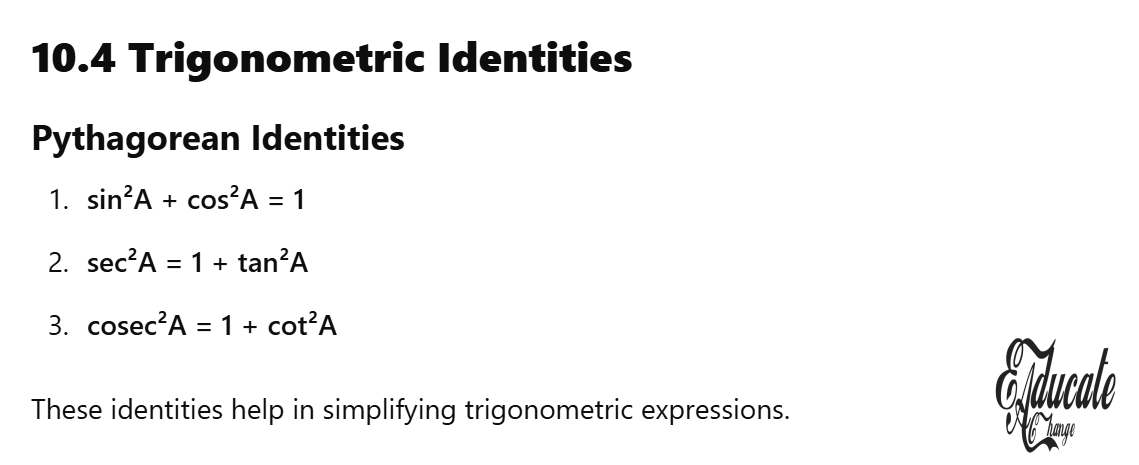
- sin2x+cos2x=1sin^2x + cos^2x = 1
- By dividing through by cos2xcos^2x: 1+tan2x=sec2×1 + tan^2x = sec^2x
- By dividing through by sin2xsin^2x: 1+cot2x=csc2×1 + cot^2x = csc^2x
- Reciprocal Identities:
- cscx=1sinxcsc x = frac{1}{sin x}
- secx=1cosxsec x = frac{1}{cos x}
- cotx=1tanxcot x = frac{1}{tan x}
- Quotient Identities:
- tanx=sinxcosxtan x = frac{sin x}{cos x}
- cotx=cosxsinxcot x = frac{cos x}{sin x}
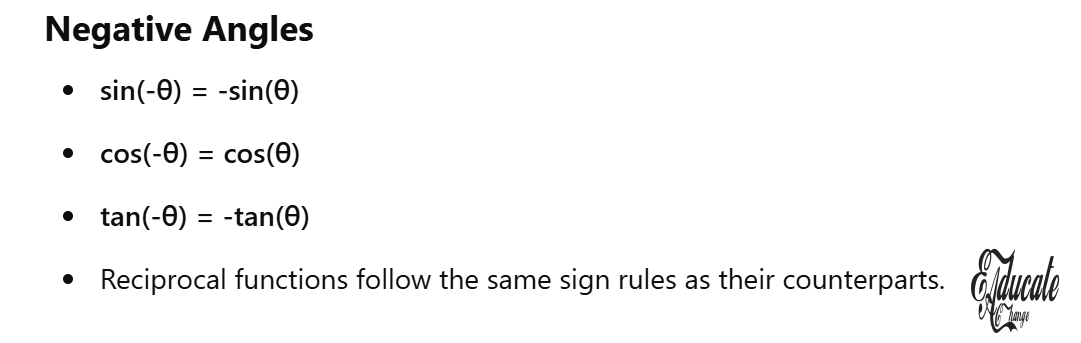
- Negative Angle Identities:
- sin(−x)=−sinxsin(-x) = -sin x
- cos(−x)=cosxcos(-x) = cos x
- tan(−x)=−tanxtan(-x) = -tan x
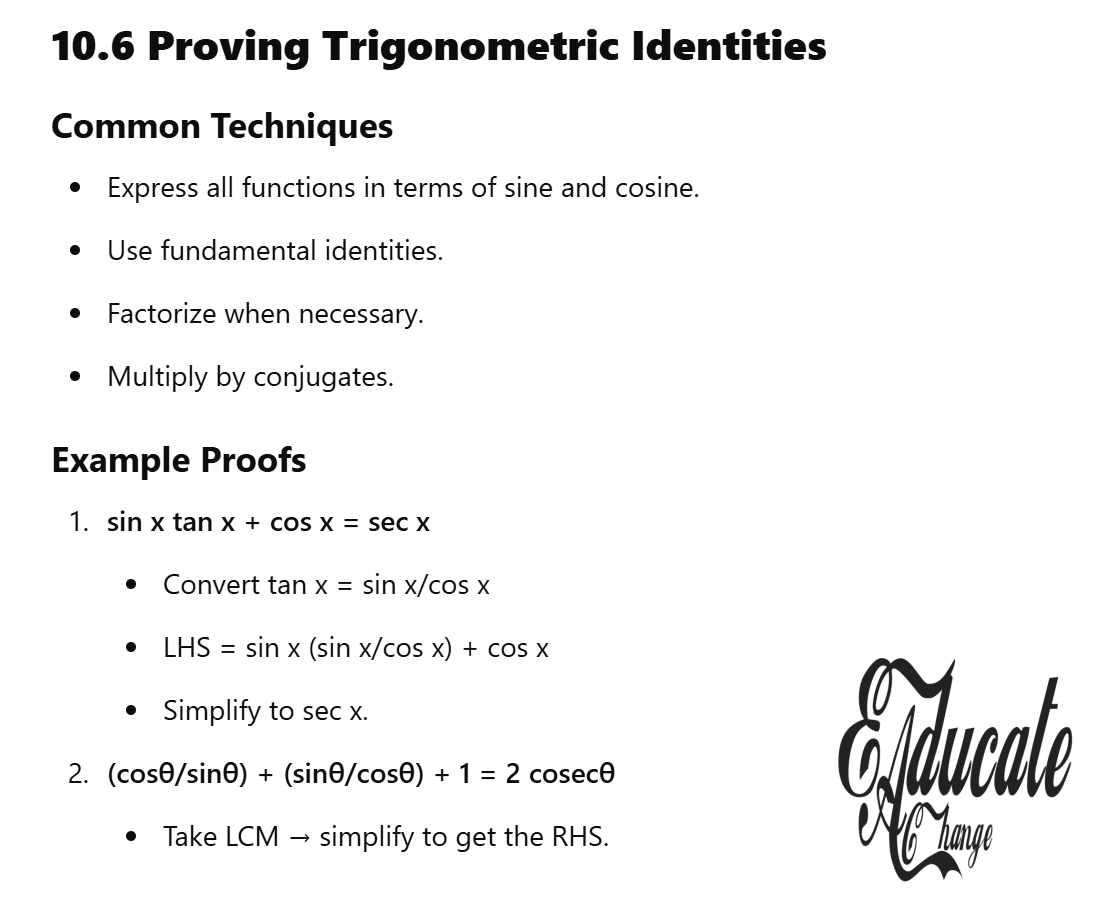
Proving Trigonometric Identities
- Begin with the more complex side (LHS or RHS) of the identity.
- Simplify using fundamental identities and algebraic techniques.
- Aim to transform it into the simpler side.
Worked Example 1
Prove:
1+tan2x=sec2×1 + tan^2x = sec^2x
- Solution:
- From the Pythagorean identity: sin2x+cos2x=1sin^2x + cos^2x = 1
- Dividing by cos2xcos^2x: sin2xcos2x+1=1cos2xfrac{sin^2x}{cos^2x} + 1 = frac{1}{cos^2x}
- Recognizing the definitions: tan2x+1=sec2xtan^2x + 1 = sec^2x
Worked Example 2
Prove:
sin2x=2sinxcosxsin 2x = 2 sin x cos x
- Solution:
- Start with the double angle formula: sin(2x)=sin(x+x)sin(2x) = sin(x + x)
- Use the sum formula: sin(x+x)=sinxcosx+cosxsinxsin(x + x) = sin x cos x + cos x sin x
- Simplify: sin2x=2sinxcosxsin 2x = 2 sin x cos x
Application of Identities
- Simplification:
- Transform complicated trigonometric expressions into simpler forms using identities.
- Example: Simplify sinx1+cosx+sinx1−cosxfrac{sin x}{1 + cos x} + frac{sin x}{1 – cos x}:
- Common denominator: sinx(1−cosx)+sinx(1+cosx)(1+cosx)(1−cosx)frac{sin x(1 – cos x) + sin x(1 + cos x)}{(1 + cos x)(1 – cos x)}
- Simplify numerator and use (1−cos2x=sin2x)(1 – cos^2x = sin^2x): 2sinxsin2x=2cscxfrac{2sin x}{sin^2x} = 2 csc x
- Solving Equations:
- Identities are critical for solving trigonometric equations by reducing complexity.
Advanced Identities
- Double Angle Formulas:
- Sine: sin2x=2sinxcosxsin 2x = 2 sin x cos x
- Cosine: cos2x=cos2x−sin2xcos 2x = cos^2x – sin^2x
- Alternate forms: cos2x=2cos2x−1=1−2sin2xcos 2x = 2 cos^2x – 1 = 1 – 2 sin^2x
- Tangent: tan2x=2tanx1−tan2xtan 2x = frac{2 tan x}{1 – tan^2x}
- Sum and Difference Formulas:
- Sine: sin(a±b)=sinacosb±cosasinbsin(a pm b) = sin a cos b pm cos a sin b
- Cosine: cos(a±b)=cosacosb∓sinasinbcos(a pm b) = cos a cos b mp sin a sin b
- Tangent: tan(a±b)=tana±tanb1∓tanatanbtan(a pm b) = frac{tan a pm tan b}{1 mp tan a tan b}
Practice Problems
- Prove:tan2x=sec2x−1tan^2x = sec^2x – 1
- Simplify:sinxcosx+cosxsinxfrac{sin x}{cos x} + frac{cos x}{sin x}
- Prove:cos2x−sin2x=cos2xcos^2x – sin^2x = cos 2x
- Solve for xx:sin2x=3cos2xfor 0∘≤x<360∘sin 2x = sqrt{3} cos 2x quad text{for } 0^circ leq x < 360^circ
Conclusion
- Mastery of trigonometric identities simplifies complex expressions and aids in solving equations.
- These tools are essential for applications in advanced mathematics, physics, and engineering.
Introduction
- This chapter focuses on solving advanced trigonometric equations involving the additional trigonometric ratios: cosecant (csccsc), secant (secsec), and cotangent (cotcot).
- Trigonometric identities and algebraic manipulation are crucial for these solutions.
- The general method involves:
- Transforming complex equations into simpler forms.
- Using standard trigonometric properties and identities.
Extended Trigonometric Ratios
- Cosecant (cscθcsc theta):cscθ=1sinθcsc theta = frac{1}{sin theta}
- Secant (secθsec theta):secθ=1cosθsec theta = frac{1}{cos theta}
- Cotangent (cotθcot theta):cotθ=1tanθ=cosθsinθcot theta = frac{1}{tan theta} = frac{cos theta}{sin theta}
Key Trigonometric Identities Used
- Reciprocal Identities:
- csc2θ=1+cot2θcsc^2 theta = 1 + cot^2 theta,
- sec2θ=1+tan2θsec^2 theta = 1 + tan^2 theta.
- Pythagorean Identity:
- sin2θ+cos2θ=1sin^2 theta + cos^2 theta = 1.
- Transformation of Products:
- Expressions such as sinxcosxsin x cos x are often converted using double-angle formulas.
Solving Advanced Equations
- Equation Involving csccsc and cotcot:
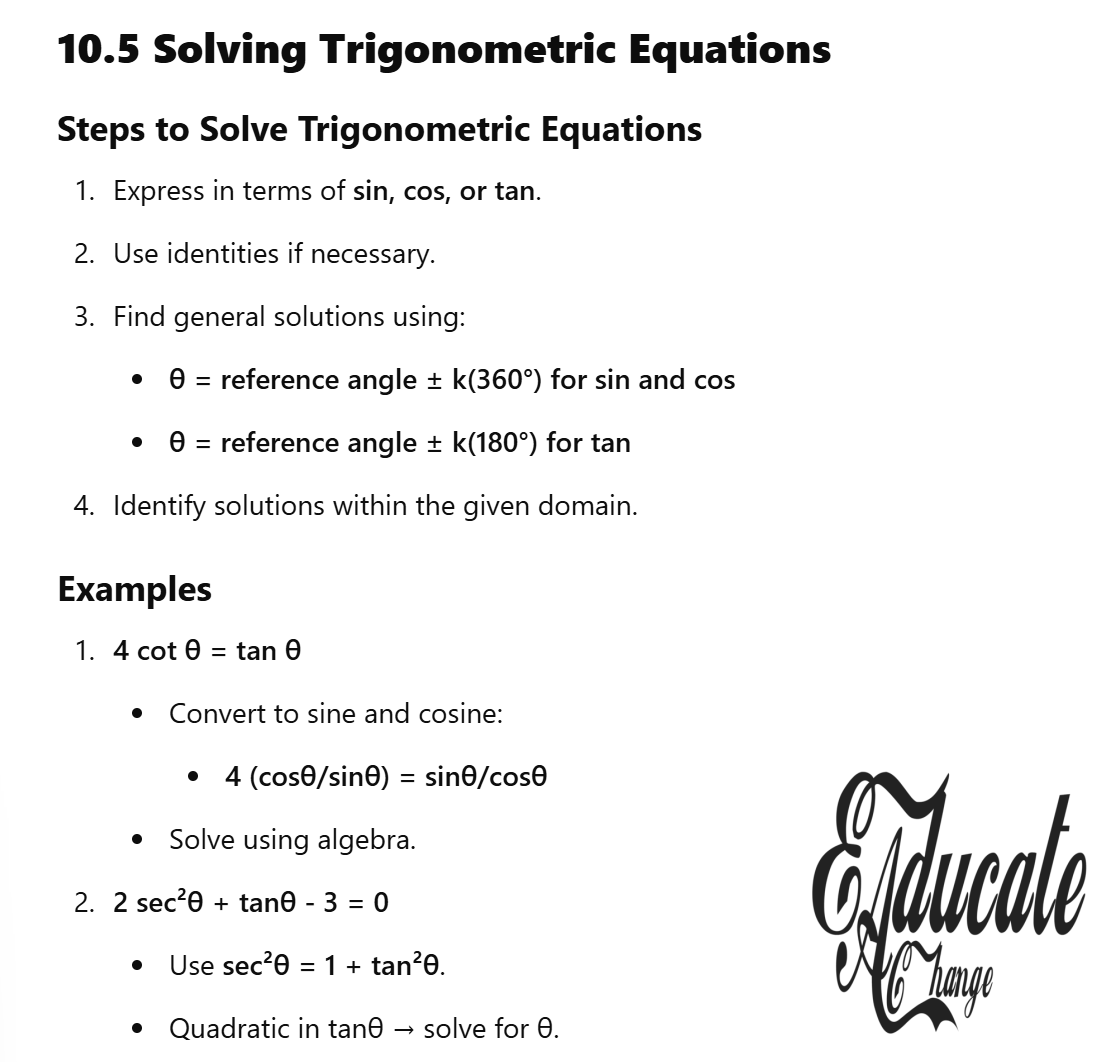
- Example: Solve 2csc2x+cotx−8=02csc^2 x + cot x – 8 = 0 for 0∘<x<360∘0^circ < x < 360^circ.
Steps:
- Use the identity: csc2x=1+cot2x.csc^2 x = 1 + cot^2 x.
- Substitute: 2(1+cot2x)+cotx−8=0.2(1 + cot^2 x) + cot x – 8 = 0.
- Expand and simplify: 2cot2x+cotx−6=0.2cot^2 x + cot x – 6 = 0.
- Factorize: (2cotx−3)(cotx+2)=0.(2cot x – 3)(cot x + 2) = 0.
- Solve for cotxcot x: cotx=32orcotx=−2.cot x = frac{3}{2} quad text{or} quad cot x = -2.
- Convert to tanxtan x: tanx=23ortanx=−12.tan x = frac{2}{3} quad text{or} quad tan x = -frac{1}{2}.
- Find angles using the calculator and quadrant properties: x=33.7∘,213.7∘,153.4∘,333.4∘.x = 33.7^circ, 213.7^circ, 153.4^circ, 333.4^circ.
- Equation Involving secsec:
- Example: Solve 3secx−5=03sec x – 5 = 0 for 0∘≤x<360∘0^circ leq x < 360^circ.
Steps:
- Isolate secxsec x: secx=53.sec x = frac{5}{3}.
- Convert to cosxcos x: cosx=35.cos x = frac{3}{5}.
- Find angles: x=cos−1(35)=53.1∘.x = cos^{-1}left(frac{3}{5}right) = 53.1^circ.
- Consider the cosine symmetry: x=53.1∘,306.9∘.x = 53.1^circ, 306.9^circ.
Graphical Approach
- Use trigonometric graphs to confirm solutions.
- Key graph properties:
- csccsc, secsec, and cotcot are undefined where sinsin, coscos, and tantan equal zero, respectively.
- Graphs show periodicity, aiding in finding multiple solutions within a range.
Worked Examples
Example 1: Solving cscx=2csc x = 2
- Given: cscx=2.csc x = 2.
- Transform to sinxsin x: sinx=12.sin x = frac{1}{2}.
- Solve: x=sin−1(12)=30∘.x = sin^{-1}left(frac{1}{2}right) = 30^circ.
- Consider all possible solutions: x=30∘,150∘.x = 30^circ, 150^circ.
Example 2: Equation With Multiple Terms
- Solve 4cot2x−3=04cot^2 x – 3 = 0 for 0∘<x<360∘0^circ < x < 360^circ.
Steps:
- Isolate cot2xcot^2 x: cot2x=34.cot^2 x = frac{3}{4}.
- Take the square root: cotx=±34=±32.cot x = pmsqrt{frac{3}{4}} = pmfrac{sqrt{3}}{2}.
- Convert to tanxtan x: tanx=±23.tan x = pmfrac{2}{sqrt{3}}.
- Find angles: x=60∘,120∘,240∘,300∘.x = 60^circ, 120^circ, 240^circ, 300^circ.
Practice Problems
- Solve the following equations for 0∘≤x<360∘0^circ leq x < 360^circ:
- 2sec2x−3=02sec^2 x – 3 = 0,
- cscx−3=0csc x – 3 = 0,
- 3cot2x−4=03cot^2 x – 4 = 0.
- Prove:1+tan2x=sec2x.1 + tan^2 x = sec^2 x.
- Use trigonometric graphs to verify solutions for:tan2x−3tanx+2=0.tan^2 x – 3tan x + 2 = 0.
Summary
- Advanced trigonometric equations often involve csccsc, secsec, and cotcot, requiring algebraic manipulation and trigonometric identities.
- Understanding the periodicity and symmetry of trigonometric functions helps identify all solutions within a specified range.
- Graphical representations complement algebraic methods to verify solutions.
Introduction to Advanced Trigonometric Identities
- Trigonometric identities are equations involving trigonometric functions that hold true for all values within their domain.
- This chapter expands on basic identities to include more complex expressions and their applications in proving equations.
Recap of Fundamental Trigonometric Identities
- Pythagorean Identity:sin2x+cos2x=1sin^2 x + cos^2 x = 1Derived from the unit circle.
- Secondary Identities:
- 1+tan2x=sec2×1 + tan^2 x = sec^2 x
- 1+cot2x=csc2×1 + cot^2 x = csc^2 x
- Basic Reciprocal Identities:
- cscx=1sinxcsc x = frac{1}{sin x}
- secx=1cosxsec x = frac{1}{cos x}
- cotx=1tanxcot x = frac{1}{tan x}
Techniques for Proving Trigonometric Identities
- Simplify the More Complex Side:
- Begin with the more intricate side of the equation.
- Use algebraic operations, factorizations, or common denominators.
- Substitution Using Identities:
- Replace terms with equivalent expressions based on known identities.
- Example:
- Replace tanxtan x with sinxcosxfrac{sin x}{cos x}.
- Combining Fractions:
- Express trigonometric functions with a common denominator to combine terms.
- Factorization:
- Factor out common terms to simplify.
- Example: sin2x−cos2x=(sinx+cosx)(sinx−cosx)sin^2 x – cos^2 x = (sin x + cos x)(sin x – cos x)
Examples of Complex Identities
Example 1: Prove sec2x−tan2x=1sec^2 x – tan^2 x = 1
- Start with the LHS: sec2x−tan2xsec^2 x – tan^2 x
- Use the identity sec2x=1+tan2xsec^2 x = 1 + tan^2 x: (1+tan2x)−tan2x=1(1 + tan^2 x) – tan^2 x = 1
- Result: LHS=RHS.text{LHS} = text{RHS}.
Example 2: Prove csc2x−cot2x=1csc^2 x – cot^2 x = 1
- Start with: csc2x=1+cot2xcsc^2 x = 1 + cot^2 x
- Rearrange: csc2x−cot2x=1csc^2 x – cot^2 x = 1
Example 3: Prove sin2×1−cosx=1+cosxfrac{sin^2 x}{1 – cos x} = 1 + cos x
- Start with LHS: sin2×1−cosxfrac{sin^2 x}{1 – cos x}
- Substitute sin2x=1−cos2xsin^2 x = 1 – cos^2 x: 1−cos2×1−cosxfrac{1 – cos^2 x}{1 – cos x}
- Factorize numerator: (1−cosx)(1+cosx)1−cosxfrac{(1 – cos x)(1 + cos x)}{1 – cos x}
- Cancel terms: 1+cosx1 + cos x
Advanced Applications of Identities
- Combining Multiple Ratios:
- Example: tanx+cotx=secxcscxtan x + cot x = sec x csc x
- Convert tanxtan x and cotxcot x into sine and cosine terms.
- Double-Angle Identities:
- sin(2x)=2sinxcosxsin(2x) = 2sin x cos x
- cos(2x)=cos2x−sin2xcos(2x) = cos^2 x – sin^2 x
- tan(2x)=2tanx1−tan2xtan(2x) = frac{2tan x}{1 – tan^2 x}
- Half-Angle Identities:
- sin2x=1−cos(2x)2sin^2 x = frac{1 – cos(2x)}{2}
- cos2x=1+cos(2x)2cos^2 x = frac{1 + cos(2x)}{2}
Worked Problems
Problem 1: Prove tan2x+1=sec2xtan^2 x + 1 = sec^2 x
- Begin with tanx=sinxcosxtan x = frac{sin x}{cos x}: tan2x=sin2xcos2xtan^2 x = frac{sin^2 x}{cos^2 x}
- Add 11: sin2xcos2x+1=sin2x+cos2xcos2xfrac{sin^2 x}{cos^2 x} + 1 = frac{sin^2 x + cos^2 x}{cos^2 x}
- Substitute sin2x+cos2x=1sin^2 x + cos^2 x = 1: 1cos2x=sec2xfrac{1}{cos^2 x} = sec^2 x
Problem 2: Prove cos4x−sin4x=cos(2x)cos^4 x – sin^4 x = cos(2x)
- Recognize difference of squares: cos4x−sin4x=(cos2x+sin2x)(cos2x−sin2x)cos^4 x – sin^4 x = (cos^2 x + sin^2 x)(cos^2 x – sin^2 x)
- Substitute cos2x+sin2x=1cos^2 x + sin^2 x = 1: 1(cos2x−sin2x)1(cos^2 x – sin^2 x)
- Substitute cos2x−sin2x=cos(2x)cos^2 x – sin^2 x = cos(2x): cos(2x)cos(2x)
Practice Problems
- Prove: tanx+cotx=secxcscxtan x + cot x = sec x csc x
- Simplify: 1−sin2xcosx=cosxfrac{1 – sin^2 x}{cos x} = cos x
- Verify: 1−tan2x=cos2x−sin2xcos2×1 – tan^2 x = frac{cos^2 x – sin^2 x}{cos^2 x}
Summary
- Trigonometric identities provide a foundation for simplifying and solving complex equations.
- Techniques include substitution, combining terms, and factorization.
- Applications extend to calculus, geometry, and physics.